
Key Takeaways
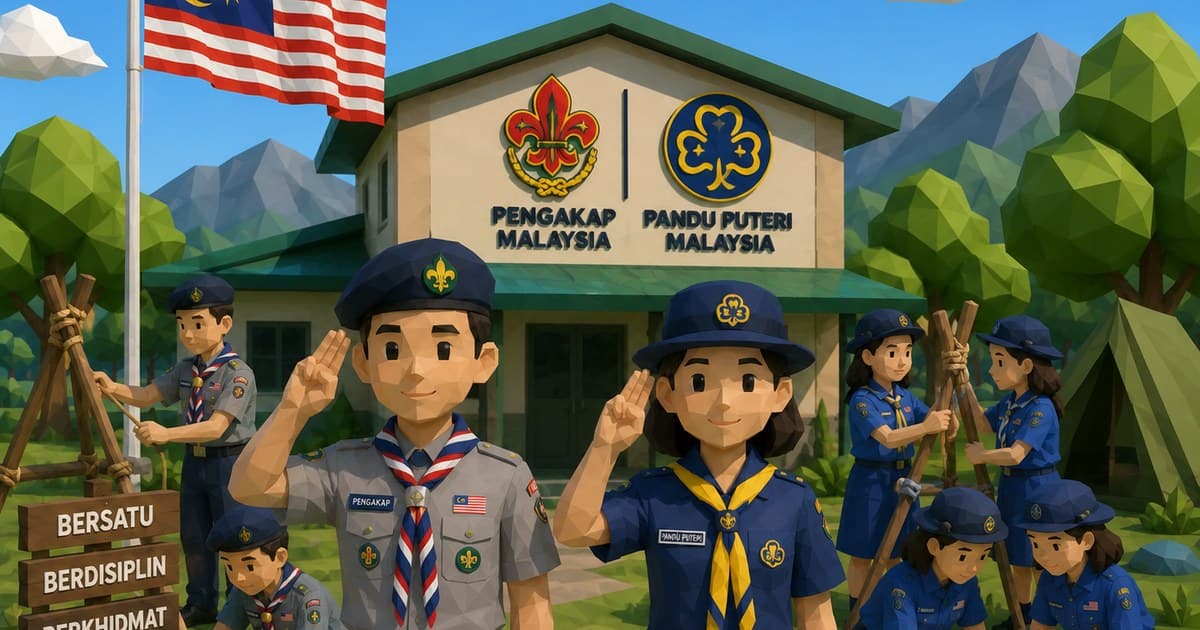
- →Malaysia runs two large uniformed youth movements side by side: the Scouts (Persekutuan Pengakap Malaysia), a WOSM member since 1957, and the Girl Guides (Persatuan Pandu Puteri Malaysia), a full WAGGGS member since 1960.
- →The Scouts reported more than 300,000 members in 2023 and enrol both boys and girls. The Girl Guides are girls-only, with about 133,367 members recorded by WAGGGS in 2018.
- →Both are secular, multi-faith movements open to every race and religion, distinct from the Christian Boys' Brigade and Girls' Brigade.
- →The top awards carry royal weight: the King's Scout (Pengakap Raja), signed by the King and state Rulers, and the Queen's Guide (Pandu Puteri Raja), presented under the Raja Permaisuri Agong.
Two movements, one guide. The Scouts (Persekutuan Pengakap Malaysia) and Girl Guides (Persatuan Pandu Puteri Malaysia) are separate secular bodies, distinct from the Christian Boys' and Girls' Brigade. Membership figures change, so treat them as indicative; verified July 2026.
In This Guide
Scouts and Girl Guides in Malaysia, at a glance
Malaysia runs two large uniformed youth movements side by side. The Scouts operate under Persekutuan Pengakap Malaysia (Scouts Association of Malaysia), and the Girl Guides operate under Persatuan Pandu Puteri Malaysia (Girl Guides Association Malaysia). Both are secular and open to members of every faith and background, and both reach most of their members through schools, with some units run by universities and community groups.
The two movements share a common origin in the international Scout and Guide programme started by Robert Baden-Powell in the early 1900s, and each belongs to its own world body. The Scouts belong to the World Organization of the Scout Movement (WOSM), and the Girl Guides belong to the World Association of Girl Guides and Girl Scouts (WAGGGS). Keep the two straight: Pengakap is the Scouts, Pandu Puteri is the Girl Guides. Both differ from the Boys' Brigade and Girls' Brigade, which are Christian uniformed groups.
Scouting reached Malaya early. An experimental troop started in Penang in 1908, and the movement spread through the peninsula over the following decades. Baden-Powell and Olave Baden-Powell visited Penang, Kuala Kangsar, Ipoh and Kuala Lumpur in 1934. After independence in 1957, the national Scouting body gained formal WOSM membership on 1 September 1957 and was later regulated by Act of Parliament. It reported more than 300,000 members in 2023.
Guiding arrived a few years later. The first Girl Guide unit in Malaya formed in 1916 at the Methodist Girls' School in Kuala Lumpur. The Malayan association became a full WAGGGS member in 1960, and after the formation of Malaysia in 1963 the Sabah and Sarawak associations joined the national body. The association runs its programme across Peninsular Malaysia, Sabah and Sarawak from its headquarters in Kuala Lumpur.
At a glance
| Scouts (Persekutuan Pengakap Malaysia) | Girl Guides (Persatuan Pandu Puteri Malaysia) | |
|---|---|---|
| Malay name | Persekutuan Pengakap Malaysia | Persatuan Pandu Puteri Malaysia |
| Movement founded globally | 1907 | 1910 |
| Arrived in Malaya | 1908 (Penang) | 1916 (Kuala Lumpur) |
| World body | WOSM | WAGGGS |
| World body membership | 1957 | 1960 |
| Top award | King's Scout (Pengakap Raja) | Queen's Guide (Pandu Puteri Raja) |
The top award in each movement carries royal weight. The King's Scout Award (Pengakap Raja) is the highest achievement in Malaysian Scouting, and its certificate carries the signature of the King and state rulers. The Queen's Guide Award (Pandu Puteri Raja) is the highest award in Guiding, presented under the patronage of the Raja Permaisuri Agong, with a certificate bearing her signature. In both cases the award sits at the end of a progression of tests and requirements completed before a member reaches adulthood.
The Scout movement: from Brownsea 1907 to Pengakap Malaysia
Scouting began with a former British Army officer, Robert Baden-Powell. His military manual Aids to Scouting found an unexpected readership among boys who copied its tracking and observation drills. To test whether those ideas worked as a youth programme, Baden-Powell ran an experimental camp on Brownsea Island in Poole Harbour from 1 to 8 August 1907. Twenty boys took part, drawn from public schools and local Boys' Brigade companies, split into four patrols named Wolves, Bulls, Curlews and Ravens. They spent the week on camping, woodcraft, observation, chivalry and lifesaving.
The camp went well enough to finish the book. Scouting for Boys appeared in January 1908 as a series of six fortnightly parts, backed by a lecture tour. The response was large enough that a separate organisation formed to run the programme, and Scouting spread quickly across the British Empire and beyond.
Arrival in Malaya
Scouting reached Malaya early. An experimental troop ran at the YMCA in Penang in 1908, making George Town one of the first places in the region to try the programme. In 1910 the Nottingham schoolmaster Frank Cooper Sands arrived in Singapore and set up Scouting there; he went on to serve as the first Chief Commissioner of Scouting in Singapore for 38 years, from 1910 to 1948.
The first formal Scout troop in Malaya was registered on 27 March 1915 at Penang Free School, started by the educator Harold Ambrose Robinson Cheeseman. Scouting grew through the Straits Settlements and the Malay States as a school-based activity. In 1934 Lord Baden-Powell and Lady Olave Baden-Powell visited Malaya, touring Penang, Kuala Kangsar, Ipoh and Kuala Lumpur.
Persekutuan Pengakap Malaysia
After independence in 1957, the Boy Scouts International Bureau granted membership on 1 September 1957, and the national body took shape as the Federation of Malaya Boy Scouts Association. Parliament incorporated it through the Boy Scouts Association of Malaysia (Incorporation) Act 1968, and a further Act in 1974 gave it the name it carries today: Persekutuan Pengakap Malaysia (PPM), the Scouts Association of Malaysia. Its headquarters is B-P House in Kuala Lumpur.
PPM is a secular, multi-faith movement open to boys and girls of every race and religion, and it is a member of the World Organization of the Scout Movement. It works as a federation of state branches covering all the states and federal territories. Membership was reported at more than 300,000 in 2023, which places it among Malaysia's largest uniformed youth movements. The Yang di-Pertuan Agong serves as its royal patron, and the movement is led by a National Chief Scout (Ketua Pengakap Negara).
Key milestones:
| Year | Event |
|---|---|
| 1907 | Brownsea Island experimental camp |
| 1908 | Scouting for Boys published; experimental troop at YMCA Penang |
| 1910 | Frank Cooper Sands establishes Scouting in Singapore |
| 1915 | First formal troop, Penang Free School |
| 1934 | Baden-Powell visits Malaya |
| 1957 | International recognition after independence |
| 1974 | Renamed Persekutuan Pengakap Malaysia by Act of Parliament |
PPM sits alongside the Girl Guides (Persatuan Pandu Puteri Malaysia) as one of the country's two largest uniformed youth movements, and both trace their roots to Baden-Powell's work.
The Girl Guides: from 1910 to Pandu Puteri Malaysia
Guiding began in England in 1910. Robert Baden-Powell had launched Scouting for boys in 1907, and girls quickly wanted in. When groups of girls turned up at the 1909 Crystal Palace Scout rally calling themselves Girl Scouts, Baden-Powell set up a separate movement for them and asked his sister, Agnes Baden-Powell, to run it. The Girl Guides were formally organised in 1910 with Agnes at the head, and she wrote the movement's first handbook, How Girls Can Help to Build Up the Empire, in 1912. From that start, Guiding spread across the British world and grew into the global movement now coordinated by the World Association of Girl Guides and Girl Scouts (WAGGGS).
Guiding arrives in Malaya
The movement reached Malaya during the same colonial period that carried Scouting here. The earliest recorded Girl Guide unit in Malaya was formed in 1916 at the Methodist Girls' School in Kuala Lumpur, and the unit was registered with the Girl Guides headquarters in Calcutta in 1917. Guiding then took root through schools across the Federated Malay States and the Straits Settlements, run for many years under British Guiding structures and local commissioners.
The Guides built a permanent home after the war. A national headquarters, the Agnes Pinnick Hut at Brickfields in Kuala Lumpur, was opened in 1955, named after former Chief Commissioner Mrs Agnes Pinnick. A larger headquarters at Pantai Baharu replaced it on 25 October 1969.
Persatuan Pandu Puteri Malaysia
The national body is Persatuan Pandu Puteri Malaysia (PPPM), the Girl Guides Association of Malaysia. It is the sole national Guiding organisation for the country and holds the WAGGGS membership on Malaysia's behalf. PPPM was given a statutory footing through an Act of Parliament, and it joined WAGGGS in 1960, first as an associate member, with full membership confirmed later in the decade.
When Malaysia was formed in 1963, the Guiding associations of Sabah and Sarawak were brought into the national body, so PPPM now covers Peninsular Malaysia, Sabah and Sarawak under one association. It runs age-based sections that carry girls from early childhood through to adult Leaders, organised down to district and school-unit level.
Like the Scouts, PPPM is a secular, multi-faith movement open to girls of every race and religion. It is a separate organisation from the Christian Girls' Brigade, and it works alongside Persekutuan Pengakap Malaysia as one of the country's two largest uniformed youth bodies.
Milestones and scale
| Year | Milestone |
|---|---|
| 1910 | Girl Guides organised in England, Agnes Baden-Powell as head |
| 1916 | First recorded unit in Malaya, Methodist Girls' School, Kuala Lumpur |
| 1955 | Agnes Pinnick Hut headquarters opened, Brickfields |
| 1960 | Joins WAGGGS (associate member first) |
| 1963 | Sabah and Sarawak associations brought into the national body |
| 1969 | New national headquarters at Pantai Baharu |
| 2016 | Centenary of Guiding in Malaysia |
Membership has run into six figures. PPPM recorded about 73,915 members in 2008 and WAGGGS reported roughly 133,367 Girl Guides in Malaysia in 2018, which makes it one of the largest girls' organisations in the country. Guiding in Malaysia marked its centenary in 2016, a hundred years after that first Kuala Lumpur unit.
How Scouts and Guides are organised in Malaysia
Both movements run on the same tiered model: a national governing body, state councils, district or division councils, and local units in schools and communities. Each is a separate legal body with its own headquarters in Kuala Lumpur.
Persekutuan Pengakap Malaysia (Scouts)
PPM is incorporated under the Scouts Association of Malaysia (Incorporation) Act 1968. Its headquarters, BP House, sits on Jalan Hang Jebat, Kuala Lumpur.
- National level. The Majlis Pengakap Negara (National Scout Council) is the policy-making body. The Ketua Pengakap Negara (National Chief Scout) is the senior office holder, and the Ketua Pesuruhjaya Pengakap Negara (National Chief Commissioner) runs day-to-day operations. The Yang di-Pertuan Agong serves as Royal Patron and the Prime Minister as National President.
- State level. Each state and federal territory has a Majlis Pengakap Negeri (State Scout Council) led by a Pesuruhjaya Pengakap Negeri (State Commissioner).
- District level. Below each state are Majlis Pengakap Daerah (District Scout Councils), each led by a Pesuruhjaya Pengakap Daerah (District Commissioner).
- Local unit. The basic unit is the Kumpulan Pengakap (Scout Group), based in a school or a community. A group runs troops by age section, and each troop divides into small patrols led by a patrol leader. The Patrol Leaders' Council and the Court of Honour handle troop planning.
Persatuan Pandu Puteri Malaysia (Girl Guides)
PPPM was founded in 1916 and is governed under the Girl Guides Act 1953 (revised 1991). Its headquarters is Wisma Pandu Puteri, Kuala Lumpur. The Raja Permaisuri Agong is Patron, and the association is led by a Yang Dipertua (President).
- National level. A national council sets policy, and the Ketua Pesuruhjaya (Chief Commissioner) leads the uniformed side.
- State level. Each state has a Pesuruhjaya Negeri (State Commissioner). Branch commissioners and divisional commissioners handle planning between the state and the units.
- Local unit. Girls meet in companies (with packs for the younger sections), each run by a Guider. Guiding operates across Peninsular Malaysia, Sabah, and Sarawak.
| Level | Scouts (PPM) | Girl Guides (PPPM) |
|---|---|---|
| National | Majlis Pengakap Negara; Ketua Pengakap Negara; Ketua Pesuruhjaya Pengakap Negara | National council; Yang Dipertua (President); Ketua Pesuruhjaya |
| State | Majlis Pengakap Negeri; Pesuruhjaya Pengakap Negeri | Pesuruhjaya Negeri (State Commissioner) |
| District / division | Majlis Pengakap Daerah; Pesuruhjaya Pengakap Daerah | Divisional and branch commissioners |
| Local unit | Kumpulan Pengakap (group), troop, patrol | Company or unit, with packs, run by a Guider |
Leaders, warrants, and volunteers
Adult leaders in both movements are volunteers, and many are serving teachers who run the unit inside their own school. A leader is appointed by warrant once the required training is completed, and commissioners at district, state, and national level hold warrants for their roles. Older youth members carry real responsibility as well, through patrol leaders and the Court of Honour on the Scout side and through the senior sections on the Guide side.
School-based and open groups
Most units in both movements are attached to schools, where Scouting and Guiding are recognised uniformed bodies (badan beruniform) in the co-curriculum. Open groups, based in a community rather than a single school, also operate nationwide and draw members from the wider public. Membership in both movements is open to all races and faiths on acceptance of the Promise and Law.
Scout age sections and the badge system
These age bands belong to the Scouts body, Persekutuan Pengakap Malaysia. A young person moves up through the sections as they progress through school, and each section carries its own motto, section colour, and set of progressive awards.
Age sections
| Section (Malay) | English | Age band | School stage | Motto | Section colour |
|---|---|---|---|---|---|
| Pengakap Kanak-Kanak | Cub Scouts | 9 to 12 | Standard 3 to 6 | Buat Habis Baik (Do Your Best) | Blue |
| Pengakap Muda | Junior Scouts | 13 to 15 | Form 1 to 3 | Sedia Selalu (Be Prepared) | Green |
| Pengakap Remaja | Senior Scouts | 15 to 17½ | Form 4 to 5 | Pandang Luas (Look Wide) | Yellow |
| Pengakap Kelana | Rovers | 17½ to 26 | Form 6 and above | Berkhidmat (Service) | Red |
University-level members belong to Kelana Universiti / Kolej (KLKM), also within the 17½ to 26 range. The stated ages are guides that follow the Malaysian school year, so a member's exact age can vary a little around the band.
Proficiency badges and progressive awards
Each section has its own ladder of progressive badges that a member climbs by completing a training scheme, plus separate proficiency (merit) badges earned for specific skills.
- Pengakap Kanak-Kanak (Cub Scouts): three progressive dagger badges, Keris Gangsa (Bronze), Keris Perak (Silver), and Keris Emas (Gold), together with merit badges.
- Pengakap Muda (Junior Scouts): three progressive rank badges, Usaha (Third Class), Maju (Second Class), and Jaya (First Class). A Junior Scout can also earn up to eight merit badges across hobbies, knowledge, and service.
- Pengakap Remaja (Senior Scouts): five progressive badges known as the Lima Lencana Tertinggi (Five Highest Badges): Jaya Diri (Independence / Self-Reliance), Kemahiran (Skills), Kegiatan (Activities), Ekspedisi (Expedition), and Perkhidmatan (Service). Completing all five is the prerequisite for assessment as a King's Scout.
Proficiency badges (Lencana Kecekapan) sit alongside the progressive ladder. They reward specific competencies such as first aid, and many require supervised practice or an external certification to earn.
King's Scout (Pengakap Raja)
The King's Scout Award is the highest award of Persekutuan Pengakap Malaysia. A Senior Scout qualifies after earning the Five Highest Badges and passing an assessment camp. The certificate is signed by the Yang di-Pertuan Agong together with the Malay Rulers, which makes it a nationally distinctive award.
Girl Guide age sections and the badge system
The Girl Guides in Malaysia, run by Persatuan Pandu Puteri Malaysia (PPPM), group members into age sections. Each section has its own uniform, programme, and set of tests that a member works through to earn badges and move up.
Age sections
| Section (Malay / English) | Age band | Notes |
|---|---|---|
| Pandu Puteri Kelip-Kelip (Firefly Guides) | 4 to 8 | Youngest section, an introduction to Guiding before the Brownie years. |
| Pandu Puteri Tunas (Brownie Guides) | 9 to 12 | Often called Tunas Puteri. Primary-school age. Members work through junior tests and interest badges. |
| Pandu Puteri Remaja (Junior Guides) | 13 to 15 | Lower-secondary age. The main Guide programme, with progressive class tests and proficiency badges. |
| Pandu Puteri Renjer (Ranger Guides) | 16 to 18 | Older secondary members, roughly Form 4 to Form 6. Lady Baden-Powell suggested the name "Renjer" (Ranger) in 1920. This is the level at which the top award is earned. |
| Pandu Puteri Klover (Clover Guides) | 18 to 30 | Young-adult section, largely college and university members. |
| Pemimpin (Leaders) | Adults | Adult volunteers who run units and train members. |
Age bands vary a little between sources. Some older references give narrower ranges (for example Renjer as 16 to 17, covering Form 4 and Form 5). The bands above follow the association's current section listing.
Badges and awards
The movement's motto is Selalu Sedia ("Always Ready"). Every member makes the Janji Pandu Puteri (Guide Promise) and follows the Undang-undang Pandu Puteri (Guide Law), a set of ten points covering trustworthiness, loyalty, usefulness, courtesy, care for living things, obedience, thrift, and self-discipline.
Badges fall into two broad kinds:
- Class tests (kelas): A member advances through set stages such as pre-promise (prapersetiaan), Second Class (Kelas Dua), and higher tests. Named tests along the way include Bintang Puteri (Star Puteri) and Tali Pekeliling. Passing each stage earns the matching badge.
- Proficiency badges: Awarded for skills and interests such as cooking, first aid, crafts, and community service, worn on the uniform.
The highest honour is the Pandu Puteri Raja (Queen's Guide) award, earned at Renjer level. A candidate must be an active Renjer, complete the required class tests, pass the Selalu Sedia workshop before turning 18, and finish challenge components such as community service, an international element, health education, and civic knowledge. Those who qualify receive a Pandu Puteri Raja badge and sash, presented on behalf of the association's royal patron.
Camps, jamborees and community service
Most of the movement happens on ordinary afternoons, in a school hall or on a field, long before any big gathering. This is where members pick up the practical skills the two bodies are built on.
For the Scouts (Persekutuan Pengakap Malaysia), a typical programme covers camping and campcraft, pioneering (lashing poles into towers, bridges and gateways), knots and lashing, first aid, map reading, estimation, foot and stave drills, and backwoodsman cooking over an open fire. Younger members work through a progressive badge ladder. Junior Scouts (Pengakap Muda, ages 13 to 15) earn Third Class, Second Class and First Class badges, then add merit badges in hobbies, knowledge and service. The sections run from Cub Scouts (9 to 12) up through Junior Scouts, Senior Scouts (15 to 17.5) and Rovers (17.5 to 26).
The top award, the King's Scout, shows how demanding this can get. Candidates sit a Pre-Rating Test Camp of three days and two nights covering responsibility, expedition, community service and independence, followed by a Rating Test Camp of four days and three nights that tests camping, pioneering models, first aid, estimation, knots and ties, map work, jungle cooking, drill and handicraft.
What the Girl Guides do
The Girl Guides (Persatuan Pandu Puteri Malaysia) follow a parallel pattern across six sections: Kelip-Kelip (Firefly Guides, 4 to 8), Tunas (Brownie Guides, 9 to 12), Remaja (Junior Guides, 13 to 15), Renjer (Ranger Guides, 16 to 18), Klover (Clovers, 18 to 30) and adult Pemimpin (leaders). Guides camp, cook, tie knots and earn proficiency badges, and the programme leans heavily on community service and personal development, the same habit of giving back that runs through Malaysia's charities and volunteering scene. Through WAGGGS they run structured campaigns: Free Being Me and Action on Body Confidence, Surf Smart on online safety, Stop the Violence, STEM sessions, and Plastic Busters clean-ups of a beach, river or park. World Thinking Day on 22 February links members to Guides and Scouts in other countries. WAGGGS credits the Malaysian association with bringing girls from different communities together.
The big gatherings
Camps scale up into jamborees, the large tented gatherings that most members remember longest.
| Event | Body | What it is |
|---|---|---|
| Jambori Pengakap Malaysia | Scouts | National jamboree, held roughly every four to five years, hosted by a different state; the 13th was in Kuala Lumpur in 2016 and the 14th Malaysian Scouts Jamboree ran in December 2024 in Selangor |
| World Scout Jamboree | Scouts | WOSM's global gathering of tens of thousands of Scouts; Malaysia sent contingents to the 24th (2019, United States) and 25th (2023, South Korea) |
| WAGGGS events | Girl Guides | International camps, webinars and campaigns run through the World Association of Girl Guides and Girl Scouts, which the Malaysian association joined as a full member in 1960 |
A jamboree brings thousands of members onto one site for about a week. They pitch their own tents, cook their own meals, build pioneering structures, run activity bases, trade badges and meet units from across the country and abroad. State-level Jambori Pengakap Antarabangsa events, such as those held in Kedah and Kuala Lumpur, add an international flavour by inviting overseas contingents. For most members, a national or world jamboree is the clearest picture of what the movement is: a large, self-run camp built on the same knots, cooking and teamwork learned on those ordinary afternoons.
Top awards: Pengakap Raja and the Guides' highest honour
Both movements have a single peak award named for the Crown, and reaching either takes years of graded work capped by an assessment camp.
Scouts: the Pengakap Raja (King's Scout)
The Pengakap Raja, in English the King's Scout Award, is the highest award of Persekutuan Pengakap Malaysia. Its certificate carries the signature of the Yang di-Pertuan Agong together with the Rulers of the states, which sets it apart from every other Scout award in the country. State Sultans or Governors present the award in the King's name.
Getting there is a long climb. A candidate must:
- Have been a registered Scout for at least three consecutive years, including the year of assessment, with a valid membership card.
- Be at least 17 years old when applying for the assessment camp.
- Clear the full ladder of proficiency badges, from the Membership Badge and the Pengakap Muda development badges (Usaha, Maju, Jaya) up to the senior badges (Jayadiri, Kemahiran, Kegiatan, Ekspedisi, Perkhidmatan).
- Hold the Senior Cord, the national Scout leadership award, before entering the assessment.
The final test is the King's Scout Rating Test Camp, a four-day, three-night camp run by the state King's Scout evaluation council. It is built around five components: Tanggungjawab (responsibility), Pengembaraan (expedition), Perkhidmatan Masyarakat (community service), Kegiatan (activity) and Berdikari (independence), tested through camping, first aid, map work, knots, jungle cooking, handicraft and interviews. The award is rare. By 2020 fewer than 0.3% of Malaysian Scout members had earned it.
The Pengakap Raja sits at the same tier as its counterparts abroad: Eagle Scout in the United States, President's Scout in Singapore and Pramuka Garuda in Indonesia.
Girl Guides: the Pandu Puteri Raja (Queen's Guide)
The highest award of Persatuan Pandu Puteri Malaysia is the Pandu Puteri Raja, the Queen's Guide Award. It is conferred under the patronage of the Raja Permaisuri Agong, the Queen of Malaysia, and its royal certificate bears the Queen's signature. A recipient receives a badge and a special sash.
The award is earned in the Ranger section, the senior branch of guiding. A candidate works through the progression tests, including the Friendship Cord and Girl Star, and the branch examinations, then completes a readiness workshop. The programme must be finished before the member turns 18. Candidates demonstrate achievement across a set of components covering community service, an international dimension, health education and civic knowledge.
Comparison at a glance
| Scouts | Girl Guides | |
|---|---|---|
| Body | Persekutuan Pengakap Malaysia | Persatuan Pandu Puteri Malaysia |
| Top award | Pengakap Raja (King's Scout) | Pandu Puteri Raja (Queen's Guide) |
| Royal link | Certificate signed by the Yang di-Pertuan Agong and the Rulers | Certificate signed by the Raja Permaisuri Agong |
| Section | Senior Scout / Rover work | Ranger Guides |
| Age gate | From age 17 for the assessment camp | Complete before turning 18 |
Both awards are recognised as marks of sustained service and leadership, and schools often cite them alongside other student honours. Names of these two peak awards are fixed in law of the movements, so use them precisely: Pengakap Raja for Scouts, Pandu Puteri Raja for Guides.
How to join a Scout or Guide unit
Both movements take children through school-based units and through open groups run outside schools. Persekutuan Pengakap Malaysia (the Scouts) is coeducational and enrols boys and girls. Persatuan Pandu Puteri Malaysia (the Girl Guides) is for girls only. Both are secular and multi-faith, and both organise members into age sections.
Who can join, and at what age
Persekutuan Pengakap Malaysia (Scouts)
| Section | Malay name | Ages |
|---|---|---|
| Cub Scouts | Pengakap Kanak-Kanak | 9 to 12 |
| Junior Scouts | Pengakap Muda | 13 to 15 |
| Senior Scouts | Pengakap Remaja | 15 to 17½ |
| Rover Scouts | Pengakap Kelana | 17½ to 26 |
Persatuan Pandu Puteri Malaysia (Girl Guides)
| Section | Malay name | Ages |
|---|---|---|
| Firefly Guides | Pandu Puteri Kelip-Kelip | 4 to 8 |
| Brownie Guides | Pandu Puteri Tunas | 9 to 12 |
| Junior Guides | Pandu Puteri Remaja | 13 to 15 |
| Ranger Guides | Pandu Puteri Renjer | 16 to 18 |
| Clover Guides | Pandu Puteri Klover | 18 to 30 |
A child normally enters the section that matches their age and school level, then moves up as they get older.
Joining through school, and co-curricular marks
Most children join through a unit at their own school. At the start of the year the school opens its uniformed bodies (pasukan badan beruniform) for sign-up, and Scouts and Girl Guides are among the choices. The teacher-in-charge registers the pupil with the unit.
Under the Ministry of Education's PAJSK system (Pentaksiran Aktiviti Jasmani, Sukan dan Kokurikulum), every pupil takes part in three co-curricular components: a uniformed body, a club or society, and a sport or game. A Scout or Guide unit satisfies the uniformed-body component.
Marks come from attendance, position held, level of participation, achievement, commitment, and service. Uniformed bodies expect a higher attendance floor than clubs or sports, usually around 18 meetings a year. These co-curricular marks matter beyond school: 10% of the merit score for admission to public universities (IPTA) comes from the co-curricular component.
Fees and uniform
Membership fees are modest and set each year. For Scouts, a recent Penang example lists an annual fee of about RM7 for youth members and RM10 for Rover Scouts, with separate fees for leaders. Figures vary by state and unit, so confirm the current rate with the teacher-in-charge or the local council. The uniform, badges, scarf, and belt are bought separately, and schools often point families to an approved supplier.
If your child's school has no unit
Some schools run neither a Scout nor a Guide unit. In that case a child can join an open group that meets outside school:
- Scouts: contact your state Scout council (Persekutuan Pengakap Malaysia negeri) or district office, which can direct you to an open group or a nearby school unit accepting outside members.
- Girl Guides: contact Persatuan Pandu Puteri Malaysia through its state branch or headquarters at Wisma Pandu Puteri in Kuala Lumpur.
Membership earned in an open group still counts as genuine uniformed-body participation, though how it feeds a pupil's school PAJSK record should be checked with the school.
Scouts and Guides among Malaysia's uniformed bodies
Malaysian schools run several uniformed bodies as co-curricular units, and the Scouts and Girl Guides are the two largest of them. To see where they sit, it helps to line them up against the other familiar names on parade: the Boys' Brigade and Girls' Brigade, St John Ambulance, and the Persatuan Bulan Sabit Merah Malaysia (Red Crescent).
Two movements, two global networks
Persekutuan Pengakap Malaysia (the Scouts) is the country's largest informal youth and educational organisation. It belongs to the World Organization of the Scout Movement (WOSM), which it joined as a full member on 1 September 1957. It is also a statutory body, established under an Act of Parliament (the Boy Scouts Association of Malaysia Act 1974, following an earlier 1968 incorporation Act). Reported membership passed 300,000 by 2023, with the association having stated a target of 500,000.
Persatuan Pandu Puteri Malaysia (the Girl Guides) is the national Guiding organisation for girls and young women. It belongs to the World Association of Girl Guides and Girl Scouts (WAGGGS), which it joined as a full member in 1960. The first Guide unit in Malaya formed in 1916 at the Methodist Girls' School in Kuala Lumpur.
What sets them apart from the Brigade, St John and PBSM
Three things distinguish the Scouts and Guides from the other uniformed bodies.
- Scale. The Scouts are the largest single uniformed youth movement in the country, and the Guides are the largest for girls. The other bodies run smaller memberships.
- Secular and multi-faith. Both movements are open to young people of every religion and background. The Boys' Brigade and Girls' Brigade are Christian organisations, with religious instruction built into their aims and church sponsorship in their history. The Scouts and Guides keep a place for personal faith through the Promise while welcoming members of all faiths on equal terms.
- Global membership. Each belongs to a worldwide network (WOSM for the Scouts, WAGGGS for the Guides) that connects Malaysian members to international programmes and jamborees.
St John Ambulance of Malaysia and the Persatuan Bulan Sabit Merah Malaysia focus on first aid, ambulance work and humanitarian service, and both link to international humanitarian movements (the Order of St John, and the Red Cross and Red Crescent Movement). Their emphasis is service and emergency care, which gives them a narrower remit than the broad youth-development programme the Scouts and Guides run.
Comparison at a glance
| Body | Malay name | Global network | Character | Religious basis |
|---|---|---|---|---|
| Scouts | Persekutuan Pengakap Malaysia | WOSM | Largest youth movement, statutory body | Secular, multi-faith |
| Girl Guides | Persatuan Pandu Puteri Malaysia | WAGGGS | Largest movement for girls | Secular, multi-faith |
| Boys' Brigade | Briged Putera Malaysia | The Boys' Brigade (global) | Christian youth work, church-linked | Christian |
| Girls' Brigade | Briged Puteri | The Girls' Brigade (global) | Christian youth work, church-linked | Christian |
| St John Ambulance | St John Ambulance of Malaysia | Order of St John | First aid, ambulance, humanitarian service | Non-denominational service body |
| PBSM (Red Crescent) | Persatuan Bulan Sabit Merah Malaysia | Red Cross and Red Crescent Movement | First aid, disaster relief, humanitarian service | Non-religious humanitarian body |
For a young person choosing a uniformed unit, the practical read is this. The Scouts and Guides offer the widest programme and the largest membership, they welcome all faiths, and they carry an international badge through WOSM and WAGGGS. The Brigades centre their work on Christian formation. St John and the Red Crescent centre theirs on first aid and humanitarian service.
Scouting and guiding today
Both movements sit among the largest uniformed youth bodies in the country, and both run mainly through schools.
Where they stand
Persekutuan Pengakap Malaysia (the Scouts) reported more than 300,000 members in 2023, against 48,394 in 2010. It is organised into 17 councils (15 territorial councils covering every state and federal territory, plus 2 national at-large councils). As of 2025, the Prime Minister Anwar Ibrahim serves as President and the King Sultan Ibrahim is Royal Patron, and the movement is led by a National Chief Scout. The body has been part of the World Organization of the Scout Movement (WOSM) since 1 September 1957.
Persatuan Pandu Puteri Malaysia (the Girl Guides) is the national Guiding organisation for girls and young women. WAGGGS records 133,367 members as of 2018. The association runs from Wisma Pandu Puteri in Kuala Lumpur and operates across Peninsular Malaysia, Sabah and Sarawak. It became a full member of the World Association of Girl Guides and Girl Scouts (WAGGGS) in 1960.
Both are secular, multi-faith movements open to Malaysians of every background. They are distinct from the Christian Boys' Brigade and Girls' Brigade. WAGGGS credits the Girl Guides with helping unify Malaysia's different communities, and the same civic role holds for the Scouts.
Recent milestones
- Anwar Ibrahim was proclaimed President of the Scouts and given the association's highest award in May 2023.
- The Gilwell Scouts Nature Park in Sandakan was approved in May 2020 as the Asia-Pacific region's third Scout Centre of Excellence for Nature, Environment and Sustainability.
- The 14th Malaysian Scouts Jamboree was held in Selangor in December 2024.
- Guiding in Malaysia marked its centenary in 2016, a hundred years after the first unit formed at the Methodist Girls' School in Kuala Lumpur in 1916.
Challenges
Both movements depend heavily on teachers who volunteer as unit leaders on top of full teaching loads, which makes leader recruitment and retention a constant task. Keeping programmes fresh for a generation with many competing after-school options is the other steady pressure.
Starting or supporting a group
- Schools register a new unit through the movement's district structure. For the Scouts, this runs through the district Scout commissioner and the Sistem Maklumat Bersepadu Pengakap (SMBP) registration system on the official website. Girl Guides units register through the state Guide association.
- A teacher-adviser is needed to run a school unit. Units are numbered by district and by when they were formed.
- Communities and companies can support by sponsoring uniforms, camp fees and equipment, offering campsite land, or volunteering as adult leaders and skills instructors.
- Old scouts and guides can rejoin as adult leaders, Rovers or Clovers, or fellowship members. Adults who caught the leadership and public-speaking habit in a troop often keep sharpening it through a Toastmasters club.
A grounded close
A century after the first troop and the first Guide unit, both bodies still do the plain work of teaching young Malaysians to tie a knot, pitch a tent, lead a patrol and keep a promise. The scale is real, the reach is national, and the need for volunteer leaders is the one thing that never lets up. A school or a parent who steps forward this year keeps a working movement running for the next.
Sources & References
This guide is cross-referenced against primary official sources, regulatory references, and locally relevant materials.
- Persekutuan Pengakap Malaysia (official) Scouts Association of Malaysia official website: organisation structure, King's Scout requirements, and membership.
- Persatuan Pandu Puteri Malaysia (official) Girl Guides Association of Malaysia official website: history, age sections, and WAGGGS programmes.
- WAGGGS: Malaysia member organisation World Association of Girl Guides and Girl Scouts profile: 1960 membership, 2018 figures, and national structure.
- Ministry of Education PAJSK guidelines Co-curricular assessment framework covering uniformed bodies and the 10% university-admission merit condition.
- Penang Scout annual registration notice (2026) State-level registration and annual membership fee reference for 2026.
Further reading: Wikipedia: Malaysian Scouts Association · Wikipedia: Persatuan Pandu Puteri Malaysia · Wikipedia: King's Scout (Scouts Association of Malaysia)