
Key Takeaways
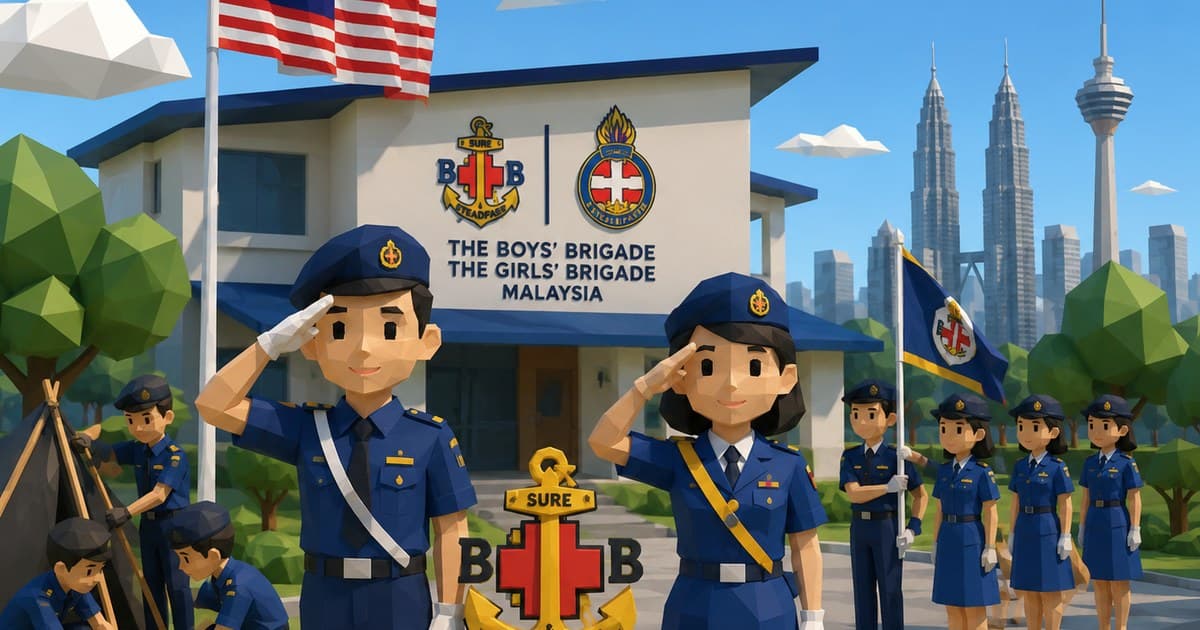
- →The Boys' Brigade and The Girls' Brigade are two separate Christian uniformed youth movements in Malaysia, both recognised by the Ministry of Education and the Ministry of Youth and Sports as uniformed bodies (badan beruniform).
- →The Boys' Brigade was founded in Glasgow in 1883 and reached Malaya in 1946 (1st Penang Company); the Girls' Brigade traces to Dublin in 1893 and reached Malaya in 1938.
- →Both serve young people aged about 6 to 21 through local Companies run by churches and schools, with weekly parades of drill, Bible study, badge work, and community service.
- →The Boys' Brigade motto is 'Sure & Stedfast' (Hebrews 6:19); the Girls' Brigade motto is 'Seek, Serve and Follow Christ' (aim drawn from Luke 2:52).
Two separate movements. The Boys’ Brigade and The Girls’ Brigade are distinct organisations with their own national bodies, mottoes and awards. Both are Christian in character and welcome members of any faith. Figures verified July 2026; membership numbers change, so treat them as indicative.
In This Guide
The Brigades in Malaysia, at a glance
The Boys' Brigade and The Girls' Brigade are Christian uniformed youth movements. In Malaysia both run mainly through churches and schools, where they are registered uniformed bodies (badan beruniform) recognised by the Ministry of Education and the Ministry of Youth and Sports. A church or school hosts a company, led by adult officers, and members meet weekly to drill, learn, earn badges, and take part in community service.
What they share. Both movements grew out of the same late-Victorian idea: shape young people through discipline, faith, and structured activity. Day to day they look similar. Members wear a uniform, fall in for drill and inspection, work through a badge and awards programme, join camps and parades, and give time to community service. Faith sits at the centre of both. The Boys' Brigade works towards "the advancement of Christ's Kingdom" among its members, and the Girls' Brigade aims to help girls become followers of Jesus Christ. Enrolment is open to young people of any background, and membership does not require the member to be Christian.
How they differ. The plainest difference is who they enrol: the Boys' Brigade takes boys and young men, the Girls' Brigade takes girls and young women. They also have separate origins and separate national bodies. The Boys' Brigade began in Glasgow in 1883, the first uniformed youth organisation in the world. The Girls' Brigade in its present form was created in 1965, when three older girls' organisations merged; the earliest of those, the Girls' Brigade in Ireland, started in Dublin in 1893. The two movements keep their own mottoes, badges, uniforms, and award schemes.
Who runs them. Each is a national organisation in its own right, part of a worldwide movement but run locally by Malaysians.
- The Boys' Brigade in Malaysia is governed by a National Council, with State Councils under it, each led by an elected State Commissioner. Its national headquarters moved to Puchong, Selangor in 2023 (the former BB House was in Kuala Ampang). As of 2019 it counted around 127 companies and roughly 8,400 members across the country.
- The Girls' Brigade Malaysia (Briged Puteri Malaysia) runs its companies through five regions covering Peninsular Malaysia, Sabah, and Sarawak.
Both belong to global parent bodies (Boys' Brigade Global and Girls' Brigade International / Worldwide), which set the shared character of the movement while each national body handles its own programme and companies.
At a glance: Boys' Brigade vs Girls' Brigade in Malaysia
| The Boys' Brigade | The Girls' Brigade | |
|---|---|---|
| Founded globally | 1883, Glasgow, Scotland (by William Alexander Smith) | 1965 in present form, from a 1965 merger of three bodies; earliest root 1893, Dublin |
| Arrived in Malaysia | 1946 (first company in Penang) | 1938 |
| Motto | "Sure & Stedfast" | "Seek, Serve and Follow Christ" |
| Members | Boys and young men | Girls and young women |
| Age range (Malaysia) | About 6 to 21, across Pre-Junior, Junior, Senior, and Primer sections | About 6 to 21 |
| National body | The Boys' Brigade in Malaysia (National Council) | The Girls' Brigade Malaysia / Briged Puteri Malaysia |
Note on the Boys' Brigade motto: the older spelling "Stedfast" is kept on purpose, following the wording of Hebrews 6:19 in the King James Bible.
The Boys' Brigade: from Glasgow 1883 to Malaysia
The Boys' Brigade began in Glasgow on 4 October 1883, when William Alexander Smith, a Sunday school teacher and volunteer soldier, gathered a group of boys at the Free Church Mission Hall on North Woodside Road. The first meeting drew three officers and about 28 boys. This became the first voluntary uniformed youth movement in the world, and it shaped later bodies including the Scouts and the Girls' Brigade. Smith was knighted by King Edward VII in 1909 for his work with young people. The movement carries the motto "Sure & Stedfast" and the anchor emblem, drawn from Hebrews 6:19.
From Scotland the BB spread through Britain and across the Commonwealth. It reached Asia through companies in Darjeeling, India (1894), Swatow, China (1915), and Singapore (1930), which set the stage for its arrival in Malaya.
The Boys' Brigade comes to Malaya
The BB reached Malaya after the Second World War. A British former soldier, Robert Davis, brought the idea to Geh Hun Kheng, an educationist who agreed to serve as the first BB Captain in Malaya. The first company started in Penang in September 1946, when 20 boys met at a Methodist church on Madras Lane. Penang became the springboard for companies elsewhere.
- 1954: The 1st Kuala Lumpur Company formed under the sponsorship of Wesley Methodist Church, Kuala Lumpur, founded by Khoo Onn Soo.
- 1957: BB companies joined the Merdeka parade on 31 August, and a Malayan Council was established.
- 1961: The first Borneo company, the 1st Kuching Company, began in Kuching (founded 17 December 1961).
- 5 December 1964: The national body, The Boys' Brigade in Malaysia, was formed by uniting the Federation of Malayan Council, the Singapore Battalion, and the 1st Kuching Company. Singapore separated as a political entity in 1965.
- 1966: The first National Review was held in Kuala Lumpur with about 600 taking part, and the biennial BB Pesta was established.
- 1993: BB House was bought as a permanent headquarters.
- 1996: The 50th anniversary was marked, and the history book Our Anchor Holds 1946-1996 was published.
- 2023: The headquarters moved to Puchong.
Girls' membership was tried experimentally from 1992 and formally approved on 2 April 1994. Today the movement runs over 130 companies across Malaysia.
The Girls' Brigade in Malaysia
The Girls' Brigade is a separate Christian uniformed movement for girls. It traces its global roots to Dublin in 1893, when Margaret Lyttle started a girls' club at Sandymount Presbyterian Church. In July 1965 three bodies, the Girls' Brigade (Ireland, 1893), the Girls' Guildry (Scotland, 1900), and the Girls' Life Brigade (England, 1902), merged to form the modern Girls' Brigade.
In Malaysia, the movement dates back to 1938. The 1st Petaling Jaya Girls' Life Brigade Company began in November 1960 under Mrs Khoo Onn Soo at Trinity Methodist Church, Petaling Jaya, with about 23 girls and officers. It later spread to Sarawak (1st Kuching, 1967) and Sabah (1st Kota Kinabalu, 1969). The Girls' Brigade Malaysia (Briged Puteri Malaysia) now organises its companies across five regions and is recognised by the Ministry of Education and the Ministry of Youth and Sports as a uniformed body for girls aged 6 to 21.
The Girls' Brigade: origins and its arrival in Malaysia
The Girls' Brigade traces back to three separate Christian organisations for girls that grew up in different parts of the British Isles. Each ran on its own for decades before they came together as one movement in the 1960s.
The three founding brigades
| Organisation | Founded | Where |
|---|---|---|
| The Girls' Brigade (Ireland) | 1893 | Sandymount Presbyterian Church, Dublin |
| The Girls' Guildry | 1900 | Glasgow, Scotland |
| The Girls' Life Brigade | 1902 | England |
The oldest of the three began in Dublin in 1893, when Miss Margaret Lyttle started a girls' club at Sandymount Presbyterian Church. The Girls' Guildry followed in Glasgow in 1900, and The Girls' Life Brigade in England in 1902. All three shared a common purpose: giving girls Christian teaching alongside activities that built character, health and service.
The 1965 merger
After years of talks, the three groups agreed in 1964 to amalgamate. The modern organisation, The Girls' Brigade, was officially formed in 1965, uniting them under one name and one aim. Its motto is to help girls "Seek, Serve and Follow Christ". Today The Girls' Brigade works across five fellowships worldwide (Africa, Asia, Caribbean and Americas, Europe, and Pacific), with more than 126,000 members in over 3,000 groups.
Arrival in Malaysia
The Girls' Brigade reached Malaya in 1938, long before the 1965 global merger, arriving through the churches as a companion movement to The Boys' Brigade. It is known in Malay as Briged Puteri Malaysia.
The movement later spread to East Malaysia. In Sarawak, the 1st Kuching Company was formed in 1967 at St Thomas's Cathedral by Ruth Duncombe. In Sabah, the 1st Kota Kinabalu Company followed in 1969.
The Girls' Brigade Malaysia
The national body, The Girls' Brigade Malaysia, oversees companies across the country. It is recognised by the Ministry of Education and the Ministry of Youth and Sports as a uniform body for girls aged 6 to 21. The country is organised into five regions:
- Northern Region (Kedah, Penang, Perak, Kelantan, Terengganu)
- Central Region (Kuala Lumpur, Negeri Sembilan, Pahang)
- Southern Region (Malacca, Johor)
- Sabah Region
- Sarawak Region
Members are grouped by age, from Cadets (6 to 9) and Juniors (10 to 12) to Seniors (13 to 15) and Pioneers (16 to 21), with Young Leaders and Officers taking on leadership roles.
Sarawak shows how the structure grew over time. The Sarawak Group Council was formed in 1972, became the Sarawak District Council in 1978, and was raised to the Sarawak Regional Council in 1994. The Kuching companies marked their 55th anniversary in 2022, counting from that first 1967 company.
The Girls' Brigade Malaysia and The Boys' Brigade in Malaysia stand as parallel Christian uniformed youth movements. The Boys' Brigade serves boys and young men, while The Girls' Brigade serves girls and young women. Both run through local churches and both are recognised uniform bodies in Malaysian schools.
How the Brigades are organised in Malaysia
Both movements are worldwide Christian uniformed youth organisations with national bodies in Malaysia. The Boys' Brigade began in Glasgow in 1883 and reached Malaya in 1946. The Girls' Brigade traces its founding movement to Dublin in 1893 and arrived in Malaysia in 1938. The two run on a similar three-tier plan: a national body, regional councils, and a local unit called a Company.
National level
The Boys' Brigade in Malaysia (BBM) runs from a national headquarters in Puchong, Selangor (since 2023). Its affairs are directed by an Executive Council (Exco), which sets policy and coordinates national programmes, supported by a small full-time staff.
The Girls' Brigade Malaysia (Briged Puteri Malaysia) is headquartered in Petaling Jaya (Ara Damansara). It is led by a national Executive Committee (EXCO) elected for a two-year term. For 2024 to 2026 the National President is Ms Lau Mee Ting, with a National Chaplain, National Secretary, National Treasurer, several portfolio officers, and Regional Representatives.
States, districts and regions
BBM groups its Companies into nine State Councils (covering Johor, Kuala Lumpur, Melaka, Penang, Perak, Sabah, Sarawak, Selangor and neighbouring states). Each is headed by a State Commissioner elected every two years. The Girls' Brigade divides the country into five Regions: Northern, Central, Southern, Sabah and Sarawak.
The Company
The Company is the working unit that boys and girls actually join. Companies are numbered within their state, for example the 1st Kuala Lumpur or the 3rd Kuching, and are split into age sections. Girls' Brigade sections run Cadet (6 to 9), Junior (10 to 12), Senior (13 to 15) and Pioneer (16 to 21).
Church-based and school-based Companies
- Church-based Companies are attached to a sponsoring church or Christian body, which holds full authority over the Company's Christian education. BBM works with over 120 churches nationwide. The very first BB Company was sponsored by Madras Lane Methodist Church.
- School-based Companies run inside a school as an approved co-curricular uniformed unit, drawing members from the pupil body. In Penang, for example, BB Senior Section work runs in schools such as Chung Ling High School and SMK Air Itam.
Both types operate under the same national rules and remain Christian in character.
Officers and leaders
Adults who lead a Company are Officers. In BBM the ranks include Warrant Officer, Lieutenant, Honorary Captain and Captain, with the Captain in charge of the Company. In the Girls' Brigade a Company is led by a Captain, supported by Officers and Helpers. Each Company also has a Chaplain, usually a minister or church worker, responsible for the spiritual side. The Girls' Brigade appoints a National Chaplain at the top: for 2024 to 2026 this is Bishop Emeritus Dr Ong Hwai Teik.
Registration as a uniformed body
Both Brigades are recognised by the Ministry of Education and the Ministry of Youth and Sports as approved uniformed bodies (badan beruniform), which lets Companies run as an official co-curricular activity in schools.
Size (where figures are known)
The clearest published count is for the Boys' Brigade. As of 2019, BBM reported 8,427 members across 127 companies, with 816 volunteers and 4 staff. The Girls' Brigade Malaysia has not published a single national membership total; its National Structure page lists registered Companies by region (Sarawak carrying the largest share).
Boys' Brigade age groups and programme
The Boys' Brigade and The Girls' Brigade are two separate Christian uniformed youth movements. Both split their members into age sections, and both run church-based units (called Companies) that a school or congregation hosts as a co-curricular activity. The section names you see depend on which body you are looking at. The global movement uses one set of names, and the Malaysian bodies use their own.
The Boys' Brigade: global names versus Malaysian names
The best-known BB structure comes from the United Kingdom, where the four sections are Anchors, Juniors, Company, and Seniors. The Boys' Brigade in Malaysia, known in Malay as Briged Putera Malaysia, uses different section names.
| Section (UK / global) | Typical age | Section (Malaysia) | Age band (Malaysia) |
|---|---|---|---|
| Anchors | 5 to 8 | Pre-Junior | 6 to 8 (Kindergarten to Primary 2) |
| Juniors | 8 to 11 | Junior | 9 to 11 (Primary 3 to Primary 6) |
| Company | 11 to 14 | Senior | 12 to 19 (Secondary 1 to Secondary 5) |
| Seniors | 14 to 18 | Primer | 19 to 21 (post-secondary) |
Younger sections focus on games, crafts, teamwork, and simple Christian teaching. As boys move up, the programme adds drill, first aid, camping, community service, and badge work. In Malaysia the Senior Section runs a badge scheme across compulsory areas (Christian Education, Drill, Recruitment) and interest groups covering arts, adventure, community, and physical activities. The Founder's Badge is the highest award a Senior member can reach. The Boys' Brigade in Malaysia was formed in 1946 with the 1st Penang Company, and its motto is "Sure and Stedfast" (the old spelling is kept on purpose).
The Girls' Brigade Malaysia (Briged Puteri Malaysia)
The Girls' Brigade is a separate movement that began in Dublin in 1893 and reached Malaya in 1938. The Malaysian body runs these groupings:
| Section | Age band |
|---|---|
| Cadet | 6 to 9 |
| Junior | 10 to 12 |
| Senior | 13 to 15 |
| Pioneer | 16 to 21 |
| Young Leader | 16 to 21 |
| Officer | 18 and above |
Girls' Brigade activities are built on four areas of development, drawn from Luke 2:52: Spiritual, Physical, Educational, and Social. In practice that means Bible study and church involvement, sport and adventure, skills that support schoolwork, and community and social service. Young Leaders and Officers are leadership and adult roles for members aged 16 and above who take on responsibility.
A few notes for parents and teachers
- Age bands are guides. A local Company may adjust slightly to fit school years.
- Both movements are recognised by Malaysia's Ministry of Education and Ministry of Youth and Sports as uniformed co-curricular bodies.
- Boys' Brigade in Malaysia has admitted girls into some Companies since 1994, so a "BB" unit is not always all-boys. The Girls' Brigade remains a distinct organisation with its own structure and badges.
Girls' Brigade age groups and programme
The Girls' Brigade groups its members into age sections, and the programme at every level runs on four sides: Spiritual, Physical, Educational, and Service (or Social). The four sides spell SPES, Latin for "hope", and draw on Luke 2:52, which describes Jesus growing "in wisdom and stature, and in favour with God and men". Physical maps to stature, Educational to wisdom, Spiritual to favour with God, and Service to relationships with people.
One point to get right first: the section names vary between the global movement and The Girls' Brigade Malaysia (Briged Puteri Malaysia). The names Explorers, Juniors, Seniors, and Brigaders are used by Girls' Brigade England and Wales. Girls' Brigade Malaysia uses Cadet, Junior, Senior, and Pioneer instead. Ages are set around local schooling years, so they differ by country and even between companies.
Girls' Brigade Malaysia sections (official age bands):
| Section | Age band |
|---|---|
| Cadet | 6 to 9 years |
| Junior | 10 to 12 years |
| Senior | 13 to 15 years |
| Pioneer | 16 to 21 years |
| Young Leader | 16 to 21 years |
| Officer | 18 years and above |
Individual Malaysian companies sometimes adjust the bands to match their school intake. For example, the 1st Petaling Jaya Company (Trinity Methodist Church) runs Cadets at 6 to 8, Juniors at 9 to 11, Seniors at 12 to 14, and Pioneers at 15 to 21.
Global naming for comparison (Girls' Brigade England and Wales):
| Section | Age band |
|---|---|
| Explorers | around 4 to 8 years |
| Juniors | around 8 to 11 years |
| Seniors | around 11 to 14 years |
| Brigaders | around 14 to 18 years |
The four-sided programme at each level
The same four sides run through every section, pitched to the age of the girls:
- Spiritual: church participation, Bible study, and building a Christian foundation.
- Physical: games, fitness, health, and a sense of adventure and fair competition.
- Educational: badge work and activities that add knowledge and practical skills alongside school.
- Service (Social): teamwork, community awareness, concern for others, and leadership training in the older sections.
As girls move up the sections, the same four sides carry more responsibility. Cadets and Juniors work through simpler badges and activities. Seniors and Pioneers take on leadership, service projects, and award work, and Pioneers can progress into Young Leader training before becoming Officers.
Aim and motto
Across the whole movement, including Malaysia, the aim is stated the same way: "To help girls become followers of the Lord Jesus Christ, and through self control, reverence and a sense of responsibility, to find true enrichment of life." The motto is "Seek, Serve and Follow Christ". Girls' Brigade Malaysia also uses the tagline "Girls' lives transformed, God's world enriched".
In Malaysian schools and churches, the Girls' Brigade runs as a uniformed co-curricular activity (CCA), the counterpart to The Boys' Brigade. Girls join a company attached to a church or school and meet weekly through the school year.
Badges and top awards
Both movements recognise progress with badges worn on the uniform, and both build towards a single top award that takes years of steady work. The two Malaysian bodies run their own award schemes, so the details differ from the global movements they belong to.
The Boys' Brigade in Malaysia
Members collect badges section by section and wear them on both sleeves.
- Junior Section (ages 9 to 11). Boys work through knowledge, life and social skills, physical education, and spirituality and character. The Junior Gold Award is the highest achievement at this level.
- Senior Section (ages 12 to about 20). Seniors earn proficiency badges grouped into four areas (interest, adventure, community, physical), at basic and advanced levels, alongside service and special awards.
Two awards sit at the top of the Senior pathway:
| Award | Standing | What it involves |
|---|---|---|
| President's Badge | Second highest | Growth across physical, social, educational and spiritual areas; a set number of proficiency badges including advanced ones. It is the gateway to the Founder's Badge. |
| Founder's Badge | Highest | Attain the President's Badge first, reach at least the rank of Lance Corporal, complete around five years of service, log 40 or more hours of community service, finish a substantial personal project, and gain the officers' nomination. |
The Founder's Badge was introduced in 1962 and stays rare. Fewer than 250 members across the whole country have earned it since then, which is why it carries weight. A boy who earns it is known as a Founder's Man, a standing kept for life.
The Boys' Brigade in Malaysia has also been the appointed Operational Authority for The Duke of Edinburgh's International Award since 2020, working with the Ministry of Youth and Sports. Members can work towards Bronze, Silver and Gold levels through their company.
The Girls' Brigade Malaysia (Briged Puteri Malaysia)
The Girls' Brigade Malaysia is recognised by the Ministry of Education and the Ministry of Youth and Sports as a uniform body for girls aged 6 to 21, organised into five regions. Its badge programme covers spiritual, educational, social and physical development.
- Cadets earn coloured stars in the order Blue, Green, Red and Gold.
- Pioneers (the senior girls) earn Triangles as they progress.
The highest national award is the Pioneer Pin (the GB National Award), earned by Pioneers who complete the full programme and take on squad leadership and mentoring roles. Because it rests on several years of consistent service and leadership, very few girls reach it.
The wider Girls' Brigade movement worldwide uses a different top structure, where the Queen's Award is the highest award and the Brigader Brooch sits below it. The Malaysian body runs its own Pioneer Pin scheme rather than issuing the Queen's Award, so the two systems should not be confused.
Faith, mottoes and anthems
Both movements are Christian at the foundation. Every company works under a local church, and the whole programme, from drill and badges to camps and community service, sits inside a plain Christian purpose.
The Boys' Brigade: Object and motto
The Boys' Brigade states its purpose as its Object: "The advancement of Christ's kingdom among members and the promotion of habits of obedience, reverence, discipline, self-respect and all that tends towards a true Christian character." The original 1883 wording said "Boys" and "Christian manliness." Malaysia uses "members" and "true Christian character" to reflect that girls have been admitted since 1994.
The BB motto is "Sure & Stedfast." Founder William Alexander Smith took it from Hebrews 6:19 in the King James Version: "Which hope we have as an anchor of the soul, both sure and stedfast." The old spelling of "stedfast" is kept on purpose. From the same verse comes the BB emblem, the anchor.
The Girls' Brigade: Aim, motto and principles
The Girls' Brigade Malaysia (Briged Puteri Malaysia) works to a stated Aim: "To help girls to become followers of the Lord Jesus Christ, and through self-control, reverence and a sense of responsibility, to find true enrichment of life."
Its motto is "Seek, Serve and Follow Christ." The GB Principles acknowledge Jesus Christ as Saviour and Lord according to the Scriptures, to the glory of one God, Father, Son and Holy Spirit. The GB crest carries a cross (Christ and His Church), lamp and torch (Christ's living Spirit shining out), crown (Christ as King) and circle (God's encircling love), in white for purity, red for the blood of Christ, blue for loyalty and gold for royalty.
Church, chaplains, parade and Bible class
Each company is attached to a sponsoring local church. That church appoints a chaplain, usually the pastor or a church worker, who oversees the Christian teaching. Weekly meetings, called parades, run one to two hours and mix drill, skills, badge work and Bible study or devotion. Companies also take part in church parade, when members march in uniform into a Sunday service. The sponsoring church gives the meeting place, adult officers and spiritual oversight.
Anthems and colours
| Item | Boys' Brigade | Girls' Brigade Malaysia |
|---|---|---|
| Motto | Sure & Stedfast | Seek, Serve and Follow Christ |
| Source text | Hebrews 6:19 | Jesus Christ per the Scriptures |
| Emblem | Anchor | Cross, lamp, torch, crown, circle |
| Anthem | "Will Your Anchor Hold" | GB Anthem; plus a Motto Song |
"Will Your Anchor Hold" (Priscilla J. Owens, 1882) is the BB anthem, tied to the anchor and to Hebrews 6:19. GB Malaysia has its own Anthem and a separate Motto Song.
Interdenominational and church-partnered
Both bodies are interdenominational. Companies run across Methodist, Anglican, Lutheran, Baptist, Presbyterian, Pentecostal and independent churches. In Malaysia the Boys' Brigade is an associate member of the Council of Churches of Malaysia (CCM) and the National Evangelical Christian Fellowship (NECF). The uniform, badges and drill are the shared frame; the sponsoring church supplies the faith content, so a company always belongs to a congregation as well as to the national movement.
Drill, band, camps and community service
Both brigades run on a weekly parade. A company meets at its church or school hall for one to two hours, usually on a weekday evening or a Saturday. The Boys' Brigade in Malaysia (BBM) and The Girls' Brigade Malaysia (GBM) are the national bodies here. Both are recognised by the Ministry of Education and the Ministry of Youth and Sports as approved uniformed youth groups, and both are Christian movements that work through the church.
A typical weekly parade falls into a set rhythm. In GBM companies this runs as roll call, singspiration, devotion or Bible study, badge work, then drill and games before dismissal. BBM parades follow a similar shape: fall-in and inspection, drill, Bible study or devotion, badge work, and games or sports. Members earn proficiency badges across areas such as first aid, sports, arts, camping, technology, and expeditions.
Drill is the backbone of both movements. Members learn to stand at attention, form squads, dress ranks, and march in step to called commands. GBM sets its own standard in the Girls' Brigade Malaysia Drill Manual: quick time is marched at 116 paces per minute, called as "Kiri, (pause), Kiri, (pause), Kiri, Kanan, Kiri". State drill instructors run regional drill camps to train girls and officers and to keep steps standard across companies. BBM runs foot drill the same way, and foot drill is a judged event at national level.
Bands give the brigades their public sound. Companies field marching bands built around side drums, bass drum, and bugles or brass. The 3rd Kuala Lumpur Company was the first BB company in Malaysia to bring in bagpipes, adding a pipe band to the usual brass and drums.
Camps and national gatherings are the yearly highlight. Most GBM companies hold at least one camp a year, on top of regional drill camps and prayer conferences. For BBM, the flagship event is BB Pesta, the National Camp and Convention, first held in 1966 as the National Review and Display. Pesta gathers members from across Malaysia and abroad, with competitions in footdrill, band, and group singing. BB Pesta 2026 is set for Penang.
Competitions run at company, state, and national level. Members compete in drill, band, singing, dancing, Bible quiz, and platoon or squad games.
Founder's Day and parades mark the calendar too. The Founder's Badge is the highest award in BBM, awarded to fewer than 250 members since 1962, and it is presented at high-profile events such as the Founder's Day Celebration, the Brigade Council Meeting, or the National Pesta. The Boys' Brigade was invited to march in the Merdeka Parade when Malaysia gained independence on 31 August 1957.
Service sits at the centre of both aims. Companies carry out service projects for the church and the local community, and members take part in church activities as part of their spiritual programme. First aid is taught both as a badge skill and as duty at events.
The uniform is worn with pride on parade. GBM members wear a royal blue six-gore skirt with epaulette, red tie, navy blue cap, navy belt, and sash, with white socks and white shoes; young leaders add a black lanyard and gold braid. BBM members wear the company uniform and carry rank on the shoulder, rising through the ranks from Private up to Staff Sergeant, with officers up to Captain.
Sections by age
| Boys' Brigade in Malaysia | Girls' Brigade Malaysia |
|---|---|
| Pre-Junior (6-8) | Cadets (6-9) |
| Junior (9-12) | Juniors (10-12) |
| Senior (12-19) | Seniors (13-15) |
| Primer (19-21) | Pioneers and Young Leaders (16-21) |
How to join a Company
Both movements run through local groups called Companies. Each Company meets weekly and is attached to a church, a school, or both. The Boys' Brigade and the Girls' Brigade are separate organisations, so a boy joins a Boys' Brigade Company and a girl joins a Girls' Brigade Company. Some Boys' Brigade Companies in Malaysia do also enrol girls, so ask the local Company what they run.
Who can join
Membership is organised by age into sections. The exact age bands can vary a little between Companies, but the common pattern is:
| The Boys' Brigade Malaysia | Age | The Girls' Brigade Malaysia | Age |
|---|---|---|---|
| Pre-Junior | 6 to 8 | Cadets | 6 to 8 |
| Junior | 9 to 11 | Juniors | 9 to 11 |
| Senior | 12 to 19 | Seniors | 12 to 14 |
| Primer | 19 to 21 | Pioneers | 15 to 21 |
Both movements cover roughly ages 6 to 21. Young people aged 18 and above can also serve as Young Leaders, helpers or officers.
You do not have to be a Christian to join. Both brigades are Christian in character, and their stated aim is to help young people grow in the Christian faith, discipline and self-respect. At the same time, the movement welcomes children of any faith or none. If you send your child, expect Bible teaching, prayer and Christian values as part of the programme.
Where Companies are found
Companies are hosted by local churches and by schools. On the church side, the sponsoring congregations are most often Methodist, with Anglican, Presbyterian, Brethren, Baptist, Lutheran and independent churches also running Companies. The Boys' Brigade in Malaysia began in Penang in 1946 through a Methodist church, and the Girls' Brigade reached Malaya in 1938. Many Companies today meet on a weekday afternoon inside a school and again on the weekend at the sponsoring church.
Fees, uniform and enrolment
- Fees. These are set by each Company, so they differ from place to place. Ask the Company you want to join for the current amount.
- Uniform. You do not need to buy a uniform before joining. New members usually start first, then get fitted for the uniform once they have settled in.
- Enrolment. Companies hold an Enrolment day each year, when new members are formally enrolled, existing members re-enrol, and some are promoted to Young Leaders. The best time to start is near the beginning of the school year, but you can enquire at any point.
Co-curricular marks for school
Brigade membership counts towards school co-curricular assessment. Both movements are recognised by the Ministry of Education and the Ministry of Youth and Sports as a uniformed body (badan beruniform). For secondary students, a uniformed body is one of the three co-curricular categories (uniformed body, club or society, and sport). Marks come from attendance, involvement, achievement and any position held, and these co-curricular marks feed into merit points used for entry to public universities. Turning up each week, earning badges and taking on responsibility all add to the record.
How to find a Company near you
- Start with your own church or your child's school and ask whether they host a Boys' Brigade or Girls' Brigade Company.
- Contact the national body directly. The Boys' Brigade Malaysia and The Girls' Brigade Malaysia both list contact details on their websites (bbmalaysia.org and girlsbrigade.org.my) and can point you to the nearest Company.
- Ask a Methodist, Anglican, Presbyterian or Brethren church in your area, since these denominations commonly run Companies.
The Brigades among Malaysia's uniformed bodies
Malaysian schools run co-curricular uniformed units (badan beruniform) as one of the approved activity types, alongside clubs, societies, and sports. Most students join one. The best-known are the Scouts (Pengakap), Girl Guides (Pandu Puteri), St John Ambulance, the Red Crescent (Persatuan Bulan Sabit Merah Malaysia, PBSM), and the cadet corps tied to public services: Kadet Polis and Kadet Bomba. The Boys' Brigade and the Girls' Brigade sit in the same category, recognised by the Ministry of Education and the Ministry of Youth and Sports as uniformed units.
What sets the two Brigades apart is their Christian foundation. The Boys' Brigade in Malaysia describes its object as the advancement of Christ's Kingdom among its members, and each Company is started and run by a local church as part of its youth ministry. Its motto, "Sure and Stedfast," is drawn from Hebrews 6:19. The Girls' Brigade is an interdenominational Christian movement whose aim draws on Luke 2:52, with the tagline "Girls' lives transformed, God's world enriched." A Brigade unit is attached to a congregation. It opens with worship and Bible study, and its programme is built around Christian teaching.
The other uniformed bodies are open to students of every faith and carry no religious teaching. Pengakap and Pandu Puteri follow the worldwide Scouting and Guiding methods. St John Ambulance and PBSM focus on first aid and humanitarian service. Kadet Polis and Kadet Bomba are cadet arms linked to the police (PDRM) and the Fire and Rescue Department (Bomba). For a Muslim-majority student body, this open, secular character is why these units are the common choice in national schools, while the two Brigades are found mainly in mission and church-linked settings.
The Brigades also keep a distinct drill-and-band tradition. Both grew out of the older British Brigade movement, and marching drill, parade, and brass or pipe bands remain a visible part of Company and Battalion life. Founder's badges, awards, and enrolment services carry a churchgoing style that the cadet corps and Scouts do not share.
It helps to separate the worldwide movement from the Malaysian body. The Boys' Brigade began in Glasgow in 1883; the Malaysian work started with the 1st Penang Company in 1946, sponsored by a Methodist church. The Girls' Brigade traces to Dublin in 1893 (the present international Girls' Brigade dates from a 1965 union of earlier girls' brigades), and Brigade work for girls in Malaysia goes back to 1938. Both Malaysian bodies are self-governing national organisations linked to the global fellowship.
| Unit | Local / Malay name | Main focus | Faith basis | Usual setting |
|---|---|---|---|---|
| Boys' Brigade | The Boys' Brigade | Christian character, drill, band, badge work | Christian, church-sponsored | Local church |
| Girls' Brigade | Briged Puteri Malaysia | Christian character, service, life skills | Christian, interdenominational | Local church |
| Scouts | Pengakap | Outdoor and survival skills, scouting method | Open to all faiths | School |
| Girl Guides | Pandu Puteri | Guiding method, life skills for girls | Open to all faiths | School |
| St John Ambulance | St John Ambulans | First aid, health, emergency care | Open to all faiths | School |
| Red Crescent | PBSM | Humanitarian aid, first aid, welfare | Open to all faiths | School |
| Police Cadets | Kadet Polis | Discipline, law, police-linked training | Open to all faiths | School, linked to PDRM |
| Fire Cadets | Kadet Bomba | Fire safety, rescue, Bomba-linked training | Open to all faiths | School, linked to Bomba |
The Brigades today, and how to support one
Both movements are steady, national, and church-rooted. The Boys' Brigade in Malaysia runs well over 100 companies across the country. Figures compiled for 2019 recorded 127 companies with 8,427 members and 816 volunteer officers, and the national body describes its network as more than 133 companies today. The Boys' Brigade says it has passed through more than 75,000 young people since the first company met in Penang in September 1946. The Girls' Brigade Malaysia organises its companies into five regions. Sarawak is by far the largest with dozens of companies, followed by Sabah, then the Central, Northern, and Southern regions on the peninsula. Girls' Brigade in Malaysia dates to 1938, with the earliest documented work traced to pioneers in Singapore and Kulai, Johor.
Both are recognised by the Ministry of Education and the Ministry of Youth and Sports as approved uniformed co-curricular bodies, so companies run inside schools as well as churches. The Boys' Brigade lists partnerships with more than 200 schools.
The global picture. The worldwide Boys' Brigade began in Glasgow in 1883; the worldwide Girls' Brigade began in Dublin in 1893. The Malaysian organisations are the national bodies for each movement, run by Malaysians and registered here. The Boys' Brigade in Malaysia is affiliated internationally through the Global Fellowship of Christian Youth and the regional grouping Boys' Brigade Asia, having joined the Pacific Regional Fellowship in 1962 and later the East Asia Regional Fellowship. The Girls' Brigade Malaysia sits within the wider Girls' Brigade International family, which links companies across Singapore, Thailand, Hong Kong, Brunei, Indonesia, the Philippines, and Cambodia.
Recent milestones. The Boys' Brigade in Malaysia marked its 75th anniversary in 2021 under the theme "Marching Onward" and moved its national headquarters to Puchong in 2023. The Girls' Brigade Malaysia celebrated its 75th anniversary in 2013. The Boys' Brigade formally adopted a Girls' Wing on 2 April 1994, and girls now serve in more than 20 of its companies.
The main challenge is people. Both movements depend on trained adult officers and helpers who give up weekly time, and recruiting and retaining them has been a constant pressure since the early years. A company lives or dies on whether enough adults will commit to run it.
Membership sections give a sense of who each serves:
| Movement | Sections and ages |
|---|---|
| Boys' Brigade | Pre-Junior (6-8), Junior (9-11), Senior (12-19), Primer (19-21) |
| Girls' Brigade | Recognised as a uniform body for girls aged 6-21 |
How a church or school can start or support a company:
- Start one: approach the national headquarters or your State Council (Boys' Brigade) or regional office (Girls' Brigade) to affiliate a new company. You will need a sponsoring church or school and a small team of adults willing to be trained and enrolled as officers.
- Host and fund: provide a weekly meeting place, cover basic running costs, and back the company from the pulpit or the assembly so parents take it seriously.
- Serve directly: enrol as an officer or helper, the single most useful thing most people can offer. Old Boys and Old Girls often return this way.
- Give: support uniforms, camps, and equipment for families who cannot meet the cost.
Neither movement is large by national standards, and both compete for the same scarce weekend hours as everything else. What keeps them going is simple and durable: a local church or school, a few committed adults, and a room to meet in once a week. On that footing, the Brigades in Malaysia keep marching on.
Sources & References
This guide is cross-referenced against primary official sources, regulatory references, and locally relevant materials.
- The Boys' Brigade in Malaysia: History Official national body account of the BB's founding, its arrival in Penang in 1946, and Malaysian milestones.
- The Girls' Brigade Malaysia (official site) Official site of Briged Puteri Malaysia, covering aim, motto, sections, programme, and the Luke 2:52 basis.
- Girls' Brigade Malaysia: National Structure Official page on the five regions, ministry recognition, and registered companies by region.
- The Boys' Brigade UK: Our History Global BB record of the 1883 founding in Glasgow by William Alexander Smith.
- Girls' Brigade Ministries: Our History History of the three founding brigades and the worldwide movement's membership figures.
- Girls' Brigade Worldwide: History Global body account of the 1964 agreement to amalgamate and the 1965 formation with the shared motto.
- Boys' Brigade Asia: Malaysia Regional fellowship page on BBM's church partnerships and reach across children aged 6 to 21.
Further reading: Boys' Brigade in Malaysia (Wikipedia) · Girls' Brigade (Wikipedia) · The Borneo Post: Girls' Brigade Sarawak 55th anniversary