
Key Takeaways
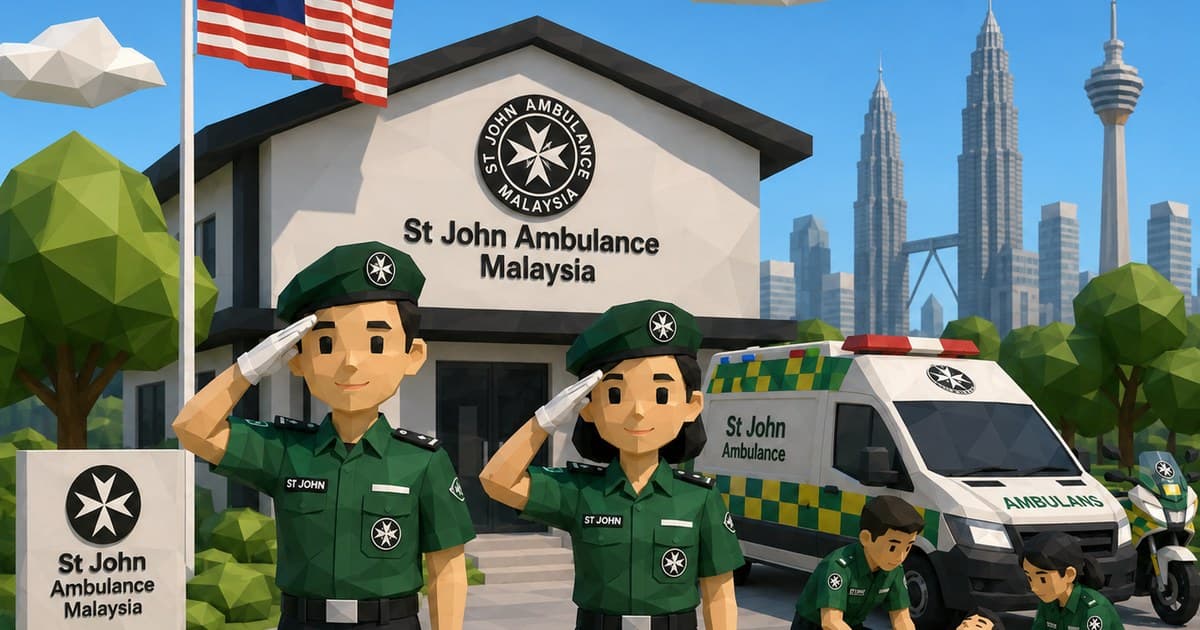
- →St John Ambulance Malaysia (SJAM, Pertubuhan St John Ambulans Malaysia) is a voluntary humanitarian body providing first aid training, ambulance services and event medical cover, tracing its presence in Malaya to 1908 and incorporated nationally under the St John Ambulance of Malaysia (Incorporation) Act 1972 (Act 74).
- →Cadets make up close to three-quarters of membership, run as a uniformed co-curricular body in most secondary schools alongside groups like Pengakap, PBSM and Kadet Polis.
- →SJAM is recognised by DOSH as an approved provider of First Aid at Workplace training; its 2-day course gives a Certificate of Competency valid three years and is HRDC-claimable.
- →SJAM reports over 60,000 volunteers contributing around 3.6 million man-hours a year, and operates the largest voluntary ambulance fleet in the country, supporting the 999 response through EMAS since 1998.
Not the Red Crescent. St John Ambulance Malaysia (SJAM) is a separate body from PBSM (Bulan Sabit Merah / Red Crescent). Both do first aid and humanitarian work. Figures and fees here are indicative and verified July 2026; confirm current details with your state SJAM division.
In This Guide
St John Ambulance Malaysia, at a glance
St John Ambulance Malaysia (SJAM, Pertubuhan St John Ambulans Malaysia) is a voluntary humanitarian organisation that provides first aid, ambulance services and medical cover at public events. It works for the relief of people in sickness, distress, suffering or danger, without distinction of race, class, colour or creed. SJAM is part of the worldwide St John movement, which grows out of the Order of St John.
The organisation is run largely by volunteers and is recognised in Malaysia as a uniformed body. You will most often see SJAM members in their black-and-white uniforms standing by with first aid at football matches, processions, school events, marathons and other public gatherings. SJAM also runs first aid courses for the public and operates one of the largest ambulance fleets in the country.
SJAM has deep roots in schools. Its Cadet and Junior programmes run as co-curricular uniformed units in primary and secondary schools across Malaysia, teaching young members first aid, discipline and community service. For many Malaysians, St John is the badge and drills they remember from school assembly and Speech Day.
The emblem and motto
The SJAM emblem is the white eight-pointed cross (the St John Cross, also called the Maltese or Amalfi cross). The eight points are traditionally linked to virtues that members are expected to uphold. In the Malaysian arms the cross is set against a black shield and flanked by two lions and two unicorns, reflecting the Order's British royal links.
The motto is Pro Fide, Pro Utilitate Hominum, Latin for "For the Faith, and in the Service of Mankind". SJAM commonly renders its working motto in English as "Service for Mankind".
At a glance
| Name | St John Ambulance Malaysia (SJAM), Pertubuhan St John Ambulans Malaysia |
| Type | Voluntary humanitarian organisation and recognised uniformed body; statutory corporation |
| Established | Roots from 1908 in British Malaya; incorporated nationally by Act in 1972 |
| Incorporating law | St John Ambulance of Malaysia (Incorporation) Act 1972 (Act 74) |
| Emblem | White eight-pointed cross (St John Cross), on a black shield with lions and unicorns |
| Motto | Pro Fide, Pro Utilitate Hominum ("For the Faith, and in the Service of Mankind") |
| Best known for | First aid training, ambulance services, event medical cover, and school cadet units |
| Youth wings | SJAM Cadets and Juniors, run as uniformed units in schools |
| Part of | The worldwide St John movement (Order of St John) |
The sections that follow set out SJAM's history, structure, services, membership and how to join.
From the Knights Hospitaller to Malaysian divisions
St John Ambulance traces its name and cross to a hospital founded in Jerusalem around 1080, where monks under Brother Gerard cared for sick and injured pilgrims travelling to the Holy Land. The Church formally recognised this religious community in 1113. After the Crusaders took Jerusalem, the order took on a military role and became known as the Knights of the Order of St John of Jerusalem, later called the Knights Hospitaller. Their eight-pointed cross remains the emblem carried by St John volunteers today.
The modern revival in England
The medieval order faded in Britain over the centuries. In 1831 a British order was recreated and grew into the Most Venerable Order of the Hospital of St John of Jerusalem. Queen Victoria granted it a royal charter on 14 May 1888.
Two working bodies came out of this revival:
- The St John Ambulance Association, founded on 10 July 1877 in England, which taught first aid to workers in railway centres, mines and factories where medical help was far away.
- The St John Ambulance Brigade, formed in June 1887, whose members wore uniforms and turned out to give first aid at public events and emergencies.
This structure, a teaching Association and a uniformed Brigade under one worldwide Order, is the model that later reached Malaya.
Arrival and growth in Malaya
The St John Ambulance Association was set up in Singapore in 1885. First aid classes reached the mainland soon after, with training organised for police in Penang and Malacca around 1897.
The movement in present-day Malaysia dates its start to 1908, when medical officers in the Colonial Medical Service formed the St John Ambulance Association in British Malaya. The pioneers included Capt. Dr John Sutton Webster, Dr Richard Desmond Fitzgerald and Mr Arthur Mitchell Goodman. Rev. P. N. Hunter, the Association secretary in Singapore, pushed for a uniformed Brigade in the same year.
The uniformed Brigade grew through the late 1930s. The first ambulance cadet division was formed in Penang in 1938, and Brigade divisions followed in Perak, Penang, Kuala Lumpur and Johor Bahru. By 1939 the Brigade operated across the Federated Malay States, the Straits Settlements and the unfederated states of Kelantan, Johor and Kedah. During the Second World War, members were drafted into the Medical Auxiliary Service in September 1941 and served as first aiders and stretcher-bearers after the Japanese invasion of 8 December 1941.
An independent Malaysian body
Malaya gained independence in 1957 and Malaysia was formed in 1963. The Government of Malaysia then decided to bring the separate Association and Brigade bodies in Malaya, Sabah and Sarawak together into one national organisation. The St John Ambulance of Malaysia (Incorporation) Act 1972 received royal assent on 23 March 1972, creating the single corporation known today as Pertubuhan St John Ambulans Malaysia.
The organisation carries royal patronage. The Yang di-Pertuan Agong serves as its Royal Patron, while the Prime Minister and the Minister of Health hold the offices of National President and Deputy National President.
How St John is organised in Malaysia
St John Ambulance of Malaysia (SJAM) runs as one statutory body with a clear chain from national level down to the local school or community unit. Almost everyone in it is a volunteer, including the principal officers at the top.
Governance and national leadership
The affairs of SJAM are governed by the St. John Council of Malaysia. Two roles are fixed by law: the National President is the Prime Minister of Malaysia, and the Deputy National President is the Minister of Health. The Yang di-Pertuan Agong serves as Royal Patron.
Day-to-day command sits with the Commander-in-Chief, appointed by the National President and answerable to the Council as chief executive, assisted by a Deputy Commander-in-Chief. The National Headquarters is at 41, Jalan Shelley, Off Jalan Peel, 55100 Kuala Lumpur.
The tiers
The rules provide for St John councils and executive committees at national, state or regional, and area levels.
- National Headquarters in Kuala Lumpur sets policy and standards.
- State and regional St. John Councils run operations in each of the states, with their own headquarters.
- Areas (or districts) coordinate on the ground below state level, present in most states.
- Divisions are where grassroots volunteers actually sit, covering events, training and community work.
Association, Brigade and Cadets
SJAM grew from three strands that later merged:
- The St. John Ambulance Association (SJAA), formed in 1908, was the training arm that taught first aid to members and the public.
- The St. John Ambulance Brigade (SJAB), formed in 1938, was the uniformed branch of adult volunteers who staffed duties and served the public.
- The Cadets are the youth section, for young people aged 10 to 17, traced back to the first ambulance cadet division formed in Penang in 1938.
These entities, together with those in Sabah, Sarawak and Malaya, were amalgamated into one corporation by the St. John Ambulance of Malaysia (Incorporation) Act 1972 (Act 74), which received Royal Assent on 23 March 1972.
Ranks and officers
Membership divides into Ambulance and Nursing streams, for both cadets and adults. Cadet non-commissioned ranks follow a chevron system worn on the sleeve: Lance Corporal (one chevron), Corporal (two) and Sergeant (three). Members promoted from sergeant level upward form the officer tier, coordinating operations, running training and mentoring cadets and adults. Promotion comes through service, examinations and assessment.
Standing in the Order of St John
SJAM is the Malaysian arm of the wider St John movement under the Most Venerable Order of the Hospital of St John of Jerusalem, the same Order of St John recognised by Queen Victoria in 1888. The organisation operates in many countries worldwide, and senior SJAM officers hold Order honours such as KStJ (Knight of the Order of St John).
St John cadets in schools
St John runs a youth programme inside schools as a uniformed body (badan beruniform), sitting alongside groups such as the Scouts (Pengakap), Kadet Bomba, Kadet Polis and the Malaysian Red Crescent (BSMM) under the Ministry of Education co-curriculum structure. Cadets make up close to 75% of St John Ambulance of Malaysia's total membership, and cadet divisions can be found in most secondary schools.
Age groups
Membership is split by age, so a pupil can move up as they grow.
| Section | Age | Level | What they focus on |
|---|---|---|---|
| St John Junior (juniors) | 8 to 11 | Mostly primary school | Essentials of First Aid, basic first aid and nursing, road and home safety, history of SJAM, general knowledge, physical recreation |
| Ambulance Cadets and Nursing Cadets | 10 to 17 | Mostly secondary school | First aid, nursing, foot drill, leadership |
Boys are enrolled as Ambulance Cadets and girls as Nursing Cadets. Joining needs written consent from a parent or guardian.
What cadets learn and do
The unit meets weekly at school. In those sessions and camps, cadets are trained in:
- Foot drill and marching
- First aid and nursing skills
- Casualty handling and public duty at community events, under supervision
- Leadership, public speaking and teamwork
- Outdoor skills such as camping, hiking and expeditions
Cadets can work through a proficiency badge scheme. Those who complete and qualify in twelve subjects before the age of 21 earn the Grand Prior's Award, the highest cadet award, and may keep the badge as adult members.
Competitions
The main event is the National First Aid and Nursing Competition, held yearly. Ambulance Cadet and Nursing Cadet team categories were added in 1981. Cadets first compete at school and state level (state first aid competitions) before reaching the national round. Placing well in these contests feeds directly into a pupil's co-curricular achievement marks.
How it counts towards co-curricular marks
St John membership is graded like any other uniformed body under the Ministry of Education co-curriculum assessment. The mark is built from four parts:
| Aspect | Weight | Note |
|---|---|---|
| Attendance (Kehadiran) | 50% | Minimum 18 sessions a year for a uniformed body |
| Participation (Penglibatan) | 20% | Commitment across activities |
| Achievement (Pencapaian) | 20% | Placing in competitions from school up to international level |
| Position held (Jawatan disandang) | 10% | For a member holding an office, held at least 9 months |
Regular attendance carries the most weight, so a cadet who turns up each week, takes an active part, holds a post such as a rank or committee role, and does well in competitions can score strongly. This co-curricular grade forms part of a pupil's overall school assessment (PAJSK).
First aid training and certification
St John Ambulance Malaysia (SJAM) runs first-aid courses for the general public, workplaces, schools and its own volunteers. Training is one of the organisation's core activities, and its certificates are used across Malaysian workplaces to meet occupational safety obligations.
Courses offered
The main courses run through SJAM's training arm cover different needs and time commitments.
| Course | Typical format | Assessment | Certificate |
|---|---|---|---|
| First Aid at Workplace (FAWP) | 2 days (16 hours) | Theory test and practical assessment | Certificate of Competency, valid 3 years |
| Basic Life Support (BLS) | 1 day | Theory and practical assessment | Certificate of Competency, valid 3 years |
| Awareness of First Aid (AWFA) | 1 day | No exam | Certificate of Attendance |
| CPR and AED | Around 2 hours | None | Awareness session, no certificate |
| Advanced First Aid | 4 days | Assessment | Certificate |
Courses run at SJAM's National Headquarters at 41, Jalan Shelley, Kuala Lumpur, at state divisions around the country, and in-house at an employer's premises for groups (commonly 10 participants or more). Instruction is usually delivered in a mix of Malay and English.
CPR and AED
CPR (cardiopulmonary resuscitation) and use of an AED (automated external defibrillator) are taught with hands-on practice on manikins. These skills sit inside the workplace and Basic Life Support courses, and SJAM also offers shorter standalone CPR and AED awareness sessions for those who want the core response without full certification.
The workplace course and DOSH requirements
Under the Occupational Safety and Health Act 1994, employers have a duty to provide first-aid arrangements for their staff. The Department of Occupational Safety and Health (DOSH), under the Ministry of Human Resources, sets out through its first-aid guidelines that workplaces must have trained first-aiders on hand during working hours, with the number depending on the size and risk level of the workplace. First-aiders are expected to hold a valid certificate from a DOSH-recognised training provider and to renew it every three years.
SJAM is recognised by DOSH as an approved provider of First Aid in the Workplace training. Its First Aid at Workplace course is built to meet this requirement: two days of training with a theory and practical assessment, leading to a Certificate of Competency valid for three years. The course covers the primary and secondary survey, CPR and AED, choking, bleeding and wound care, fractures, burns, and common medical emergencies such as heart attack, stroke and diabetic emergencies. It is claimable under the HRD Corp (HRDC) training levy scheme, and SJAM offers free re-attempts at the assessment and free re-attendance while the certificate remains valid.
Fees and enquiries
Course fees vary by course type, group size and whether the class is public or in-house, and are quoted on enquiry, and SJAM does not publish a fixed price list. Employers and individuals can request a quotation or rate card directly from SJAM's training office or a state division.
Why the certification is widely recognised
St John Ambulance has taught first aid for well over a century and operates in many countries, so its name carries weight with employers and safety officers. In Malaysia the certificate's standing rests on two things: SJAM's DOSH recognition, which lets the workplace certificate satisfy legal first-aider requirements, and HRDC claimability, which lets companies recover the training cost through the levy. Together these make the SJAM certificate a common default for Malaysian workplaces arranging first-aid cover.
Ambulance and event medical cover
St John Ambulance Malaysia (SJAM) puts trained first aiders and ambulances where crowds gather and where disasters strike. This is the visible face of the organisation, the volunteers in white and black uniforms standing by at the finish line, the marathon water station, or the flood relief centre.
Standby cover at public events
SJAM volunteers attend thousands of events across the country every year. They cover marathons and other sporting events, parades, public gatherings, concerts, and community functions, giving first aid to anyone who falls sick or gets injured. At a typical duty, the team sets up a first aid post, keeps trained first aiders circulating through the crowd, and holds one or more ambulances ready for rapid transport if someone needs a hospital.
The service is provided free at the point of delivery. A charge may be levied on the organiser for attendance at commercial events, with the fee going back to fund the organisation's work. Community groups and non-profit organisers are given special consideration on rates.
Festive and highway standby
During major festive seasons such as Hari Raya and Chinese New Year, SJAM stations ambulances along major expressways to give first aid support to travellers. This expressway response has run since 1996. In Kuala Lumpur and Penang, cycle response units let first aiders reach casualties quickly through dense event crowds where a vehicle cannot pass.
Ambulance service
SJAM runs both emergency and non-emergency ambulance services, operating the largest fleet of ambulances of any voluntary organisation in Malaysia, a status recognised by the Malaysian Book of Records. Emergency crews have answered 999 calls since 10 September 1998 across states including Selangor, Penang, Kedah, Perak, Johor, and Sabah. Non-emergency crews handle patient transfers between homes, clinics, and hospitals, including cross-border transfers where permitted. Ambulance hotline numbers are run at state level. In Selangor, for example, the 24-hour ambulance hotline is 03-3371 5005.
Floods, disasters, and community health
When floods, fires, and landslides hit, SJAM volunteers mobilise to give on-site medical aid and logistical support at relief operation centres. During the late-2025 floods, teams ran a mobile clinic serving flood victims and responders at designated relief centres. On the community health side, SJAM operates haemodialysis centres, nursing care, wound care, mobile clinics, and free medical services for low-income groups.
How organisers book duty cover
Booking works through the state or Wilayah division that covers your event location. The general steps:
- Contact the division early. Reach the division for the state where your event is held. For the Wilayah Persekutuan (Kuala Lumpur, Putrajaya, Labuan) division, event duty enquiries go to [email protected] or 03-9285 5294 (7am to 7pm).
- Give the event details. Share the date, venue, expected crowd size, activity type, and hours, so SJAM can work out how many first aiders and ambulances to assign.
- Request a quote. For commercial events, ask for a quote. Community and non-profit organisers should say so, as special rates apply.
- Confirm the deployment. SJAM assigns first aiders, a first aid post, and ambulances as needed, all certified in basic and advanced first aid.
Contact details vary by state, so start at the SJAM national site (sjam.org.my) and follow the link to your state division.
Uniform, ranks and awards
St John Ambulance Malaysia (SJAM) is recognisable by its black-and-white uniform. The organisation keeps six orders of dress, coded A to F, for different settings. Uniform A is the ceremonial dress for formal parades, Uniform B is the service order worn for most duties, and the others cover evening, cadet, leisure (polo shirt) and corporate operational wear. On event duty members often add high-visibility garments so the public can find first-aiders quickly.
Ranks
SJAM has separate rank lines for cadets and adults, and for the ambulance (male) and nursing (female) divisions.
Cadet ranks. Cadets start as ordinary cadets and can be promoted through the non-commissioned grades. The cadet NCO badges are worn as chevrons on the sleeve:
| Rank | Insignia |
|---|---|
| Cadet Lance Corporal | One chevron |
| Cadet Corporal | Two chevrons |
| Cadet Sergeant | Three chevrons |
Above the sergeants, capable cadets may serve as Cadet Leaders.
Adult ranks. New adult volunteers are usually admitted as Ambulance Member or Nursing Member. From there the line runs up through the NCO grades of Lance Corporal, Corporal, Sergeant and Staff Sergeant, then the warrant officer grades of Area, State and National Sergeant-Major, and then the officer appointments that carry authority at divisional, area, state and national level. Adult divisions tend to use shoulder slides, while cadet badges sit on the sleeve.
Cadet awards
Cadets earn proficiency by passing subjects from a set of 26 Cadet Proficiency Badges, grouped into five areas: Care, Emergency Care, Leisure, Communication, and Life and Social Skills. Once a cadet passes a subject, the badge goes on the uniform.
The Grand Prior's Award is the highest award a cadet can reach. To qualify, a cadet must complete twelve subjects, including the compulsory "Knowledge of SJAM" badge, before turning 21. Only four badges per calendar year count towards the award, so the twelve are earned over at least three years. The award itself is issued by the Order's Secretariat in London. Cadets who earn it are known as Grand Prior cadets, and they keep wearing the Grand Prior's badge as adult members throughout their service.
Long service by cadets and members is marked with the Special Service Shield, awarded for community service at 100, 200, 500, 750 and 1,000 hours.
Honours and service medals
In 1997 the National St John Council of Malaysia instituted a set of national awards for members and officers. These include the Setia Utama (a sash and star, limited to ten living holders), Bakti Perkasa (neck decoration), and three meritorious service medals: Jasa Gemilang (gold), Jasa Cemerlang (silver) and Jasa Terpuji (bronze). The Commander-in-Chief's Award, first presented in 2003, goes to individuals who have given remarkable service to SJAM. Long service is recognised through the Service Medal of the Order of St John for ten years of active and efficient service, and a Five Years Service Medal added in 2004.
Beyond national awards, dedicated members may be admitted to the Most Venerable Order of St John, the international order behind the movement. Its grades run from Member (MStJ), through Officer (OStJ), Commander (CStJ), Knight or Dame (KStJ/DStJ), up to Bailiff or Dame Grand Cross (GCStJ), the most senior grade.
How to join or train with St John
St John Ambulance Malaysia (SJAM) runs three doors in. You can enrol as an adult volunteer, join as a school cadet or junior, or take a first-aid course as a member of the public without joining at all. Pick the one that fits your age and how much time you want to give.
Join as an adult volunteer
Adult membership is open to anyone from 16 to 65 years old who wants to serve the community. Adult members train in first aid and basic life support, then carry out first-aid duty at events, community service, ambulance work and home nursing. Experienced members also lead and train cadets and juniors. With further training you can be promoted to Non-Commissioned Officer or Officer and help lead a division.
To sign up, contact the St John Ambulance division nearest to you. There is no online-only shortcut. You approach a division, and members must keep themselves qualified through re-examinations and public duties, so expect an ongoing membership with continuing duties.
Join as a cadet or junior (through school)
Most SJAM members start young. Cadets make up roughly three-quarters of the membership, and the majority begin in secondary school by enrolling in the cadet division attached to their school.
| Programme | Age | Notes |
|---|---|---|
| St John Junior | 8 to 11 | Basics of first aid, safety and recreation. Juniors do not perform actual first-aid duty. Parental written consent needed. |
| Cadet (Ambulance for boys, Nursing for girls) | 10 to 17 | Trained as qualified first aiders. Parental or guardian consent needed. |
Cadet meetings usually run weekly, during or after school, and cover foot drill, first aid and nursing. Beyond the weekly session, cadets join camps, first-aid and nursing competitions, proficiency training and leadership programmes. Senior cadets do supervised public duty alongside adults.
If your school already has an SJAM cadet unit, sign up there. If it does not, contact the nearest St John Ambulance office to ask about the closest school unit or open division.
Take a first-aid course (no membership needed)
You do not have to become a volunteer to learn first aid. SJAM runs public courses for individuals and for organisations across major cities, tailored to workplaces, government departments, schools and offices.
| Course | Length | Certificate |
|---|---|---|
| Awareness of First Aid (AWFA) | 1 day | Certificate of Attendance, no assessment |
| Basic Life Support (BLS) | 1 day | Certificate of Competency, valid 3 years |
| First Aid at Workplace (FAWP) | 2 days | DOSH-recognised Certificate of Competency, valid 3 years |
| CPR + AED | 2 hours | No charge, no assessment |
Public class dates are published on the SJAM first-aid site calendar, and organisations can book in-house sessions.
Where to find a division or course
SJAM is organised by state, with divisions attached to schools, workplaces and communities and over 60,000 volunteers nationwide. Many states run their own SJAM websites (for example Penang, Selangor and Wilayah Persekutuan), which list local divisions and course schedules.
To find the unit or class nearest you:
- National office: call +603 9285 1576 or email [email protected]
- Public first-aid courses: email [email protected] or call +6016 331 0325 (national first-aid centre at 41 Jalan Shelley, Off Jalan Peel, 55100 Kuala Lumpur)
- State divisions: check your state's SJAM website, or ask the national office to point you to the closest division
Fees and subscription amounts are not published centrally and vary by division and course, so confirm the current cost with the division or course organiser when you enquire.
St John among Malaysia's uniformed bodies
Malaysia runs a strong tradition of uniformed bodies (badan beruniform) in schools and communities. Students usually join one as a co-curricular activity, and adults carry the same membership into voluntary public service. St John Ambulance Malaysia (SJAM) sits inside this family alongside the Red Crescent, the Brigades, the Scouts and the Guides. Each wears a uniform, follows a rank structure, and trains members in discipline and service. What separates them is the mission each one carries and the international movement it belongs to.
What makes St John distinct
St John is built around first aid and pre-hospital care. Members are trained to treat casualties, run duty coverage at public events, and support ambulance and emergency response. The organisation traces its lineage to the Order of St John, formally the Most Venerable Order of the Hospital of Saint John of Jerusalem, which received a royal charter from Queen Victoria in 1888. The St John Ambulance Association was founded in England in 1877 to teach first aid, and its uniformed first-aiders, the St John Ambulance Brigade, followed in 1887.
In Malaya, the Association began in 1908, and uniformed Brigade divisions spread through schools and towns from 1938 onward. The Association (which trained members) and the Brigade (which ran public services) were later joined into one body under the St. John Ambulance of Malaysia (Incorporation) Act 1972, Act No. 74.
The closest body in purpose is the Malaysian Red Crescent Society (Persatuan Bulan Sabit Merah Malaysia, PBSM). Both do humanitarian and first-aid work, so people often confuse them. The distinction is the parent movement. PBSM belongs to the International Red Cross and Red Crescent Movement and was recognised by the ICRC in 1963. St John belongs to the Order of St John. The Brigades, Scouts and Guides carry a wider youth-development brief covering character, faith or outdoor skills, where first aid is one part of a broader programme.
Comparison table
| Body | Malay name | Founded in Malaya/Malaysia | Global movement | Main focus |
|---|---|---|---|---|
| St John Ambulance Malaysia (SJAM) | Pertubuhan St John Ambulans Malaysia | Association 1908; incorporated 1972 | Order of St John | First aid, ambulance and humanitarian service |
| Red Crescent (PBSM) | Persatuan Bulan Sabit Merah Malaysia | 1948 (Sabah/Sarawak); ICRC recognition 1963 | International Red Cross and Red Crescent Movement | Humanitarian aid, disaster relief, first aid |
| Boys' Brigade / Girls' Brigade | Briged Budak Lelaki | 1946 (Penang) | The Boys' Brigade (founded Glasgow 1883) | Christian youth character development |
| Scouts | Persekutuan Pengakap Malaysia | Introduced 1908 (Penang); incorporated 1968 | World Organization of the Scout Movement (WOSM) | Outdoor skills, character, citizenship |
| Girl Guides | Persatuan Pandu Puteri Malaysia | 1916 (Kuala Lumpur) | World Association of Girl Guides and Girl Scouts (WAGGGS) | Girls' development and life skills |
Three of these bodies are set up by their own Act of Parliament: the Scouts (1968), PBSM (Malaysian Red Cross Society Act 1965, renamed 1975), and St John (1972). That legal footing puts SJAM among the established national uniformed organisations, with first aid as its clear and lasting speciality.
St John today, and how to support it
St John Ambulance of Malaysia (SJAM) runs today on the same footing it has held for over a century: a uniformed volunteer body serving the public. The organisation reports more than 60,000 volunteers nationwide, contributing around 3.6 million man-hours a year across first aid duty, ambulance work, and community service. With the exception of a small number of paid staff, the people who wear the uniform and crew the ambulances are volunteers.
Where SJAM stands now
The work remains steady and visible. SJAM provides free first aid coverage at public events, from sports meets to processions and concerts. Through its Emergency Medical Assistance Service (EMAS), it has supported the Ministry of Health's 999 ambulance response in metropolitan areas since 1998, and it operates one of the largest voluntary ambulance fleets in the country. Its cadet divisions sit in secondary schools across the states, keeping the youth pipeline that has fed the movement since the first cadets formed in Penang in 1938. First aid training, run for both the public and corporate clients, remains a core activity and a source of income.
Funding as a charity
SJAM is a non-profit organisation and has depended on the generosity of the public, government grants, and corporate sponsorships since its early days. Its best known public appeal is the annual Flag Day, held around June and July, when members collect donations house to house, at shopping centres, and in public places under permits issued by the police under the House to House Collection Ordinance 1947. State bodies also run charity runs, dinners, food fairs, and similar events to keep divisions equipped and the free ambulance service running.
How the public can support it
There are four straightforward ways to help.
| Way to help | What it involves |
|---|---|
| Donate | Give by cash, cheque, or online banking. Cash donations to SJAM qualify for tax exemption under Section 44(6) of the Income Tax Act 1967. The Penang body, for example, notes that a donation of RM100 or more is tax-deductible. |
| Volunteer | Adults aged 16 to 65 can join a local division. Induction and first aid training are given free, and passing the Basic First Aid examination is the prerequisite before you are recognised as a uniformed volunteer. |
| Take a course | Sign up for a first aid course. Public classes run at the National Headquarters at 41, Jalan Shelley, Kuala Lumpur, near Cochrane MRT station. Fees support the organisation and the skill can save a life. |
| Sponsor a division | Companies and individuals can sponsor equipment, ambulances, or a local or cadet division, either directly or through corporate partnerships. |
To join or enquire, contact your state body or the National Headquarters, or write to [email protected].
A grounded closing
SJAM has carried its motto, "For the Service of Mankind", from 1908 through incorporation in 1972 and past its centenary in 2008. It works quietly at the roadside, at the school hall, and at the public event, mostly through people who give their time for free. Every donation, course fee, and new recruit keeps a division stocked and an ambulance on the road. That is the practical shape of supporting it today.
Sources & References
This guide is cross-referenced against primary official sources, regulatory references, and locally relevant materials.
- St John Ambulance Malaysia (official site, About Us) Official SJAM statement of mission, structure, national headquarters and core services.
- SJAM First Aid Training (firstaid.sjam.org.my) Official SJAM first-aid course catalogue, certificate validity, venue and contact details.
- SJAM First Aid at Workplace course page Official FAWP course content, HRDC claimability and re-attempt policy.
- SJAM Youth Development and Membership pages Official detail on cadet share of membership, weekly activities, age groups and consent.
- SJAM Awards and Honours Official list of national awards, service medals and the Commander-in-Chief's Award.
- SJAM Fundraising Official page on Section 44(6) tax exemption and the annual Flag Day appeal.
- SJAM Wilayah Persekutuan (sjamwp.org.my) State body confirming DOSH recognition and event health service enquiry details.
- SJAM Penang (sjampenang.org.my) State division detail on workplace course format, DOSH compliance, HRDC SBL claims and donations.
- DOSH Guidelines on First-Aid in the Workplace (2nd ed., 2004) Regulator guidance on employer first-aid duties under OSHA 1994 and certificate renewal.
- Ministry of Education co-curriculum: St John Ambulans (badan beruniform) MOE listing of St John as a recognised school uniformed body.
- Museum of the Order of St John: History of the Order Institutional account of the order's origins in Jerusalem and Church recognition in 1113.
- St John International: SJAM flood support news St John movement report on SJAM disaster and flood relief work.
Further reading: Wikipedia: St John Ambulance of Malaysia · Wikipedia: St John Ambulance · Wikipedia: Malaysian Red Crescent Society