
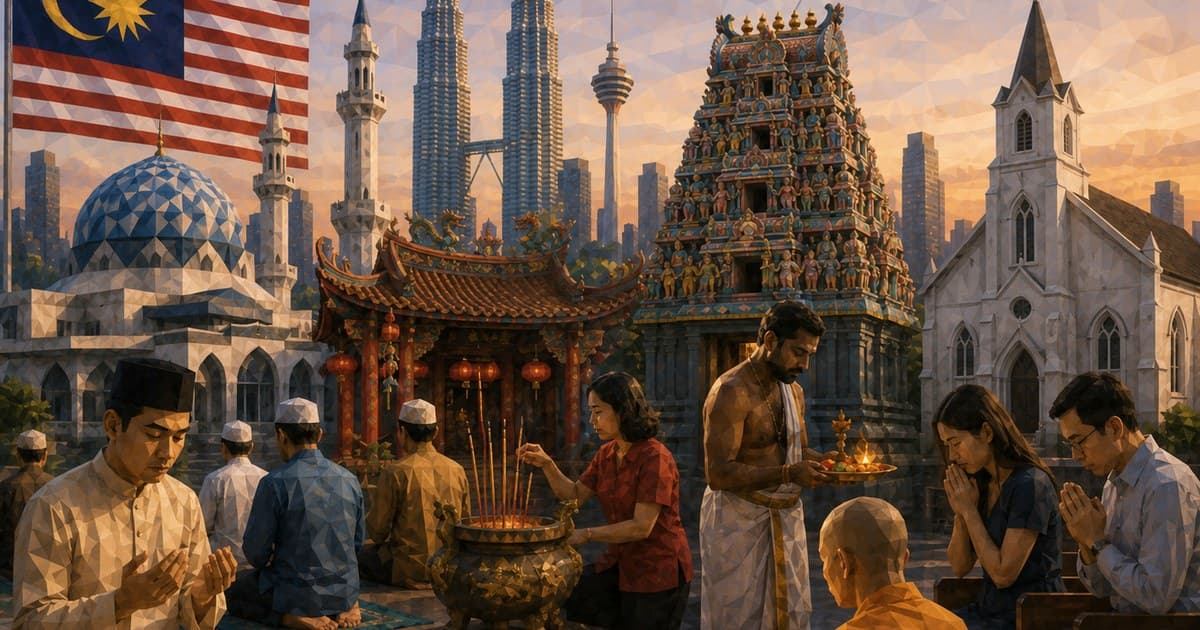
Sensitive topic: Religion in Malaysia is constitutionally and legally sensitive. Proselytising to Muslims is restricted or prohibited in most states, and insulting any religion can be an offence under the Penal Code and the Communications and Multimedia Act. This guide is educational, it is not legal or religious advice.
In This Guide
Malaysia’s Religious Landscape
Malaysia is one of the most religiously diverse countries in Southeast Asia, and faith is woven into almost every aspect of public life, the calendar of public holidays, the food on the table, the way people dress, the architecture of the skyline, and even the structure of the legal system. For visitors and expats, understanding the religious landscape is essential to understanding Malaysia itself.
The country's diversity is a product of its history: indigenous animist traditions, the arrival of Hinduism and Buddhism through Indian and regional trade more than a thousand years ago, the coming of Islam to the Malay world from the 13th century, and the Christian missions and Chinese and Indian migration of the colonial era. Today these layers coexist, sometimes harmoniously and sometimes uneasily, within a single nation.
Religion by the numbers (2020 Census, DOSM):
| Religion | Share of population | Practised mainly by |
|---|---|---|
| Islam | 63.5% | Malays, most indigenous Bumiputera, some Indians |
| Buddhism | 18.7% | Chinese Malaysians |
| Christianity | 9.1% | Chinese, Indians, Sabah/Sarawak natives |
| Hinduism | 6.1% | Indian Malaysians |
| No religion | 1.8% | Mixed (often Chinese who don't identify with one label) |
| Other religions | 0.9% | Sikhs, Baháʼís, Confucianism/Taoism/folk, animists |
The total population recorded in the 2020 Census was 32.4 million (including non-citizens). Note that the "Buddhist" figure absorbs much of what is really a blend, many Chinese Malaysians who register as "Buddhist" also follow Taoism, Confucianism and ancestral worship, so Taoism and Chinese folk religion are undercounted because the census forces a single choice.
The 2010-to-2020 shift: Islam's share rose from 61.3% (2010) to 63.5% (2020), a 2.2-point increase driven mainly by the higher birth rate among the Malay-Muslim majority. Over the same period Buddhism and Hinduism edged down slightly as the Chinese and Indian share of the population shrank.
Religion and ethnicity are tightly linked. Under the constitution, a "Malay" is by definition a person who professes Islam, habitually speaks Malay and follows Malay custom (Article 160). This means religion in Malaysia is rarely just a private spiritual matter, it is bound up with ethnic identity, politics and law.
Religion State by State
Malaysia's religious map is sharply regional. Because Islam is administered at state level, and because ethnic communities are unevenly distributed, the religious make-up of one state can look nothing like its neighbour's.
Religious composition by state (2020 Census, DOSM):
| State / territory | Muslim | Buddhist | Christian | Hindu |
|---|---|---|---|---|
| Terengganu | 97.3% | 2.0% | 0.3% | 0.2% |
| Kelantan | 95.5% | 2.8% | 0.4% | 0.2% |
| Sabah | 69.6% | 5.1% | 24.7% | 0.1% |
| Selangor | 61.1% | 21.6% | 4.9% | 10.3% |
| Penang | 45.5% | 37.6% | 4.3% | 8.4% |
| Kuala Lumpur | 45.3% | 32.3% | 6.4% | 8.2% |
| Sarawak | 34.2% | 12.8% | 50.1% | 0.2% |
(The balance in each row is "other religions / no religion / not stated".)
The patterns:
- The conservative east coast, Terengganu, Kelantan and Pahang's interior, is overwhelmingly Malay-Muslim, and both Kelantan and Terengganu are governed by the Islamist party PAS, which has the most assertive religious administration in the country.
- Penang is the most religiously mixed peninsular state, with no single religion holding a majority and a strong Buddhist-Chinese presence; Kuala Lumpur is similarly mixed and has a non-Muslim majority overall.
- Sarawak is the only Malaysian state with a Christian plurality (around half the population), a legacy of Anglican, Methodist, Roman Catholic and Borneo Evangelical (SIB) missions among the Iban, Bidayuh and Orang Ulu. Christianity in Borneo is often conducted in Malay/Iban, which is why the "Allah" word dispute hit Sarawak Christians especially hard.
- Sabah is genuinely plural, a Muslim majority alongside one of the largest Christian communities in the country (Kadazan-Dusun, Murut and others). Roughly two-thirds of all Malaysian Christians live in Sabah and Sarawak.
This regional variation matters in practice: moral-policing enforcement, the strictness of halal rules, the visibility of non-Muslim places of worship, and even the local public-holiday calendar all differ between, say, Kota Bharu and Kuching.
A Religious History of the Malay World
Malaysia's religious diversity is the accumulated sediment of more than two thousand years of trade, migration and empire.
Animism (earliest era): The original peoples of the peninsula (Orang Asli) and Borneo followed animist belief systems centred on nature spirits, ancestors and the rice cycle, traditions that survive among some communities and in festivals like Sabah's Kaamatan and Sarawak's Gawai Dayak.
The Hindu-Buddhist era (roughly 2nd-13th centuries): Indian traders and the great maritime empires brought Hinduism and Buddhism to the region. The Buddhist-Hindu thalassocracy of Srivijaya (centred on Sumatra) dominated the Straits of Melaka, and the Bujang Valley in Kedah preserves temple ruins (candi) dating back well over a millennium, Malaysia's richest archaeological evidence of this period. Sanskrit loanwords still pepper the Malay language.
The coming of Islam (from the 13th century): Islam spread through Muslim traders from Arabia, India and China and was firmly established when the Melaka Sultanate (founded c. 1400) adopted Islam in the early 1400s under rulers such as Parameswara/Megat Iskandar Shah. Melaka became a hub from which Islam radiated across the archipelago, and the sultanate model, a Muslim ruler as protector of the faith, became the template for the Malay states.
Colonial Christianity and migration (16th-20th centuries): The Portuguese capture of Melaka (1511), followed by the Dutch and then the British, brought Christianity, first Catholicism, later a wide range of Protestant denominations. Under British rule in the 19th and early 20th centuries, large-scale migration of Chinese (bringing Buddhism, Taoism and Confucianism) and Indian labourers (bringing Hinduism, plus Sikhism via Punjabi migrants) created the plural society of today. Christian missions were active especially in Borneo, where they reshaped the religious life of many indigenous peoples.
Independence and after (1957 onwards): The 1957 Merdeka constitution named Islam the religion of the Federation while protecting other faiths. From the 1970s and especially the 1980s Islamic revival (dakwah movement), Islam became a more prominent feature of public and political life, a trajectory explored in the politics section below.
Religion and the Constitution
The legal status of religion in Malaysia rests on a small number of constitutional provisions that have been debated ever since independence.
Article 3, Islam as the religion of the Federation:
Article 3(1) states that "Islam is the religion of the Federation; but other religions may be practised in peace and harmony in any part of the Federation." This single sentence captures the balance Malaysia tries to strike, an official Islamic identity alongside protected pluralism.
Crucially, the founding Reid Commission (which drafted the 1957 constitution) recorded that naming Islam as the official religion was intended for ceremonial and symbolic purposes, and "shall not imply that the State is not a secular State." Whether Malaysia is a secular state or an Islamic state has been argued by politicians, judges and scholars ever since, and there is no settled answer.
Article 11, Freedom of religion:
Article 11 guarantees every person the right to profess and practise their religion. However, Article 11(4) allows states to pass laws controlling or restricting the propagation of any religious doctrine among Muslims. This is the constitutional basis for the laws in most states that prohibit non-Muslims from proselytising to Muslims.
Other relevant provisions:
- Article 12, no discrimination in education on grounds of religion, but every religious group has the right to establish institutions for the education of children in its own religion.
- Article 160, defines "Malay" as a Muslim, tying ethnicity to faith.
- List II (State List), Islamic law and the administration of Islamic affairs are matters for each state, not the federal government. This is why religious rules differ from state to state.
The Conference of Rulers and the nine Malay Rulers are the heads of Islam in their respective states; the Yang di-Pertuan Agong (King) is head of Islam for the federal territories, Penang, Melaka, Sabah and Sarawak.
The Dual Legal System: Civil vs Syariah Courts
One of the most important things to understand about Malaysia is that it runs two parallel court systems.
Civil courts apply to everyone, regardless of religion, and handle the criminal law, commercial disputes, constitutional matters and the affairs of non-Muslims.
Syariah (Shariah) courts apply only to Muslims and only in specific areas, primarily family law (marriage, divorce, custody, inheritance), and certain religious offences such as khalwat (close proximity between unmarried couples), failing to fast in Ramadan, consuming alcohol, and apostasy. Syariah courts cannot try non-Muslims.
Where the two systems collide:
Problems arise in mixed situations, for example when one spouse in a non-Muslim marriage converts to Islam, raising questions about which court decides the divorce, the custody of children, and the religion of those children. Landmark cases include:
- Lina Joy (2007), a Malay woman who converted to Christianity was told by the Federal Court that only the syariah court could authorise her to leave Islam, effectively making it impossible for her to change her religion on her identity card.
- M. Indira Gandhi (2018), the Federal Court ruled that the unilateral conversion of children to Islam by one parent was unlawful, an important win for the civil-court side of the divide.
- Nik Elin Zurina v Kelantan (2024), in a landmark 8-1 decision on 9 February 2024, the Federal Court struck down 16 provisions of Kelantan's Syariah Criminal Code (I) Enactment 2019 as unconstitutional, ruling that the state had legislated on matters reserved for federal (civil) law. It was the first successful challenge of its kind and reaffirmed that state syariah law cannot stray into areas covered by federal criminal law.
Article 121(1A): A 1988 constitutional amendment stated that the civil High Courts "shall have no jurisdiction in respect of any matter within the jurisdiction of the Syariah courts." This has been at the centre of decades of legal argument over which court has the final say.
For visitors and expats, the practical takeaway is simple: as a non-Muslim you fall under civil law. Syariah offences do not apply to you. But sensitivities around conversion, religious freedom and "interfaith" disputes run deep in Malaysian public debate.
Conversion, Apostasy & the Landmark Cases
Few areas of Malaysian law are as fraught as religious conversion. Converting into Islam is administratively simple. Converting out of Islam (apostasy, or murtad) is, in practice, almost impossible, and the leading court cases have shaped where the boundary lies.
Lina Joy (Federal Court, 2007): Azlina Jailani, born Muslim, converted to Christianity and sought to remove "Islam" from her MyKad (identity card). In a 2-1 decision the Federal Court held that the National Registration Department could not change her religious status without a certificate or order from the syariah court, effectively meaning a Muslim cannot unilaterally leave Islam through the civil system. It remains the defining apostasy precedent.
M. Indira Gandhi (Federal Court, 2018): After her husband converted to Islam and unilaterally converted their three children, the Federal Court ruled that a single parent cannot unilaterally convert a child to Islam, both parents' consent is required, and reaffirmed that the civil courts retain the power of judicial review over administrative religious decisions. A major win for the civil-court side of the divide. (One of the children, Prasana Diksa, taken by the father, has still not been returned years later.)
Rosliza Ibrahim (Federal Court, 2021): Led by then-Chief Justice Tengku Maimun Tuan Mat, the court declared Rosliza, raised Buddhist by her mother, not a Muslim. Crucially, this was not an apostasy ruling: the court found she had never been a Muslim (her parents were not validly married under Islamic law), so the syariah courts had no jurisdiction over her in the first place. The case illustrates the narrow path: civil courts will declare someone non-Muslim only if they were never genuinely Muslim, not if they wish to leave Islam.
Unilateral child conversion: Beyond Indira Gandhi, the conversion of children when one parent embraces Islam has been a recurring flashpoint (the earlier Subashini and Shamala cases raised the same issues). A 2017 federal bill to bar unilateral conversion was tabled but the key clause was withdrawn, leaving the matter to be governed by case law and individual state enactments.
Apostasy as an offence: Several states treat attempting to leave Islam as a syariah offence, and some operate "faith rehabilitation" (akidah) centres. There is no uniform federal apostasy law; the rules differ by state, which is why outcomes can vary depending on where a person lives.
The landmark cases at a glance:
| Case | Court / year | What it decided |
|---|---|---|
| Lina Joy | Federal Court, 2007 (2-1) | A Muslim cannot leave Islam via the civil system; only the syariah court can certify apostasy. |
| Indira Gandhi | Federal Court, 2018 | One parent cannot unilaterally convert a child to Islam; civil courts keep judicial review over religious bodies. |
| Rosliza Ibrahim | Federal Court, 2021 | Declared never a Muslim (not apostasy), so syariah courts had no jurisdiction over her. |
| Nik Elin v Kelantan | Federal Court, 2024 (8-1) | Struck down 16 Kelantan syariah criminal provisions as beyond state legislative power. |
Religion and Politics
Religion and politics are deeply entangled in Malaysia, and the relationship has grown more so over the past four decades. This section describes the landscape neutrally; it is not an endorsement of any side.
The Islamic revival and the "Islamisation race": From the 1970s a global Islamic revival reached Malaysia through the dakwah movement. Through the 1980s and 1990s the ruling UMNO (under Mahathir Mohamad, with Anwar Ibrahim then a rising Islamist figure he had recruited) and the opposition Islamist party PAS competed to demonstrate Islamic credentials, expanding Islamic institutions, Islamic banking, the International Islamic University, and JAKIM's reach. In 2001 Mahathir declared Malaysia an "Islamic state" as a political statement, though the constitution was unchanged.
PAS and hudud: PAS, which governs Kelantan (continuously since 1990) and Terengganu, has long campaigned for syariah criminal law (hudud). Its repeated attempts to enforce a hudud enactment in Kelantan have been blocked because Islamic criminal law is constitutionally limited. In February 2024 the Federal Court underlined that limit in Nik Elin Zurina v Kelantan, striking down 16 provisions of Kelantan's 2019 syariah criminal enactment as beyond state powers, though Kelantan's assembly moved to re-legislate the offences.
RUU355: PAS president Abdul Hadi Awang tabled a private member's bill (introduced in 2016) to amend the Syariah Courts (Criminal Jurisdiction) Act 1965 ("Act 355"), seeking to raise the maximum syariah punishments from the current 3 years' jail / RM5,000 fine / 6 strokes, earlier versions proposed ceilings as high as 30 years' jail, RM100,000 fine and 100 strokes. Supporters frame it as strengthening syariah courts; non-Muslim bodies (including the MCCBCHST) and civil-society groups oppose it as a step toward harsher religious enforcement. The bill has not been passed.
The "green wave" (GE15, 2022): At the 15th General Election on 19 November 2022, PAS won 49 parliamentary seats, the most of any single party, and its Perikatan Nasional coalition surged, a result widely dubbed the "green wave" (green being PAS's colour). No bloc won a majority, producing Malaysia's first hung parliament. Anwar Ibrahim was sworn in as the 10th Prime Minister on 24 November 2022, leading a "unity government" of Pakatan Harapan, Barisan Nasional (UMNO) and the East Malaysian coalitions. The result intensified debate about the role of religion in national politics.
The bottom line for residents: Day-to-day life for non-Muslims is governed by civil law and is largely unaffected by these debates, but religion is a permanent and sensitive feature of the political conversation.
Interfaith Bodies & Dialogue
Malaysia's interfaith landscape is built more on quiet coexistence and festival "open houses" than on formal national machinery, and an attempt to create such machinery failed.
The MCCBCHST: The principal interfaith body for non-Muslims is the Malaysian Consultative Council of Buddhism, Christianity, Hinduism, Sikhism and Taoism, founded in 1983 (originally as the Council of Buddhism, Christianity, Hinduism and Sikhism; Taoism was formally added in 2006, when the present name was adopted). It speaks collectively for the non-Muslim religions in dialogue with government, comments on legislation (it has, for example, opposed RUU355), and represents minority religious interests. JAKIM and the state Islamic authorities operate separately, on the Muslim side.
The Inter-Faith Commission that never was: In 2005 the Bar Council convened a major conference at Bangi to propose a national Inter-Faith Commission (IFC), a statutory body to manage religious disputes. It drew more than 200 representatives from some 50 organisations, but a coalition of Muslim NGOs (ACCIN) opposed it, arguing it would promote religious pluralism and facilitate apostasy. Prime Minister Abdullah Badawi shelved the bill, redirecting effort toward festival open houses and a lower-profile cabinet committee to promote understanding and harmony among religious adherents (JKMPKA). A standing, independent national interfaith commission has never been established.
Article 11 coalition and civil society: A civil-society "Article 11" coalition campaigned in the mid-2000s for constitutional religious-freedom guarantees, but its forums were disrupted and the movement faded. Today interfaith dialogue is carried mainly by NGOs, universities, religious councils and goodwill events rather than by a formal state institution, and observers note such dialogue has become harder to sustain amid rising religious sensitivity.
Islam, The Majority Faith
Islam is the religion of about 63.5% of Malaysians and of essentially all ethnic Malays. The dominant tradition is Sunni Islam of the Shafi'i school, which is the official madhhab; Shia Islam and certain other movements are not officially recognised and in some states are restricted.
Islam in daily life:
- The call to prayer (azan) sounds five times a day from mosques nationwide.
- Friday (Jumaat) prayers are the most important of the week; many Muslim-owned businesses and government counters pause roughly 12:30-2:30pm.
- Ramadan, the fasting month, reshapes daily rhythms, Ramadan bazaars appear everywhere, and the celebration of Hari Raya Aidilfitri at its end is the biggest holiday of the Malaysian year.
- Halal food rules and modest dress are widely observed.
Notable mosques: Masjid Negara (National Mosque, KL), Masjid Putra (the "Pink Mosque", Putrajaya), Masjid Sultan Salahuddin Abdul Aziz (the "Blue Mosque", Shah Alam), and the floating Masjid Tengku Tengah Zaharah in Terengganu.
For the full picture, history, schools of thought, syariah, festivals, mosque etiquette and current debates, see the dedicated **Islam in Malaysia guide**.
Buddhism, Taoism & Chinese Folk Religion
Among Chinese Malaysians, religion is typically a fluid blend of Mahayana Buddhism, Taoism, Confucian ethics and ancestral worship, many people practise all of them without seeing a contradiction. This is why census figures, which force a single choice, tend to record most Chinese as "Buddhist" while undercounting Taoism and folk religion.
Buddhism (18.7%) in Malaysia includes Mahayana (the majority, of Chinese origin), Theravada (followed by Thai, Sinhalese, Burmese and some Chinese communities), and Vajrayana (Tibetan) traditions. The biggest Buddhist celebration is Wesak Day, a national public holiday marking the Buddha's birth, enlightenment and passing.
Taoism and Chinese folk religion centre on temples dedicated to deities such as Mazu (the sea goddess), Guan Yin (the goddess of mercy), and the Datuk Kong local guardian spirits, a uniquely Malaysian fusion. Festivals such as the Nine Emperor Gods Festival and the Hungry Ghost Festival are major events.
Notable temples: Kek Lok Si (Penang, one of Southeast Asia's largest Buddhist temples), Thean Hou Temple (KL), Sam Poh Tong (Ipoh), and the Snake Temple (Penang).
See the dedicated **Buddhism guide and Taoism, Confucianism & Chinese folk religion guide** for the full detail.
Christianity
Christians make up about 9.1% of Malaysians, but the distribution is highly uneven. In Sabah and Sarawak, Christianity is the largest or second-largest religion, the legacy of 19th- and 20th-century missions among the indigenous Kadazan-Dusun, Iban, Bidayuh and other peoples. In Peninsular Malaysia, Christianity is followed mainly by Chinese and Indian Malaysians.
The community spans Roman Catholic and a wide range of Protestant denominations (Anglican, Methodist, Borneo Evangelical/SIB, Basel, Lutheran, and fast-growing Pentecostal and independent churches).
Sensitive issues: The use of the word "Allah" by Christians (long standard in Malay- and Iban-language Bibles, especially in Borneo) has been the subject of major legal battles. The Catholic weekly The Herald fought a long case after a 2007-2008 Home Ministry ban; the High Court ruled in its favour in 2009, but the Court of Appeal reversed that in 2013, and on 23 June 2014 the Federal Court dismissed the Church's leave to appeal in a narrow 4-3 split, leaving the ban on the paper using "Allah" in place. In a separate case, the Kuala Lumpur High Court ruled on 10 March 2021 in favour of Jill Ireland Lawrence Bill, a Sarawakian (Melanau) Christian whose CDs had been seized, quashing the 1986 directive and affirming her right to use "Allah" (and the words Baitullah, Kaabah and Solat) in religious materials for personal/educational use; the government's appeal against that ruling was withdrawn in May 2023. The earlier "10-point solution" (2011) already allowed the import and printing of the Malay-language Bible (Alkitab), though tensions remain in the peninsula.
Christmas and Good Friday are widely celebrated; Christmas is a national public holiday and Good Friday is a public holiday in Sabah and Sarawak.
See the dedicated **Christianity in Malaysia guide** for history, denominations, the Borneo church and current debates.
Hinduism
Hinduism is practised by about 6.1% of Malaysians, overwhelmingly Indian Malaysians descended from Tamil labourers brought to the rubber and sugar estates during the British colonial period, alongside older trading communities.
Malaysian Hinduism is vibrant and visible: ornate gopuram-towered temples, the spectacular Thaipusam pilgrimage at Batu Caves (where devotees carry kavadi up 272 steps), and the festival of lights Deepavali, a national public holiday.
Notable temples: Batu Caves Sri Subramaniar Temple (KL's most famous Hindu site), Sri Mahamariamman Temple (KL's oldest, in Chinatown), and Arulmigu Balathandayuthapani Temple (Penang).
Temple administration, estate-community heritage and the rights of the Indian Malaysian community are recurring social and political themes. See the dedicated **Hinduism in Malaysia guide** for the full picture.
Sikhism, Baháʼí & Other Faiths
Beyond the four largest religions, Malaysia is home to several smaller but well-established faith communities.
Sikhism: Brought by Punjabi migrants who served in the colonial police and military and worked in various trades, the Sikh community numbers in the tens of thousands. Gurdwaras across the country are known for their langar (free community kitchen) open to all, and Vaisakhi is the main celebration. See the **Sikhism in Malaysia guide**.
The Baháʼí Faith: One of Malaysia's oldest organised minority religions, present since the 1950s with communities in every state, including notable membership among indigenous peoples in Sabah. See the **Baháʼí Faith in Malaysia guide**.
Indigenous and animist traditions: Before the world religions arrived, the peoples of the Malay Peninsula and Borneo followed their own belief systems. Some indigenous communities, particularly among the Orang Asli of the peninsula and various groups in Sabah and Sarawak, still maintain animist traditions, ancestral reverence, and agricultural festivals such as Gawai Dayak (Sarawak) and Kaamatan / Pesta Kaamatan (Sabah's Kadazan-Dusun harvest festival, honouring the rice spirit Bambaazon). See the **Indigenous beliefs guide**.
New Age and "no religion": A small but growing minority, especially younger, urban Malaysians, identify as spiritual-but-not-religious, agnostic, atheist, or follow New Age practices (yoga, meditation, mindfulness, alternative spirituality). For Muslims, openly leaving Islam remains legally and socially fraught, so irreligion among the Malay-Muslim majority is rarely public.
Religious Education
Religion is a significant part of Malaysia's education system, especially for Muslims.
Islamic education in national schools: Islamic Studies (Pendidikan Islam) is a compulsory subject for Muslim pupils in government schools; non-Muslim pupils take Moral Education (Pendidikan Moral) instead. Quranic recitation and jawi (Arabic-script Malay) feature in the syllabus.
Sekolah agama and tahfiz schools: Beyond the national system sit thousands of religious schools, government religious schools (SMKA / sekolah agama bantuan kerajaan), state religious schools, and large numbers of private and independent tahfiz schools where children memorise the Quran. Many tahfiz schools are privately run and lightly regulated.
Tahfiz safety: Regulation became a national issue after the Darul Quran Ittifaqiyah fire in Kampung Datuk Keramat, Kuala Lumpur, on 14 September 2017, which killed 23 people, 21 students and 2 teachers, trapped behind grilled windows. It was found to be operating without proper permits and was started deliberately by a group of teenagers (one was later convicted of 23 counts of murder). The tragedy prompted calls for stricter fire-safety and licensing rules for religious boarding schools.
Mission and vernacular schools: Malaysia retains a network of Christian mission schools (many now government-aided national schools that keep their heritage names, e.g. the various St John's, Methodist and Convent schools) and Chinese and Tamil vernacular primary schools, which carry their own cultural and, historically, religious character.
Higher Islamic education: Institutions such as the International Islamic University Malaysia (IIUM/UIA) and Universiti Sains Islam Malaysia (USIM) provide tertiary Islamic education, while non-Muslim communities run their own seminaries and Bible/Buddhist colleges.
The Halal Economy
Halal in Malaysia is both a religious requirement and a major industrial policy and export sector, and the country positions itself as a global halal hub.
Scale: Malaysia's halal product exports reached a record RM61.79 billion in 2024, up about 15% on the year before (RM53.72 billion in 2023). Under the Halal Industry Master Plan, the government targets the sector to contribute around 10.8% of GDP (roughly RM231 billion) by 2030. Globally, Malaysia has topped the Global Islamic Economy Indicator for ten consecutive years.
Certification: JAKIM's halal certification is the gold standard, and JAKIM in turn recognises some 88 foreign halal certification bodies across roughly 49 countries (as of late 2024), giving Malaysian-certified products international reach. Categories covered include food and beverages, pharmaceuticals, cosmetics, logistics and even Islamic tourism.
Why it matters in daily life: The halal logo is ubiquitous on packaging and restaurant signage. Major fast-food and retail chains seek JAKIM certification; mislabelling or misusing the logo is an offence. For Muslim consumers it is a daily marker of what they can eat and use; for businesses it is a passport to the Muslim-majority domestic market and to export markets across the Islamic world. Beyond halal, Islamic finance (sukuk, takaful, Islamic banking) is another pillar in which Malaysia is a recognised global leader.
Blasphemy, "Insult to Religion" & the 3R
Speech about religion is legally risky in Malaysia, and the law applies to insults against any religion, not Islam alone.
The 3R: Race, Religion and Royalty are the three recognised "sensitive" subjects of public life. Authorities treat content touching these as potentially seditious or inflammatory, and police regularly open investigations into social-media posts that are seen to cross the line.
The main laws:
- Penal Code sections 298 and 298A, uttering words or doing acts that wound religious feelings, or causing disharmony on religious grounds.
- Sedition Act 1948, still in force, and used against speech deemed to promote ill-will between religions or communities.
- Communications and Multimedia Act 1998, section 233, the most commonly used provision for online content deemed offensive, with potential fines and jail.
- State syariah enactments, separately criminalise acts like insulting Islam or its officials, applicable to Muslims.
In practice: Prosecutions and investigations frequently follow viral posts, over things like jokes about religious figures, food images posted during Ramadan, cartoons, or comments perceived as mocking a faith, and these have involved Muslims and non-Muslims alike. The lesson for residents and visitors is simple and consistent: do not post or publicly comment on religious controversies. Even well-meaning content can be reported and investigated, and "I didn't mean to offend" is not a reliable defence.
Death, Dress & Food Across Faiths
For the practical reader, newcomers, expats and respectful visitors, here is how some everyday-yet-sensitive matters differ across Malaysia's faith communities.
Death and burial:
- Muslims are buried (not cremated), usually within 24 hours, in a Muslim cemetery; embalming is generally avoided. The body of a person registered as Muslim is handled by the religious authorities, a point that has caused painful disputes when a deceased's religion is contested.
- Chinese (Buddhist/Taoist) funerals may involve elaborate wakes, joss-paper offerings and either burial or cremation; the Qingming (tomb-sweeping) festival is when families tend ancestral graves.
- Hindus almost always cremate, often the same or next day, and observe specific mourning rites.
- Christians hold church funerals followed by burial or cremation.
Religious dress:
- Many Muslim women wear the tudung (headscarf); the niqab (face veil) is much less common. Modest dress is the norm in Muslim settings and required in mosques.
- Sikh men typically wear the turban (dastar) and keep uncut hair.
- Hindu married women may wear the thali and a bindi; saris are common at temples and festivals.
- There is no national dress code in public, but government offices, mosques and some temples enforce modest-dress rules (covered shoulders and knees).
Food taboos to know:
- Muslims eat only halal food, no pork, no alcohol, and meat slaughtered Islamically. This is the most widely observed taboo and shapes most public dining.
- Hindus generally avoid beef (the cow is sacred); many are vegetarian, especially during festivals.
- Buddhists/Taoists, many observe vegetarian days; some are strictly vegetarian.
- Practical etiquette: when hosting or being hosted, check dietary restrictions in advance, don't offer pork or alcohol to Muslims or beef to Hindus, and note that many eateries are clearly marked halal, non-halal, or vegetarian.
Religious Freedom, Harmony & Tensions
Malaysia's official narrative is one of religious harmony, symbolised by the way Hari Raya, Chinese New Year, Deepavali and Christmas "open houses" bring neighbours of all faiths together. For the most part, daily interfaith coexistence in Malaysia is genuine and warm.
But there are real and recurring tensions:
- Proselytising to Muslims is prohibited or restricted by state law; the reverse (dakwah, inviting non-Muslims to Islam) is encouraged.
- Conversion and apostasy disputes, especially involving children of converts, periodically reach the courts and the headlines.
- The "Allah" word controversy over Christian and Sikh use of the term.
- Moral policing by some state religious authorities (raids on khalwat, dress codes) applies to Muslims.
- Periodic flashpoints such as temple relocations, the status of unregistered places of worship, and "insult to religion" complaints on social media.
Insulting religion is an offence. Section 298 and 298A of the Penal Code, the Sedition Act, and Section 233 of the Communications and Multimedia Act 1998 can all be used against speech deemed to insult or stir religious enmity, and they are applied to content about any religion. Visitors and residents should be especially careful what they post online about religious matters.
3R sensitivities, Race, Religion, Royalty, are the recognised "no-go" zones of Malaysian public discourse. Foreigners are strongly advised not to comment publicly or get involved in religious controversy.
A Visitor’s Guide to Places of Worship
Malaysia's mosques, temples, churches and gurdwaras are among its most beautiful and welcoming sights. A few simple courtesies go a long way.
General etiquette:
- Dress modestly, cover shoulders and knees. At mosques, women cover their hair; robes and scarves are usually provided free at the entrance.
- Remove your shoes before entering mosques, Hindu and Buddhist temples, and gurdwaras.
- Lower your voice; switch your phone to silent.
- Don't walk in front of, or photograph, people who are praying without permission.
- Many mosques close to non-Muslim visitors during the five daily prayer times and Friday prayers, check posted visiting hours.
By faith:
- Mosques, visiting hours are usually posted; some major mosques (e.g. Masjid Negara) run free guided tours. Avoid Friday around midday.
- Hindu temples, you may be asked to be vegetarian-respectful; leather items are sometimes discouraged. Photography rules vary.
- Chinese temples, generally relaxed; you can watch joss-stick offerings, but step around worshippers.
- Gurdwaras, cover your head (scarves provided), and you're welcome to share in the free langar meal.
- Churches, normal church courtesies; dress neatly for services.
Eating across faiths: halal (no pork/alcohol, Islamically slaughtered) is ubiquitous; many Chinese and Indian eateries are non-halal or vegetarian. When hosting or being hosted, it's polite to check dietary restrictions in advance.
Sources & References
Data in this guide is cross-referenced against the following official sources.
- Department of Statistics Malaysia (DOSM), Population & Housing Census 2020 Official census data on religion, ethnicity and the 63.5% Muslim figure.
- Federal Constitution of Malaysia (AGC) Articles 3, 11, 12, 121(1A) and 160 on religion and the courts.
- JAKIM, Department of Islamic Development Malaysia Federal Islamic authority and halal certification body.
- Malaysian Consultative Council of Buddhism, Christianity, Hinduism, Sikhism and Taoism (MCCBCHST) Principal interfaith body representing non-Muslim religions in dialogue with government.
- U.S. State Department, 2023 Report on International Religious Freedom: Malaysia Detailed survey of religious demography, law and freedom-of-religion issues.