
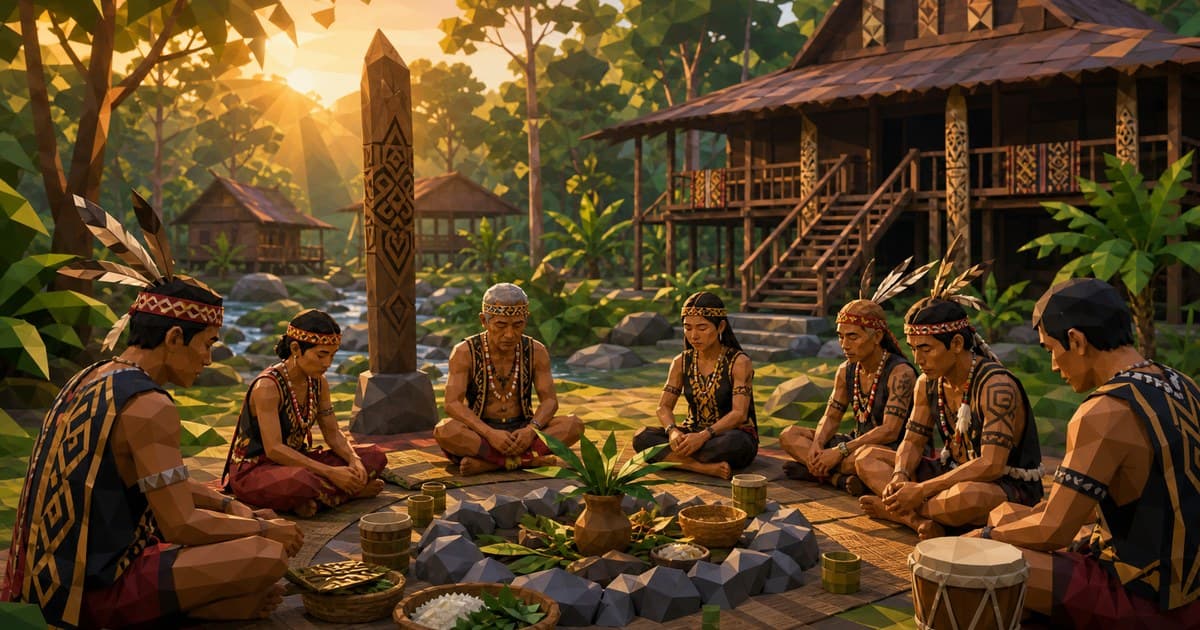
A note on respect: these are living cultures and faiths, not relics or folklore curiosities. Beliefs vary widely between and within communities, terms differ by district and language, and many indigenous Malaysians today are Christian or Muslim while still valuing ancestral custom (adat). This guide is an introduction written with care, it is not a substitute for the voices of the communities themselves, and any single figure or term should be treated as a starting point, not a final word.
In This Guide
The Older Spiritual World
Long before Islam, Hinduism-Buddhism and Christianity reached the Malay Archipelago, the peoples of the Peninsula and the island of Borneo lived within animist and ancestral belief systems, worldviews in which the land, forest, rivers, rice, weather and the dead are alive with spirit and meaning. This is, in effect, Malaysia's oldest layer of belief.
These belief systems were never a single "religion". They are local, plural and tied to place: a particular river, a particular mountain, a particular longhouse. They are carried in adat (customary law and proper conduct), in ritual specialists, in song and chant, in dreams, in taboos, and in the great communal festivals of the agricultural year.
Today most indigenous Malaysians identify as Christian or Muslim, and many traditions survive syncretically, folded into, or practised alongside, a world faith. Others have faded as elders pass and young people move to cities. But the festivals, the stories and the sense of obligation to land and ancestors remain a defining part of Malaysian identity, especially in Sabah and Sarawak.
Broadly, three indigenous worlds are covered here:
- Orang Asli, the indigenous peoples of Peninsular Malaysia.
- Kadazan-Dusun, Murut, Rungus, Lundayeh and others, the indigenous peoples of Sabah.
- Dayak (Iban, Bidayuh, Orang Ulu) and others, the indigenous peoples of Sarawak.
Why You Rarely See These Beliefs Counted
If you read Malaysia's religious statistics, animism and ancestral worship barely appear, yet they shaped the spiritual life of the country for millennia. There are a few reasons for this census invisibility:
- No tick-box of their own. National data tends to record Islam, Christianity, Buddhism, Hinduism and a residual "other / none". Traditional indigenous belief is usually folded into "other" or simply not separately enumerated, so its presence is systematically under-counted.
- Syncretism hides it. A person may record "Christian" on a form and still keep the harvest offerings, the dream beliefs and the taboos. The questionnaire sees one religion; the lived reality holds two layers.
- Conversion is real but uneven. Decades of Christian mission (especially in Borneo) and state-sponsored Islamic outreach (dakwah) have genuinely shifted affiliation, but custom (adat) often persists underneath the new label.
The honest position is that the number of strict traditional believers is small and shrinking, while the cultural footprint, festivals, foods, music, design, identity, remains huge and is celebrated far beyond the communities of origin.
At a Glance: Group, Region, Belief, Priest, Festival
A simplified map of the worlds covered in this guide. Reality is far richer, dozens of distinct peoples sit under each heading, each with its own language and local variation.
| Group | Region | Traditional religion | Key deities / spirits | Priest / shaman | Main festival |
|---|---|---|---|---|---|
| Orang Asli (Negrito, Senoi, Proto-Malay) | Peninsular Malaysia | Animism (varies by group) | Forest & nature spirits; thunder-deity complex; moyang (ancestors) | halak / halaa' / poyang / bomoh | Local rites; no single national festival |
| Kadazan-Dusun | Sabah & Labuan | Momolianism | Creator Kinoingan; rice spirit Bambarayon/Bambazon; Huminodun | bobohizan / bobolian | Pesta Kaamatan (30-31 May) |
| Murut, Rungus, Lundayeh | Sabah | Animism | Spirits of land, harvest & ancestors | local ritual specialists | Kaamatan & local rites |
| Iban ("Sea Dayak") | Sarawak | Iban traditional religion | Sengalang Burong (war/omens); Sempulang Gana (paddy); Selampandai (creator) | lemambang (bard); manang (shaman) | Gawai Dayak (1-2 Jun) |
| Bidayuh ("Land Dayak") | Sarawak | Animism | Paddy & guardian spirits | priest-leaders | Gawai / local gawea |
| Orang Ulu (Kayan, Kenyah, Kelabit) | Sarawak (interior) | Animism / Bungan reform | Sky & nature spirits; bird omens | aristocratic & ritual elders | Gawai & local festivals |
Festival dates are public holidays in their home states, Kaamatan in Sabah and Labuan, Gawai Dayak in Sarawak, and are now celebrated as cultural occasions by people of all faiths.
Orang Asli of the Peninsula
Orang Asli ("original people" in Malay) is the collective term for the indigenous minority peoples of Peninsular Malaysia, around 221,000 people (2024), well under 1% of the national population. The federal department JAKOA officially groups them into three broad categories, each with six recognised sub-groups (18 in total):
- Negrito (Semang), by far the smallest category (about 3% of all Orang Asli, on the order of 6,000-7,000 people), traditionally mobile hunter-gatherers of the northern forests and among the longest-resident peoples of the Peninsula; the six sub-groups are the Batek, Jahai, Kensiu, Kintaq, Lanoh and Mendriq.
- Senoi, the largest category (roughly 55% of all Orang Asli), historically practising shifting (swidden) hill agriculture; its six sub-groups are the Semai (the single largest Orang Asli people), Temiar, Jah Hut, Che Wong (Chewong), Semoq Beri and Mah Meri.
- Proto-Malay (Aboriginal Malay), the second-largest category (about 42%), peoples mostly of the centre and south such as the Temuan, Jakun, Semelai, Orang Kanaq, Orang Kuala and Orang Seletar (boat-dwelling people of the Johor-Singapore straits), culturally closer to coastal Malay life.
These category labels are administrative conveniences rather than self-chosen ethnic identities; communities identify first by their own sub-group name.
Traditional belief across these groups is broadly animist, though it differs from valley to valley: the natural world is inhabited by spirits, and right conduct toward the forest, rivers and animals keeps the world in balance. Recurring themes include a sense that land is a web of relationships, not property; a rich dream life through which spirits guide the living; and the central role of ritual specialists and ancestors. The sections that follow unpack the cosmology, the carvers, and the present-day pressures on land and faith.
Orang Asli Cosmology: Soul, Thunder & Taboo
The best-documented Orang Asli cosmologies are those of the Semai and Temiar (both Senoi). They are not identical, but share a recognisable shape.
- The soul. Many Senoi hold that a person has more than one soul-component, commonly a "head-soul" and a "heart-soul", that can wander, especially in sleep, and that illness or misfortune follows when a soul is lost, startled or stolen. Much ritual is about calling souls back and keeping them attached.
- Dreams. Dreams are not idle. They are a real channel of contact with spirits and spirit-guides (the Temiar speak of song and guidance received in dreams), and a source of healing power, hunting knowledge and new ceremonial songs.
- The thunder-deity complex. Across several Aslian peoples there is a powerful thunder being (recorded under names such as Karei / Enku / Engku in the literature) associated with violent storms. Mocking animals, mixing certain categories of things, or laughing at or tormenting creatures is widely believed to provoke catastrophe, thunder, lightning and flood. The Semai term for such a transgression and the disaster it invites is terlaid (also written tarlaid). The point is ethical as much as meteorological: it enforces restraint and respect toward other living things.
- Spirits of place. The Temiar describe powerful beings of the earth, rivers and trees. Forest, mountain and water are inhabited and must be treated with care.
These beliefs are remarkably consistent with the famous Semai ethos of non-violence and conflict-avoidance, a worldview in which provoking spirits, animals or other people all carry real danger.
The Halak & the Sewang Trance Ceremony
The mediator between the human and spirit worlds is the shaman-healer, known as halak or halaa' among the Temiar, poyang among some groups, and often referred to with the Malay word bomoh. The halak's power typically comes through dreams, in which a spirit-guide gives songs and helps; the shaman is healer, song-keeper and ritual leader rather than a "priest" of a fixed church.
The signature ceremony is the sewang (the Temiar genggulang and related rites), a night-time gathering of song, percussion and trance:
- Led by the halak, the community sings spirit-songs received in dreams, keeping rhythm with bamboo stamping-tubes.
- Through the singing the shaman may enter trance to contact spirit-guides, to heal the sick, recover a lost soul, seek guidance on a major decision, or restore harmony with the forest.
- It is bound by taboos and protocol: once underway, participants are expected to remain and to behave correctly, because the gathering is understood to be attended by spirits.
Today the sewang is sometimes performed to welcome guests, but for many Temiar and Semai it remains a serious healing and protective rite, and a living statement of their bond with the forest they are fighting to keep.
Spirit Carvings: Mah Meri & Jah Hut
Two Senoi peoples are renowned for a woodcarving tradition that is religious art, not souvenirs.
- Mah Meri of coastal Selangor, especially Pulau Carey (Carey Island), carve *masks and figures called moyang*, manifestations of ancestral and nature spirits* (muyang), each tied to a story (chita' muyang*). There are reportedly hundreds of named spirit-forms. The masks appear in rituals such as Hari Moyang (Ancestors' Day) and in the jo'oh dance. They are traditionally carved from the reddish heartwood of nyireh batu (a mangrove timber), the craft passed from father to son.
- Jah Hut of Pahang carve striking, sometimes deliberately grotesque figures representing spirits that cause illness (often glossed as bes). The carvings are bound up with healing and the diagnosis of spirit-caused sickness.
Both traditions are recognised nationally as fine art, the Mah Meri and their cultural village have UNESCO and tourism recognition, yet both are also under pressure, with fewer master carvers and, for the Jah Hut, a craft now described as rare. Buying directly from carvers, and understanding what a piece means, is the respectful way to engage.
Orang Asli: Land, Faith & Sensitivities
Orang Asli identity, land and religion are bound together, and politically sensitive.
- Land. Customary forest land is central to both livelihood and belief. Logging, plantations, dams and "development" have displaced communities and severed people from sacred and ancestral places. Native customary rights (NCR) to land were strengthened by the landmark Sagong Tasi case, in which Temuan villagers in Selangor, whose land was taken for the KLIA expressway, won recognition that their customary rights amount to a proprietary interest in the land itself, not merely a licence to use it. The Shah Alam High Court ruling (2002) was upheld by the Court of Appeal in 2005. In practice, however, NCR remains contested, under-protected and slow to enforce, and later cases have not always followed the same reasoning.
- Administration. The federal department JAKOA (Jabatan Kemajuan Orang Asli), under the Aboriginal Peoples Act 1954, oversees Orang Asli affairs. It is widely described as under-resourced, and its historical role has included assimilation and development programmes, while religious outreach (dakwah / Islamisation) toward Orang Asli, alongside Christian evangelism, has been a long-running source of tension, with advocates arguing it can pressure people away from their own beliefs.
- Self-determination. Indigenous-rights groups stress that conversion, schooling and "development" should not come at the cost of language, custom and land. Malaysia voted in favour of the UN Declaration on the Rights of Indigenous Peoples (UNDRIP).
The respectful posture for outsiders: Orang Asli beliefs are not a tourist spectacle, sacred sites are not photo backdrops, and these communities speak best for themselves.
Sabah: Kadazan-Dusun & the Rice Spirit
In Sabah, the largest indigenous grouping is the Kadazan-Dusun (the closely related Kadazan and Dusun peoples, often treated together), alongside the Murut, Rungus, Lundayeh and many others. Their traditional religion is known as Momolianism, centred on creator deities and a world divided between the seen material world (Pomogunan Tulun) and the unseen spirit world (Pomogunan Tosundu), with its spiritual roots traced to the ancestral homeland of Nunuk Ragang.
Key elements:
- Kinoingan / Kinorohingan (with his consort, often named Sumundu / Suminundu), the supreme creator(s). In the central myth, his daughter Huminodun (Ponompulan) willingly sacrifices herself so that humanity may have food; from her buried body grow rice and other staple crops. Rice is therefore sacred, a gift of self-sacrifice, not a mere commodity.
- Bambarayon / Bambazon, the rice (paddy) spirit, understood as the manifestation of Huminodun dwelling in the grain and the harvest. Honouring and recalling this spirit is the heart of the harvest rites.
- Bobohizan / bobolian, the high priestess (bobohizan is the Kadazan term, bobolian the Dusun; usage varies by district), a ritual specialist and spirit medium who chants the vast sacred oral liturgy (rinait / inait), heals, and mediates between the human and spirit worlds. Their knowledge can take a lifetime to master and is now critically endangered, as very few young people train.
Most Kadazan-Dusun today are Christian (many Roman Catholic) or Muslim, yet the rituals, the rice myth and above all the harvest festival endure as a shared cultural inheritance for all Sabahans.
Pesta Kaamatan & the Magavau Rite
Pesta Kaamatan (Tadau Kaamatan) is the Harvest Festival, observed through May and culminating on 30-31 May, a public holiday in Sabah and the Federal Territory of Labuan. It is at once a thanksgiving for the rice harvest, a remembrance of Huminodun's sacrifice, and an honouring of the rice spirit Bambarayon.
- Magavau. The most sacred rite, traditionally led by the bobohizan, is a ceremony to call the rice spirit home, to gather any portion of Bambarayon's essence lost or scattered during harvesting and restore it, ensuring the next season's fertility. It is the spiritual core beneath the public festivities.
- Unduk Ngadau. A cultural beauty pageant that honours Huminodun, the maiden whose self-sacrifice gave rice; finalists from across Sabah compete at the state level. It is the festival's most visible modern event.
- Sumazau and music. The graceful, bird-like sumazau dance, performed to gong ensembles, is the signature dance of Kaamatan.
- Tapai and lihing. Home-brewed rice wines, tapai and the prized Kadazan lihing, are central to hospitality and to the offerings.
Kaamatan is now celebrated by Sabahans of every faith and ethnicity as a festival of regional identity, with open houses, food, sport and music, while the older rites continue quietly within it.
Murut, Rungus & Lundayeh
Beyond the Kadazan-Dusun, Sabah holds dozens of other peoples, several with strong animist roots:
- Murut, peoples of the southwestern interior (the Murut Tahol and others). Traditional Murut belief holds that spirits govern human life, and ritual surrounds birth, marriage, farming, hunting and death; ancestral and guardian beings (in some accounts associated with figures such as Aki Kaulung) feature in their cosmology. Christianity reached the Murut from the 1890s; many are now Christian, some Muslim.
- Rungus, of the Kudat peninsula, among the most tradition-minded of Sabah's peoples, long famous for their longhouses (historically very large, though now much smaller) and for distinctive beadwork and brassware. Originally animist, most Rungus are now Protestant Christian, with Catholic, Muslim and traditionalist minorities.
- Lundayeh / Lun Bawang, highland people of the Sabah-Sarawak-Kalimantan borderlands. Once animist, the great majority became Christian from around the 1930s onward through the Borneo Evangelical Mission (founded in Australia in 1928, with missionaries reaching Borneo's interior from the late 1920s; the church today is largely the Sidang Injil Borneo / Borneo Evangelical Church, Malaysia's biggest Protestant body), a conversion often credited within these communities with ending older cycles of feuding and heavy rice-wine drinking.
The pattern across Sabah is consistent: deep animist foundations, large-scale 20th-century conversion to Christianity or Islam, and the survival of adat, festival and craft as living culture.
Sarawak: The Dayak World
Dayak is an umbrella term for the indigenous peoples of Sarawak (and Borneo broadly). The largest are the Iban (historically "Sea Dayak"), the Bidayuh ("Land Dayak"), and the various Orang Ulu ("upriver people") of the interior, among them the Kayan, Kenyah and Kelabit.
Traditional Iban religion is the best-documented and centres on a supreme being and a pantheon of petara, deities or regents who act as intermediaries between humans and the divine. Among the most important:
- Sengalang Burong (Singalang Burong), the great god of war and omens, chief of the augury birds and apex of the spirit world.
- Sempulang Gana (Simpulang Gana), the principal god of paddy, land and agriculture, to whom farming rites are addressed.
- Selampandai, the maker / shaper of humankind, a divine smith.
- Other named petara govern medicine and shamanism (Menjaya, the first manang), justice, and wealth.
The Iban also kept a class of charms (pengaroh), stones, woods and objects believed to hold protective power, frequently received from spirits in dreams. Two great ritual practices, augury and the miring offering, structured daily life; both are detailed in the next section.
Most Dayak today are Christian; a minority of Iban are Muslim; and traditional rites persist most strongly in rural longhouse communities.
Augury, the Omen Birds & the Miring Offering
Two practices defined everyday traditional Iban spirituality, and both turned on reading and pleasing the unseen.
- *Augury (interpreting omens, beburong*). The will of the gods was read in the natural world, above all in the calls and flight of seven omen birds (burung mali), regarded as the messengers and son-in-law spirits of Sengalang Burong. The names usually given are the Ketupong, Beragai, Bejampong, Embuas, Pangkas, Kelabu Papau (Senabong) and Nendak, though the exact line-up and ranking vary between districts and tellings (some lists treat Nendak as a separate messenger). Each is identified with a real forest bird (the Ketupong with the rufous piculet, the Nendak with the white-rumped shama, and so on). Their sounds, the side they flew from, and their behaviour told whether to farm, travel, build, marry or go to war**, or to wait. A "bad bird" could halt a project entirely.
- The miring (offering ceremony). In miring, arrangements of food, drink and betel called piring are laid out and presented to the gods and spirits, before important undertakings, at festivals, and in times of crisis, to seek blessing and protection. It remains widely performed today, including at Gawai.
- The manang (shaman). Distinct from the bard, the manang is the Iban healer who diagnoses spirit-caused illness and conducts the pelian healing rites, typically working to locate and restore a sick person's wandering soul, sometimes using a quartz "seeing-stone". Menjaya, the first manang in the petara pantheon, is the divine patron of this calling.
- The lemambang (bard). Iban ritual is sung. The lemambang is the ceremonial bard who chants the long sacred narratives, the timang and pengap invocation-chants that summon the gods to a feast and recount the deeds of the spirit world. Like the bobohizan's rinait, this oral repertoire is immense and endangered as the number of trained bards falls.
This is the key cultural point: "religion" here was not a weekly service but a constant reading of the world, birds, dreams, offerings, woven through farming, travel and the seasons.
Gawai: Harvest & the Festival of the Dead
The Iban word gawai means "festival" or "ritual feast", and traditional Iban life was punctuated by a whole calendar of them, for farming, fortune, healing, weaving and the dead.
- Gawai Dayak, the harvest thanksgiving, celebrated on 1-2 June, a public holiday in Sarawak. Rooted in gratitude to the gods of the paddy at the close of the rice season, it is today a pan-Dayak celebration of identity. In its modern, official form it was gazetted in 1964 and first celebrated on 1 June 1965 (championed by Dayak leaders such as Tra Zehnder), partly as a unifying alternative to the more contested idea of a "Dayak National Day". Expect a miring offering, the ngajat dance (the warrior/hornbill dance), tuak (rice wine), traditional dress, and longhouse open houses where guests are welcomed with tuak before entering.
- Gawai Antu, the great Festival of the Dead, among the most sacred and demanding of Iban rituals, held only at long intervals. It honours departed ancestors with elaborate offerings, all-night chanting by the lemambang, and miniature spirit-houses (sungkup), formally completing the living community's obligations to the dead so their souls may rest in Sebayan, the Iban afterworld. Because it is so costly and labour-intensive, it is staged less often today.
Other gawai address fortune, healing and the dyeing and weaving of cloth, a reminder that, traditionally, the spiritual and the everyday were inseparable.
Bidayuh & Orang Ulu: Headhouses & the Bungan Reform
The Iban share Sarawak with peoples whose traditions differ in important ways.
- Bidayuh ("Land Dayak"). Hill-dwelling peoples of the Kuching-Serian uplands, with their own animist cosmology centred on paddy and guardian spirits and their own harvest rites, the older thanksgiving ceremony is the Gawai Sowa (Gawea Sowa), while the modern pan-Dayak festival on 1-2 June is called Andu Gawai in Bidayuh. A distinctive feature is the baruk (also panggah), a round, raised headhouse with a conical thatched roof, which served as the village's ritual and meeting hall, a gathering place for warriors, and a site where the sick were given ritual treatment by the chief (and, historically, where trophy heads were kept). A handful of baruk survive and are now heritage landmarks, including at the Sarawak Cultural Village.
- Orang Ulu (Kayan, Kenyah, Kelabit and others). Interior peoples whose traditional religion read bird and animal omens much like the Iban, and whose elaborate taboo-and-augury systems could halt farming for days. Around the mid-1940s this gave rise to a notable religious reform movement, Bungan (Adat Bungan, also Bungan Malan), which began in the Apau Kayan highlands (on the Indonesian side of the border) and is associated with a Kenyah named Jok Apui, spreading into Sarawak from about 1948 into the 1950s. Bungan deliberately simplified the old, burdensome omen rules and costly ritual fees while keeping a link to the ancestral adat, songs and stories. It is often read as, in part, a commoners' response to aristocratic and ritual constraints. Bungan declined from the 1970s as most Orang Ulu became Christian, though it has not entirely vanished.
The wider point: Borneo's indigenous religions were never static, communities reformed, debated and adapted them long before, and during, the spread of Christianity.
Longhouse Life, Tattoos & the Headhunting Past
Several features of Borneo's indigenous cultures are widely known but often misunderstood.
- *The longhouse (rumah panjang). Many Iban, Bidayuh and Orang Ulu communities live, or recently lived, in long communal dwellings, a row of family apartments (bilik) sharing one long covered veranda (ruai*). The longhouse is more than architecture; it is the social and ritual unit, where festivals, offerings and decisions happen collectively under a headman (tuai rumah).
- *Tattoos (Iban pantang / bungai*). Traditional Iban tattooing is a deep art with spiritual meaning. The bungai terung ("eggplant flower"), tattooed on the shoulders, marked a young man setting out on bejalai*, his rite-of-passage journey to gain experience, knowledge and standing in the wider world. Its inner spiral, the tali nyawa* ("rope of life-breath"), and motifs such as the hornbill were believed to protect and guide the wearer; in some beliefs the tattoos serve as a "passport" for the soul's journey to Sebayan after death. Designs were often understood as gifts from spirits received in dreams.
- *The headhunting past (ngayau*). Historically, headhunting featured in the warrior culture of several Borneo peoples, tied to status, mourning, ritual fertility and the spiritual power believed to reside in a taken head. This practice ended generations ago under colonial-era suppression, peace-making and conversion, and is recounted here strictly as history**. Modern Dayak communities are peaceful, and the subject deserves neutral, non-sensational treatment rather than the lurid framing it often receives.
Living Traditions Today: Threats & Revival
Where do these belief systems stand now?
- Conversion and decline. The majority of indigenous Malaysians are now Christian or Muslim, and the number of practising traditional ritual specialists, the bobohizan, the Iban lemambang and manang, the Orang Asli halak, has fallen sharply. Much of the oral liturgy (rinait, timang, spirit-songs) is held by a shrinking number of elders and is genuinely endangered.
- Threats. Beyond conversion, the pressures are concrete: deforestation and plantation expansion, dam and infrastructure displacement, urban migration of the young, language loss, and the death of knowledge-holders before their repertoire is recorded.
- Syncretism. Many people hold their world faith sincerely and keep adat, observing the harvest festival, the offerings, the taboos and ancestral respect as culture and identity rather than as a competing religion.
- Revival and preservation. State cultural boards, museums (such as the Sarawak Museum and Sabah's institutions), universities, language activists and community groups are documenting chants, languages and rituals, and reviving festivals, dance, beadwork and tattoo art. Younger artists and writers increasingly tell these stories on their own terms.
- Festivals for everyone. Kaamatan and Gawai Dayak are now celebrated by Sabahans and Sarawakians of all religions and ethnicities as expressions of regional pride, proof that the cultural layer can flourish even as the strictly religious practice contracts.
- Land and rights. Native customary rights (NCR) to land remain a central, ongoing struggle. For many communities, protecting the land is protecting the belief, the forest, river and field are where the spirits and ancestors live.
Respectful Tourism, Cultural Villages & Etiquette
If you are invited to a longhouse, a village or a harvest festival, the welcome can be genuinely warm, Gawai and Kaamatan open houses are famous for hospitality. There are also well-run cultural villages that offer a respectful, community-linked introduction, including the Sarawak Cultural Village (Damai, near Kuching) and Mari Mari Cultural Village (near Kota Kinabalu), as well as the Mah Meri Cultural Village on Carey Island.
How to be a good guest:
- Be invited, don't intrude. Visit with a local host or a reputable, community-based operator rather than turning up at private homes or sacred sites uninvited.
- Ask before photographing people, rituals, ritual specialists and sacred objects. A ceremony is not a performance.
- Accept hospitality graciously. It is customary to be offered food and tuak, tapai or lihing (rice wine). A small taste is polite; decline gently and respectfully if you don't drink.
- Bring a small gift when staying overnight in a longhouse, and follow your host's lead on customs, footwear and where you may go.
- Don't treat beliefs as superstition. Skip the "do you still take heads?" jokes. Approach with curiosity and respect.
- Support communities directly, buy crafts (weaving, beadwork, carving) from the makers, and choose tours and villages that channel money and recognition back to the community.
Sources & References
Data in this guide is cross-referenced against the following official sources.
- Orang Asli population, data.gov.my Official population dashboard: ~221k, three categories, sub-group breakdown
Further reading: Sagong Tasi · Bobohizan · Momolianism · Iban culture