
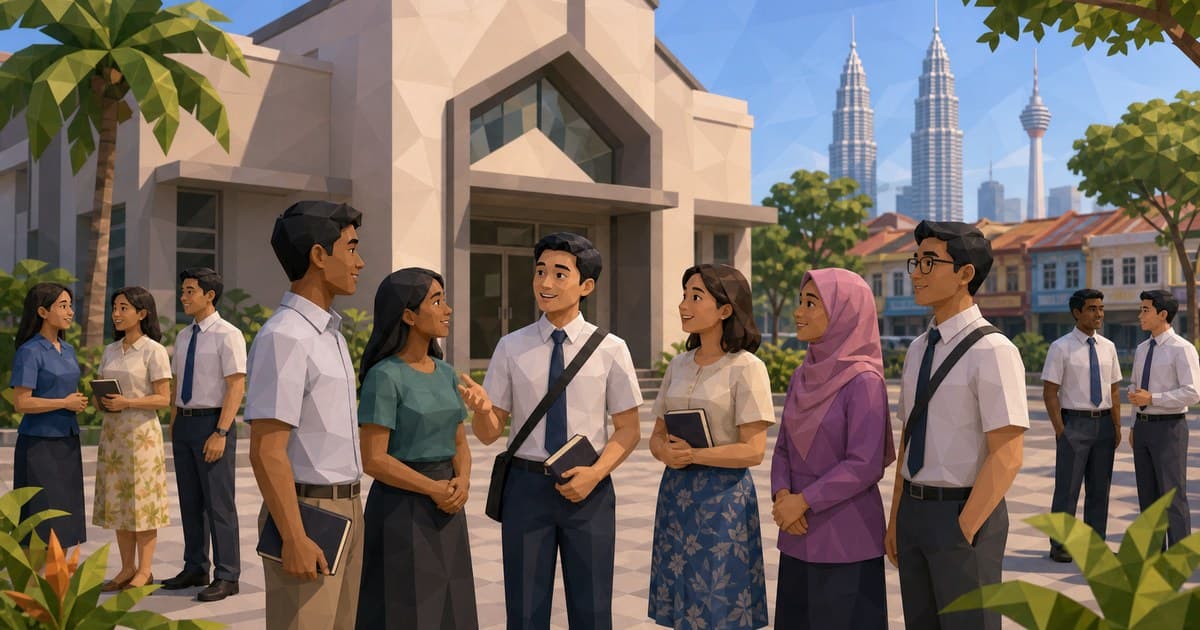
On names: the organisation's official name is The Church of Jesus Christ of Latter-day Saints. "Mormon" and "LDS" are older, informal terms the Church itself has asked people to retire; members are properly called Latter-day Saints. This guide uses the full name and is written neutrally for general information, not endorsement.
In This Guide
Overview: A Small, Established Community
The Church of Jesus Christ of Latter-day Saints is a small but long-established Christian-restorationist community in Malaysia. According to the Church's own statistics, there were 11,769 members in 24 congregations (all organised as branches) across 5 districts as of 31 December 2025.
That makes it a minority faith within Malaysia's already-minority Christian population, Christians are roughly 9% of Malaysians, and Latter-day Saints are a small fraction of that. The community is concentrated in the Klang Valley, Penang, and East Malaysia (Sabah & Sarawak), with a notable presence in indigenous communities of Borneo.
Key facts at a glance:
| Item | Detail (as of 31 Dec 2025) |
|---|---|
| Official name | The Church of Jesus Christ of Latter-day Saints |
| Informal names | "Mormon", "LDS" (now discouraged by the Church) |
| Members in Malaysia | 11,769 |
| Congregations | 24 (all branches; 0 wards) |
| Districts | 5 (Kuala Lumpur, Kota Kinabalu, Kuching, Miri, Sibu) |
| Stakes | 0 |
| Temples in Malaysia | 0 (nearest serving temple: Bangkok, Thailand) |
| Official recognition | 19 October 1977 |
This guide explains who they are, what they believe, their history in Malaysia, how they are organised, how they worship, and how the community fits into the country's multi-faith setting, all presented factually.
A Note on Names: "Mormon", "LDS" or "Latter-day Saint"?
The terms can be confusing, so it helps to be precise:
- The Church of Jesus Christ of Latter-day Saints is the full, official name of the organisation.
- "Mormon" is a nickname derived from the Book of Mormon, a scripture the Church uses. It was widely used for more than a century, including by members themselves.
- "LDS" is an abbreviation of "Latter-day Saints" that was common in everyday use.
In 2018, the Church renewed its long-standing emphasis on using its full name, asking members and the public to stop using "Mormon" and "LDS" as shorthand for the Church. According to the Church's own style guidance, the preferred usage is now:
- the full name on first reference;
- "the Church", "the Church of Jesus Christ" or "the restored Church of Jesus Christ" as shortened forms;
- members referred to as "Latter-day Saints" or "members of the Church".
"Mormon" remains acceptable only in proper nouns such as the Book of Mormon and in historical phrases like the "Mormon Trail". Most Malaysians still recognise the community as "Mormons", which is why this guide notes the older terms, but the respectful, current form is Latter-day Saints.
Beliefs: How It Differs From Mainstream Christianity
Latter-day Saints consider themselves Christian, they centre worship on Jesus Christ, but their theology differs in important ways from Catholic, Orthodox and Protestant Christianity. The tradition is restorationist: it teaches that the original Church established by Christ fell into apostasy and was restored through the prophet Joseph Smith, who organised the Church in the United States in 1830.
Distinctive features include:
- Additional scripture. Alongside the Bible, the Church uses three further books of scripture: the Book of Mormon, the Doctrine and Covenants, and the Pearl of Great Price.
- Continuing revelation. A living President / prophet and Quorum of the Twelve Apostles are believed to receive ongoing revelation for the Church.
- The Godhead. The Father, Son and Holy Ghost are taught as three distinct beings united in purpose, a view that differs from the traditional Trinitarian creeds shared by most other Christians.
- Plan of salvation & eternal families. Teachings emphasise a pre-mortal existence, degrees of heaven, and families being "sealed" together for eternity in temples.
| Most other Christian churches | Latter-day Saints | |
|---|---|---|
| Scripture | Bible only | Bible + Book of Mormon, Doctrine & Covenants, Pearl of Great Price |
| Founding | 1st century (with later reformations) | Restored 1830, USA |
| The Godhead | Trinity (one being, three persons) | Three distinct, united beings |
| Living prophet | No | Yes |
Mainstream Christian denominations generally regard Latter-day Saint theology as outside historic Christianity, while Latter-day Saints firmly self-identify as followers of Christ. This guide simply records both positions without taking sides.
A Living Prophet and Worldwide Leadership
A defining belief is that the Church is led by a living prophet, its President, supported by two counsellors (together the First Presidency) and the Quorum of the Twelve Apostles. Members believe these leaders can receive continuing revelation for the whole Church.
- The President is the most senior surviving apostle and serves for life; when he dies, the longest-serving apostle succeeds him.
- Russell M. Nelson, the 17th President (from 2018), died on 27 September 2025.
- Dallin H. Oaks was set apart as the 18th President on 14 October 2025, and is the current President of the Church.
Worldwide, the Church is divided into geographic areas. Malaysia falls within the Asia Area, whose headquarters are in Hong Kong. Day-to-day mission work in Malaysia is administered from Kuala Lumpur (see History below). None of these leadership roles is salaried at the local level; the structure is explained in the next sections.
Early History: The 1854 Visit
The Church's contact with the region is old, though its organised presence is far more recent.
- 1854, Elam Luddington, the first Latter-day Saint missionary sent to Siam (modern Thailand), passed through the Straits region on his journey. Historical accounts record that, after leaving Siam by ship in mid-August 1854, he landed on the Malacca peninsula on 21 August 1854 while travelling back via Singapore. Luddington's Siam mission lasted barely four months and was marked by hardship; no lasting Latter-day Saint community formed from this 19th-century contact.
For more than a century afterwards there was effectively no organised Latter-day Saint presence in what is now Malaysia. The community that exists today traces its real beginnings to the 1970s, covered in the next section.
Modern Re-establishment and Growth
The Church's organised presence in Malaysia dates from the second half of the 20th century and has grown steadily ever since.
- Early 1970s, Small groups of expatriate and local members, including ethnic-Chinese converts, began meeting in Penang and Kuala Lumpur. In 1974 the Singapore Mission was organised, with Malaysia inside its boundaries.
- 19 October 1977, The Church was officially recognised by the Malaysian government, with Anthony T. K. Lim acting as a formal Church representative. Senior missionaries (Elder and Sister Werner Kiepe) were sent to help establish the Church in the Kuala Lumpur area.
- 1980, The first district (the Kuala Lumpur District) was organised on 2 April 1980, and early Malaysian members (such as Jenny Lum, Derrick Ho and Doreen Khoo) served full-time missions while others, including Ricky Tjeong and Ivan Bee Ho, took on branch and district leadership.
- 1986, A seminary and institute (religious-education) program for youth and young adults was established. (commonly cited; exact year not confirmed against an official source.)
- 1995, Apostle Joseph B. Wirthlin visited Malaysia and offered a prayer dedicating the country for the preaching of the Church's message.
- 2018, A Malay-language translation of Latter-day Saint scripture (the Book of Mormon and other texts) was completed, making the Church's distinctive scripture available in Bahasa Malaysia.
- July 2022, The headquarters of the Singapore Mission rotated to Kuala Lumpur, placing mission leadership for the region in Malaysia.
Today the community continues to grow, led largely by Malaysian members.
Membership Growth Over Time
Recorded membership has risen markedly over the past quarter-century, even though the community remains small in absolute terms. The Church reported that by 2019 membership was roughly nine times what it had been in 1999, with the number of congregations more than doubling over the same period.
| Year | Reported members |
|---|---|
| 1977 | ~66 |
| 1999 | ~1,141 |
| 2004 | ~2,456 |
| 2009 | ~6,404 |
| 2014 | ~9,259 |
| 2019 | ~10,845 |
| 2024 | ~11,341 |
| 31 Dec 2025 | 11,769 |
A note on "membership" figures: like most churches, these are cumulative records of baptised members on the rolls, which can be higher than the number who attend regularly. They are useful for tracking trends rather than as a precise count of active worshippers.
How the Church Is Organised
Latter-day Saint congregations follow a worldwide standard structure. In Malaysia, all congregations are currently branches (smaller units) grouped into districts, the country has no stakes or wards yet, which require larger, more established membership. (Some reports note a Malaysian district approaching the membership needed for a first stake, but none has been organised so far.)
- Branch, a local congregation, led by a branch president (a lay leader, not paid clergy).
- District, a group of branches. Malaysia has 5 districts, organised in the following years:
| District | Organised |
|---|---|
| Kuala Lumpur | 2 April 1980 |
| Kota Kinabalu | 4 May 1997 |
| Kuching | 11 March 2003 |
| Miri | 15 June 2008 |
| Sibu | 29 November 2009 |
(Wards and stakes are the larger equivalents found in countries with more members.) Within each congregation, members serve in organisations that mirror the global Church:
| Organisation | Who it serves |
|---|---|
| Relief Society | Adult women |
| Elders Quorum | Adult men |
| Young Women | Girls roughly 11-18 |
| Young Men | Boys roughly 11-18 |
| Primary | Children |
| Sunday School | All ages, gospel study |
| Seminary & Institute | Religious education for teens and young adults |
There is no paid local clergy, congregations are run entirely by volunteer members who are "called" to serve for a period and then released.
Missionary Work and Legal Restrictions
Missionary work is central to Latter-day Saint identity worldwide, but in Malaysia it operates under clear legal limits that apply to all faiths.
- No proselytising to Muslims. Malaysian law and several state enactments prohibit propagating any religion other than Islam to Muslims. The Church, like other non-Islamic faiths, does not proselytise to Muslims and confines its activity to non-Muslims and existing members.
- Limited foreign-missionary visas. Malaysia restricts religious-worker visas, so the Church cannot freely send large numbers of full-time foreign missionaries. Historically, missionaries were rotated in and out on short (around 30-day) tourist visas to comply with Malaysian law.
- Reliance on local members. Because of these limits, growth depends heavily on local member-missionary work and service missionaries, Malaysian members sharing their faith within legal bounds, senior couples doing humanitarian, family-history and administrative service rather than street preaching, and Malaysian young people serving full-time missions (often abroad).
The result is that the Church in Malaysia is, by necessity, a locally led and locally grown community rather than one driven by foreign missionary forces. The restrictions are a feature of Malaysia's wider religious-freedom framework, not specific to this Church.
Sunday Worship and the Sacrament Meeting
Latter-day Saint Sunday worship in Malaysia follows the global pattern.
- Sacrament meeting. The central service is the sacrament meeting, where bread and water are blessed and passed to the congregation in remembrance of Jesus Christ. Talks are usually given by ordinary members rather than a professional preacher.
- A two-hour block. Since 2019 the Church has used a two-hour Sunday schedule: the sacrament meeting plus, on alternating weeks, Sunday School or other classes (Relief Society, Elders Quorum, Young Women, Young Men, Primary for children).
- Meetinghouses, not temples. This worship takes place in ordinary chapels / meetinghouses, which are open to the public; visitors are generally welcome at Sunday services.
- Lay-led. All preaching, teaching and music is done by unpaid volunteer members who are "called" to their roles.
Dress is typically modest and formal (Sunday best). Services in Malaysia are commonly held in English and Malay, with other languages used where local membership calls for it.
Distinctive Everyday Practices
Beyond Sunday worship, Latter-day Saint life involves several distinctive lifestyle commitments.
- Tithing. Faithful members give 10% of their income as tithing, which funds chapels, programs and humanitarian work.
- Fast offerings. Members typically fast (skip two meals) one Sunday a month and donate at least the cost of those meals as a fast offering to help the needy.
- The Word of Wisdom. A health code under which observant members abstain from alcohol, tobacco, coffee and tea, and avoid harmful substances.
- Family focus. Strong emphasis on family; many hold a weekly Family Home Evening, a designated family time for teaching and activities, traditionally on Monday.
- Family history / genealogy. Members research their ancestors using the Church's free FamilySearch service, supported by local family history centres. This work has wider value for anyone tracing Malaysian family roots.
- Temple garments. Adult members who have made temple covenants wear simple garments as a private reminder of those commitments, an aspect of personal devotion rather than public dress.
Temples: None in Malaysia (Yet)
It is important to distinguish meetinghouses (ordinary chapels for Sunday worship, open to all) from temples (special buildings reserved for sacred ordinances such as eternal marriage "sealings", which require a member recommend to enter).
- No temple in Malaysia. The Church's official statistics list 0 temples in Malaysia.
- Nearest serving temple: Bangkok. Malaysian members were historically assigned to the Hong Kong China Temple; since the Bangkok Thailand Temple was dedicated on 22 October 2023 (the first temple in mainland Southeast Asia), members in this region travel there.
- Singapore Temple under way. A Singapore Temple was announced by the Church on 4 April 2021, and ground was broken on 28 June 2025 at a one-acre site at 233 Pasir Panjang Road, Singapore. Once completed it will be much closer for Malaysian members than Bangkok. (As of 2026 it is under construction, not yet open.)
Because temple visits require international travel, attending the temple is a periodic, significant event for Malaysian members rather than a weekly activity.
Welfare and Humanitarian Work
Service is a major part of how the Church operates, both internally and in the wider community.
- Latter-day Saint Charities is the Church's humanitarian arm. In Malaysia, documented projects include a clean-drinking-water initiative that assisted around 15 Malaysian communities. Across the region, Latter-day Saint Charities is also known for disaster relief, wheelchair, vision-care and food programs, frequently run in partnership with local NGOs and without religious conditions attached.
- Internal welfare. Congregations help members in need through fast offerings and a network of practical support coordinated by the Relief Society and Elders Quorum.
- Volunteer service. Members take part in community clean-ups, blood drives and charity efforts, which fit naturally into Malaysia's strong culture of gotong-royong (communal mutual aid).
This humanitarian work is one of the most visible ways the small community contributes to Malaysian society at large.
Community Life in a Multi-Faith Malaysia
As a small minority, Latter-day Saints in Malaysia keep a low public profile and operate well within the country's religious framework.
- Where they meet. Meetinghouses are found in and around cities such as Kuala Lumpur, Petaling Jaya, Penang, Ipoh, Johor Bahru, Kuching, Sibu, Miri and Kota Kinabalu, mirroring where members are concentrated.
- Diverse membership. The community includes ethnic Chinese and Indian Malaysians, indigenous peoples of Sabah and Sarawak, and expatriates, reflecting Malaysia's diversity. The Borneo states have a particularly strong share of members.
- Coexistence. Like all non-Muslim faiths, the Church operates under the freedom-of-religion provisions of the Federal Constitution (Article 11) while respecting the legal limits around Islam. It does not engage in public street preaching to Muslims and focuses on serving its members and the broader community.
- Youth & young adults. Programs such as seminary, institute and young-single-adult activities help connect and retain younger members, who form a meaningful share of this growing community.
For most Malaysians, the Church is best known through its clean-cut missionaries (where present), its humanitarian work, and its emphasis on family, a quietly established thread in the country's rich religious tapestry.
Why the Community Skews to Borneo
One of the most distinctive features of the Church in Malaysia is its East Malaysian centre of gravity. Although roughly 80% of Malaysians live in Peninsular Malaysia, only about a third of the Church's branches are on the peninsula, the majority are in Sabah and Sarawak. Tellingly, four of the five districts (Kota Kinabalu, Kuching, Miri and Sibu) are in Borneo, with only the Kuala Lumpur District on the peninsula.
A few reasons explain this:
- A larger Christian base. In Sarawak especially, Christians are the largest religious group, so a Christian-restorationist faith encounters more familiarity and receptivity than in Muslim-majority peninsular states.
- Fewer practical restrictions. Because the legal bar on propagating other religions to Muslims has less day-to-day effect where the population being reached is largely non-Muslim, congregations in Borneo have been freer to grow.
- Indigenous membership. Much of the growth has been among native peoples such as the Iban and other Bornean communities, often in the larger towns rather than remote interiors.
By contrast, growth in Sabah has been steadier and more modest than in Sarawak, and the peninsular community, though it includes the oldest and administratively central branches around Kuala Lumpur and Penang, is proportionally smaller than the island states.
Visiting or Learning More
Anyone curious about the Church can usually learn more without any pressure or commitment.
- Sunday services are open. Visitors are generally welcome to attend a sacrament meeting at a local meetinghouse; dress is modest and formal. (Temples are different, entry is restricted to members with a recommend, and there is no temple in Malaysia anyway.)
- Online resources. The Church publishes its scriptures, beliefs and Malaysia-specific news on its official websites, including a Malaysia newsroom.
- Family history. Even non-members can use the Church's free FamilySearch genealogy tools and local family history centres to trace their ancestry.
Whatever one's own beliefs, the Latter-day Saint community is a small, lawful and long-established part of Malaysia's multi-faith society, best understood, as this guide aims to present it, on its own terms and neutrally.
Sources & References
Data in this guide is cross-referenced against the following official sources.
- The Church of Jesus Christ of Latter-day Saints, Malaysia Facts & Statistics Official country statistics: 11,769 members, 24 congregations (all branches), 5 districts, 0 temples (as of 31 Dec 2025).
- Church History, Malaysia: Overview Official history: 1854 contact, 1970s gatherings in Penang/KL, government recognition on 19 October 1977, 2018 Malay scripture translation.
- Church Newsroom, Malaysia The Church's official Malaysia newsroom and announcements.
- Newsroom, Style Guide on the Name of the Church Official guidance on preferred names and why "Mormon" and "LDS" are discouraged.
- Newsroom, Groundbreaking for the Singapore Temple (June 2025) Singapore Temple announced 2021; ground broken 28 June 2025; will serve Malaysian members once complete.