
In This Guide
Why Malaysian Food is World-Class
Malaysia is where Malay, Chinese, Indian, and indigenous cuisines collide, creating one of the world's most exciting food scenes. This isn't fusion for the sake of it—it's centuries of culinary evolution, where each culture brought their best and the mixing created something entirely new.
The Malaysian Food Advantage
Food isn't just sustenance here—it's a national obsession. Malaysians plan their day around meals, drive hours for a specific dish, and debate the best nasi lemak stall with religious fervor. When locals ask "have you eaten?" it's not small talk—it's genuine concern for your wellbeing.
What Makes Malaysian Food Special:
- Four major cuisines in one country (Malay, Chinese, Indian, Peranakan)
- Street food culture that rivals any fine dining experience
- Incredibly affordable—world-class meals for under RM15
- Regional specialties worth traveling for
- 24/7 eating culture (mamak never sleeps)
- Food as social glue—business deals and friendships formed over meals
The Culinary Melting Pot
| Cuisine | Signature Flavors | Must-Try Dish |
|---|---|---|
| Malay | Coconut, sambal, lemongrass | Nasi lemak |
| Chinese | Wok hei, soy sauce, pork | Char kway teow |
| Indian | Curry, spices, banana leaf | Banana leaf rice |
| Peranakan | Sweet-sour-spicy fusion | Laksa |
Regional Food Map
Each state has its own food identity. Penang is the undisputed food capital, but every region brings something unique.
Penang: Street food paradise, char kway teow, assam laksa, cendol
KL: Everything from every state, plus excellent international options
Melaka: Peranakan cuisine, chicken rice balls, satay celup
Ipoh: Bean sprout chicken, hor fun, white coffee
Johor: Mee rebus, laksa Johor, asam pedas
Kelantan: Nasi kerabu, ayam percik, keropok lekor
Sarawak: Laksa Sarawak, kolo mee, midin fern
20 Must-Try Malaysian Dishes
These are the dishes that define Malaysian cuisine. Skip these and you haven't really eaten in Malaysia.
National Icons
1. Nasi Lemak (RM3-15)
The national dish. Coconut rice with sambal, fried anchovies, peanuts, cucumber, and egg. Basic version at RM3, elaborate versions with rendang or fried chicken at RM15. Eaten for breakfast, lunch, dinner, or 3am.
2. Char Kway Teow (RM6-12)
Flat rice noodles wok-fried with prawns, cockles, Chinese sausage, egg, and bean sprouts. The best versions have "wok hei"—that smoky breath of the wok that takes years to master.
3. Laksa (RM7-15)
Spicy noodle soup with regional variations. Penang assam laksa (sour fish-based), curry laksa (coconut curry), Sarawak laksa (unique to Borneo). Each version is completely different.
4. Satay (RM1 per stick)
Grilled meat skewers with peanut sauce. Chicken, beef, or mutton. Best eaten at dedicated satay stalls where they grill over charcoal. Order by the stick—10 is a good starting point.
5. Rendang (RM12-20)
Dry curry of meat slow-cooked in coconut and spices until caramelized. Takes hours to prepare properly. The darker and drier, the better.
Street Food Essentials
6. Roti Canai (RM1.50-4)
Flaky flatbread served with curry. Tear it, dip it, repeat. Variations: roti telur (egg), roti pisang (banana), roti bom (thick and buttery).
7. Mee Goreng (RM5-8)
Fried noodles with sweet-spicy sauce, egg, tofu, and vegetables. The mamak version has a distinct taste you won't find elsewhere.
8. Hokkien Mee (RM7-12)
Dark braised noodles in thick soy sauce with pork, prawns, and kangkung. A KL specialty that's impossible to recreate at home.
9. Cendol (RM3-6)
Shaved ice with green pandan jelly, coconut milk, and palm sugar. The perfect antidote to Malaysian heat. Melaka's version with gula Melaka is legendary.
10. Rojak (RM5-8)
Fruit and vegetable salad with thick shrimp paste dressing. Sounds strange, tastes incredible. Both Indian and Chinese versions exist.
Regional Specialties
11. Assam Laksa - Penang (RM7-10)
Sour, fish-based noodle soup. Nothing like other laksas. Ranked among world's best dishes by CNN.
12. Ipoh Hor Fun (RM7-10)
Silky flat rice noodles in clear broth with chicken, prawns, and bean sprouts. Ipoh's water supposedly makes the noodles better.
13. Nasi Kerabu - Kelantan (RM8-12)
Blue-tinted rice colored with butterfly pea flowers, served with herbs, fish, and sambal. A visual and flavor experience.
14. Sarawak Laksa (RM8-12)
Unique to Sarawak—rice vermicelli in coconut-based curry with prawns, chicken, and sambal. Anthony Bourdain's "breakfast of the gods."
15. Bak Kut Teh (RM15-25)
Pork rib soup with herbs and garlic. Klang is the spiritual home. Eaten with rice, you tiao (fried dough), and tea.
Indian Malaysian
16. Banana Leaf Rice (RM10-15)
Rice served on banana leaf with assorted curries, vegetables, papadum, and pickle. Eat with your right hand for authenticity.
17. Nasi Kandar (RM10-20)
Penang specialty—rice with your choice of curries ladled over. The curry mixing is an art form.
18. Thosai/Dosa (RM2-5)
Crispy fermented rice crepe served with coconut chutney and sambal. Best for breakfast.
Desserts & Drinks
19. Teh Tarik (RM2-3)
"Pulled" milk tea, poured between cups to create a frothy top. The national drink. Watch the performance.
20. Kuih (RM1-3 each)
Traditional bite-sized desserts. Hundreds of varieties—ondeh ondeh, kuih lapis, seri muka. Buy an assortment.
Hawker Centers & Street Food
Street food isn't just cheap food in Malaysia—it's where you'll find the best food, period. Michelin would have a field day if they ever seriously surveyed Malaysian hawkers.
How Hawker Centers Work
The Setup:
- Open-air food courts with multiple stalls
- Each stall specializes in 1-3 dishes
- You find a seat, then walk to stalls to order
- Food is brought to your table (remember your table number)
- Pay each stall separately (cash preferred)
Etiquette:
- Sharing tables with strangers is normal and expected
- Tissue packets on chair = seat is taken
- Don't hog tables during peak hours
- Tipping is not expected
- Clearing your own tray is appreciated but not required
Top Hawker Centers by City
Kuala Lumpur:
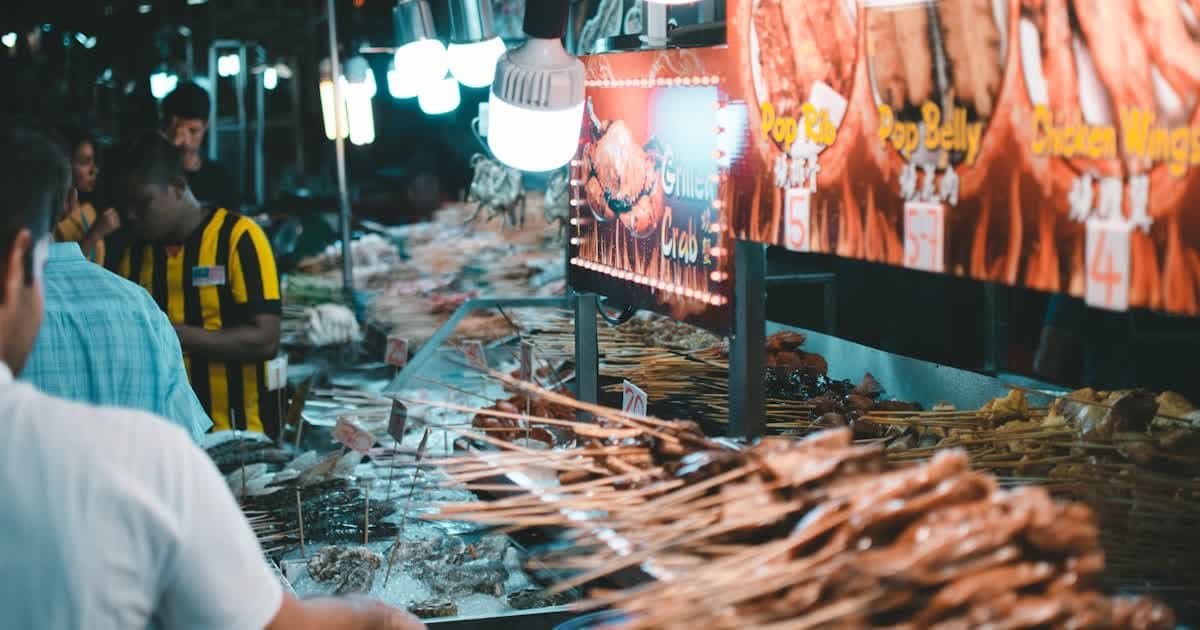
Jalan Alor (Bukit Bintang): Tourist-famous but still good. Grilled seafood, chicken wings, and more. Best after 6pm.
Petaling Street (Chinatown): Daytime food market. Curry noodles, wan tan mee, and traditional desserts.
Imbi Market (ICC Pudu): Morning market for locals. Hokkien mee, chee cheong fun, and coffee.
Bangsar Baru: Upscale area with excellent hawker food nearby. Good for evening eating.
Penang (Food Capital):
Gurney Drive Hawker Centre: The famous one. Char kway teow, pasembur, laksa—everything Penang is known for.
New Lane (Lorong Baru): Local favorite. Less touristy than Gurney, equally good food.
Chulia Street: Backpacker area with excellent street food. Night market atmosphere.
Air Itam Market: Near Kek Lok Si temple. Famous laksa stall, local crowds.
Padang Brown: Colonial-era field turned food haven. Indian food excellence.
Ipoh:
Taman Jubilee Food Court: Bean sprout chicken, hor fun, and more Ipoh specialties.
Woolley Food Centre: Local breakfast spot. Dim sum and coffee.
Melaka:
Jonker Street Night Market: Friday-Sunday nights only. Chicken rice balls, cendol, and Peranakan snacks.
Medan Portugis: Portuguese settlement with seafood. Sunset views.
Street Food Safety
Malaysian street food is safe. The high turnover means fresh food, and vendors have been doing this for generations.
Signs of a Good Stall:
- Long queue of locals (worth the wait)
- High turnover—food isn't sitting around
- Specializes in few dishes (master of one)
- Clean cooking area (you can see it)
- Confident, fast cooking
Signs to Avoid:
- Empty stall while neighbors are busy
- Food sitting pre-cooked for hours
- General uncleanliness
- Menu with 50+ items (jack of all trades)
Timing Your Hawker Visits
Breakfast (7-10am):
- Dim sum, nasi lemak, roti canai
- Coffee shops most active
- Best time for traditional breakfast foods
Lunch (12-2pm):
- Economy rice (nasi campur), chicken rice
- Office worker crowds
- Some stalls only open for lunch
Dinner (6-10pm):
- Widest selection available
- Night markets come alive
- Seafood at its freshest
Late Night (10pm-3am):
- Mamak reigns supreme
- Post-club hunger cures
- Different crowd, same great food
Craving Malaysian Food & Coffee?
Get hawker food delivered with Foodpanda, grab Malaysia's favourite specialty coffee at ZUS, or use CHAGEE code 3DsGVzx for premium tea rewards.

Food delivery from thousands of restaurants, hawker stalls, and grocery shops.

Malaysia's largest coffee chain (~740-750 outlets). Use code EDWXWTG for rewards on your first order.

Premium Chinese tea and milk tea in Malaysia. Use referral code 3DsGVzx for app rewards.
Regional Food Specialties
Every Malaysian state has dishes worth traveling for. Food tourism is a thing here—people drive 4 hours for the right bowl of noodles.
Penang - The Food Capital
Penang's food reputation is earned. The island has preserved traditional recipes better than anywhere else, partly because Penangites are stubborn perfectionists about their food.
Must-Eat:
- Char kway teow at Lorong Selamat (Sister's Char Kway Teow)
- Assam laksa at Air Itam
- Cendol at Penang Road Famous Teochew Chendul
- Nasi kandar at Line Clear or Hameediyah
- Pasembur at Gurney Drive
Why It's Special:
Street hawkers here have been perfecting single dishes for generations. The competition is fierce, and quality is non-negotiable.
Ipoh - White Coffee & Noodles
Ipoh's mineral-rich water supposedly gives its food a unique quality. White coffee originated here, and the hor fun is impossibly silky.
Must-Eat:
- Bean sprout chicken (taugeh ayam) at Lou Wong
- Hor fun (flat noodles) at Thean Chun
- White coffee at Sin Yoon Loong or Nam Heong
- Dim sum at Foh San
Why It's Special:
Ipoh developed in isolation from KL, creating unique dishes you won't find elsewhere. The water theory might be myth, but the results speak for themselves.
Melaka - Peranakan Paradise
Melaka is the birthplace of Peranakan cuisine—the Chinese-Malay fusion that's been developing for 500 years.
Must-Eat:
- Chicken rice balls at Hoe Kee or Chung Wah
- Cendol with gula Melaka
- Nyonya laksa (sweeter, coconut-based)
- Satay celup (DIY satay hot pot)
- Asam pedas (sour spicy fish)
Why It's Special:
Peranakan cooking is elaborate, passed down through generations. The flavors are more complex than typical Malay food—sweet, sour, spicy in perfect balance.
Johor - Southern Flavors
Johor borders Singapore, and the food culture is distinct. Sweeter, more coconut-rich, with Indonesian influences.
Must-Eat:
- Mee rebus Johor (noodles in sweet potato gravy)
- Laksa Johor (with spaghetti instead of rice noodles)
- Asam pedas at Muar
- Kacang pool (Yemeni-influenced breakfast)
Kelantan & Terengganu - East Coast Traditions
The east coast preserved Malay food traditions better than anywhere. Breakfast here is an event.
Must-Eat:
- Nasi kerabu (blue rice)
- Nasi dagang (coconut rice with fish curry)
- Ayam percik (grilled coconut chicken)
- Keropok lekor (fish sausage)
- Budu (fermented fish sauce—acquired taste)
Why It's Special:
Less Chinese and Indian influence means purer Malay flavors. The food is vibrant, colorful, and herb-heavy.
Sarawak & Sabah - Borneo Bounty
East Malaysia has completely different food traditions, influenced by indigenous Dayak culture and Sarawak's unique history.
Must-Eat Sarawak:
- Sarawak laksa (completely unique)
- Kolo mee (springy dry noodles)
- Midin (wild jungle fern)
- Bambangan (wild mango)
Must-Eat Sabah:
- Hinava (raw fish salad)
- Ngiu chap (beef noodle soup)
- Tuaran mee (egg noodles)
- Seafood at Filipino Market, KK
Why It's Special:
Indigenous ingredients you won't find in Peninsular Malaysia. More adventurous eating for curious foodies.
Restaurant Guide
Beyond hawker food, Malaysia has excellent restaurants for every budget and cuisine.
Fine Dining (RM200-500+ per person)
Dewakan (KL):
Malaysia's first Michelin-starred restaurant. Darren Teoh's modern Malaysian tasting menus use foraged local ingredients. Book weeks ahead.
DC by Darren Chin (KL):
French-Asian fine dining. Impeccable technique with Asian touches.
Nadodi (KL):
Modern South Indian with molecular techniques. Tasting menu only.
Mid-Range Excellence (RM50-150 per person)
Rebung (KL):
Chef Ismail's traditional Malay cuisine. Buffet of kampung (village) recipes you won't find elsewhere.
Bijan (KL):
Upscale Malay in elegant setting. Good for impressing dates or clients.
Sambal Hijau (KL):
Modern Malay comfort food. Excellent rendang and ulam (herb salad).
Old China Cafe (KL):
Peranakan in heritage building. Set lunches excellent value.
Reliable Chains
Madam Kwan's: Mall-friendly Malaysian. Nasi lemak and nasi bojari. Consistent quality.
PappaRich: Kopitiam (coffee shop) classics. Hainanese chicken rice, toast, and kopi.
Nando's: Peri-peri chicken, halal everywhere in Malaysia.
Secret Recipe: Cakes and Western-Malaysian fusion. Good for families.
Best Value Options
Economy Rice (Nasi Campur):
- Point at dishes behind glass, rice underneath
- Pay based on what you choose
- RM6-12 for a full meal
- Found everywhere, lunch specialty
Kopitiam (Traditional Coffee Shop):
- Multiple stalls under one roof
- Drinks from main counter, food from stalls
- Toast, eggs, and coffee for breakfast
- RM5-10 per person
Food Courts:
- Mall basement food courts
- Air-conditioned comfort
- Multiple cuisines
- RM8-15 per meal
Restaurant Booking Tips
Do You Need Reservations?
- Hawker centers: Never
- Casual restaurants: Rarely (except weekends)
- Nice restaurants: Yes, especially weekends
- Fine dining: Essential, book days/weeks ahead
Apps for Reservations:
- TableApp: Works for most restaurants
- Eatigo: Discounts for off-peak times
- WhatsApp: Many restaurants take bookings directly
Tipping Culture
Tipping is not expected or required in Malaysia.
The Reality:
- Service charge (10%) often included at restaurants
- Rounding up is appreciated but not necessary
- Hawker stalls: Never tip
- Fine dining: 10% if service exceptional and no service charge
Malaysian Drinks Guide
Malaysian drinks are as distinctive as the food. The heat demands constant hydration, and locals have developed creative solutions.
Essential Malaysian Drinks
Teh Tarik (RM2-3)
The national drink. Black tea with condensed milk, "pulled" between cups to create a frothy top. The pulling aerates the tea and cools it. Watch the mamak guys—it's performance art.
Variations:
- Teh tarik kurang manis: Less sweet
- Teh halia: With ginger
- Teh tarik kosong: No sugar (rare)
- Teh C: With evaporated milk instead
Kopi (RM2-3)
Malaysian coffee is roasted with sugar and margarine, giving it a caramelized flavor unlike any other coffee.
The Code:
- Kopi: Black coffee with condensed milk
- Kopi-O: Black coffee with sugar
- Kopi-C: With evaporated milk
- Kopi-O-kosong: Black, no sugar
- Kopi peng: Iced
Milo (RM3-5)
Malaysians are obsessed with this chocolate malt drink. It's not just for kids.
The Milo Spectrum:
- Milo ais: Iced Milo
- Milo dinosaur: With extra Milo powder on top
- Milo godzilla: With ice cream
- Milo tabur: Extra Milo, extra condensed milk
Fresh Juices & Blends
Every hawker center has a drinks stall with fresh juices.
Popular Options:
- Air kelapa (coconut water): Fresh from the coconut
- Air tebu (sugarcane juice): Refreshing, natural sweetness
- Limau ais (lime juice): With sour plum for extra kick
- Watermelon juice: Simple and perfect for heat
- Mixed fruit: Whatever's fresh
Cooling Dessert Drinks
Cendol (RM3-6)
Shaved ice + green pandan jelly + coconut milk + palm sugar. Straddling the line between drink and dessert.
ABC (Air Batu Campur) (RM4-6)
Shaved ice mountain with beans, corn, jelly, and syrups. Every stall has their own version.
Bandung (RM2-3)
Rose syrup with milk. Pink, sweet, and nostalgic for Malaysians.
Soya Bean (RM2-3)
Fresh soya milk, hot or cold. Often from dedicated soya stalls.
Where to Get Great Drinks
Best Teh Tarik: Any busy mamak restaurant. Skill varies—watch the pour.
Best Kopi: Traditional kopitiam coffee shops. Chains like OldTown are okay but not the same.
Best Fresh Juice: Hawker center drinks stalls, morning markets
Best Cendol: Penang Road Famous Teochew Chendul (Penang), Jonker Street (Melaka)
Alcohol in Malaysia
Available but not central to food culture.
Where to Find:
- Chinese restaurants (beer with meals common)
- Bars and pubs in cities
- Hotel restaurants
- Convenience stores (7-Eleven, etc.)
- Duty-free in Langkawi
Where You Won't Find:
- Malay restaurants (halal)
- Mamak restaurants
- East coast states (Kelantan, Terengganu)
- Most hawker centers
Coffee Culture Evolution
Third-wave coffee has hit Malaysia hard. KL has excellent specialty coffee. Local chains like ZUS Coffee have also exploded in popularity, offering affordable specialty drinks at hundreds of outlets nationwide. See our ZUS Coffee review for app deals and loyalty rewards.
Recommended Cafes:
- VCR (KL): Pioneer of local coffee scene
- Feeka (KL): Brunch and espresso
- Pulp (KL): Multiple locations, consistent
- Macallum Connoisseurs (Penang): Industrial-chic pioneer
- China House (Penang): Longest cafe in world, great cakes
Food Tips & Etiquette
Eating like a local means understanding the unwritten rules.
Eating Etiquette
Using Your Hands:
- Eating with hands is traditional for Malay and Indian food
- Use RIGHT hand only (left is considered unclean)
- Wash hands before and after at provided basin
- Perfectly acceptable to use utensils instead
Sharing Tables:
- Hawker centers: Sharing with strangers is normal
- Just ask "Is this seat taken?" and sit down
- Don't need to make conversation
- Keep belongings on lap or visible
Ordering at Hawker Centers:
- Find a seat first
- Note your table number
- Walk to stalls and order
- Tell them your table number
- Food arrives, pay each stall separately
Money-Saving Tips
Best Value Meals:
- Economy rice lunch: RM6-10
- Mamak dinner: RM8-12
- Food court: RM8-15
- Hawker breakfast: RM5-8
Expensive Mistakes:
- Hotel restaurants (3x hawker prices)
- Tourist area restaurants (marked up)
- Bottled water (tap water boiled = free)
- Imported foods (local is better and cheaper)
Timing Savings:
- Lunch sets at restaurants (cheaper than dinner)
- Early morning markets (freshest, cheapest)
- Eatigo app (restaurant discounts)
Food Safety
Malaysian street food is safe. The key is choosing busy stalls.
Safe Practices:
- Eat where locals eat (high turnover = fresh)
- Cooked food > raw food for sensitive stomachs
- Ice is generally safe (made commercially)
- Bottled water if cautious, but local water is treated
Stomach Adjustment:
- Start mild, build up to spicy
- Chili oil and sambal can be intense
- Coconut-based dishes are gentler
- Probiotics before trip can help
Understanding the Menu
Common Terms:
- Nasi: Rice
- Mee: Noodles
- Goreng: Fried
- Rebus: Boiled
- Ayam: Chicken
- Daging: Beef
- Ikan: Fish
- Sayur: Vegetables
- Pedas: Spicy
- Kurang manis: Less sweet
Spice Levels:
- "Tak pedas" = Not spicy
- "Sikit pedas" = A little spicy
- "Pedas biasa" = Normal spicy (still hot)
- "Pedas gila" = Crazy spicy (challenge level)
Food Allergies & Dietary Needs
Vegetarian:
- Indian restaurants have most options
- Specify "no egg" if strict
- Watch for shrimp paste in Malay food
- "Vegetarian" in Malay: "Sayur sahaja"
Allergies:
- Peanuts: Common in satay sauce, rojak
- Shellfish: Common in noodle dishes, laksa
- Soy: In most Chinese cooking
- Always ask—language barrier can be tricky
Gluten-Free:
- Rice dishes are safe
- Rice noodles (kuey teow, laksa) usually okay
- Watch for soy sauce (contains wheat)
- Indian dosas are fermented rice
Best Food Instagram Spots
For content creators:
Photogenic Dishes:
- Nasi kerabu (blue rice)
- Cendol (green jelly, palm sugar)
- Rainbow desserts at trendy cafes
- Banana leaf rice (overhead shot)
Best Backdrops:
- China House, Penang (aesthetic cafe)
- Jonker Street, Melaka (heritage buildings)
- Lot 10 Hutong, KL (recreated heritage)
- Any traditional kopitiam (vintage vibes)
The Future of Malaysian Food Looks Absolutely Delicious
These are forward-looking predictions, not guarantees — but every sign on the table points to a golden era for Malaysian food, and we're calling it with full confidence.
Global recognition is about to explode. Expect more Malaysian hawkers, nasi lemak slingers, and char kway teow masters to earn Michelin nods and Bib Gourmand status through the late 2020s. The world is finally waking up to the fact that the best meal of your life might cost RM6 at a roadside stall — and once that story spreads, it never stops.
Visit Malaysia 2026 will trigger a food tourism boom. Culinary tourism is set to be the breakout star, with travellers flying in specifically to eat. Guided street-food crawls, heritage kopitiam tours, and Penang hawker pilgrimages will surge — many bookable in advance on platforms like klook so you skip the guesswork and go straight to the good stuff.
Young hawkerpreneurs will revive the heritage. The "dying trade" narrative is reversing. A new generation of degree-holding, design-savvy young hawkers is taking over family recipes, branding them beautifully, and proving you can honour tradition and still pack a stall every morning. Hawker heritage isn't fading — it's leveling up.
Modern-Malaysian fine dining will go world-class. Chefs reimagining rendang, laksa, and sambal through refined, contemporary techniques will put KL and Penang firmly on the global gastronomy map. Expect "new Malaysian" tasting menus to become a genuine destination-dining draw.
Cashless, app-ordered hawker food becomes the norm. QR payments and delivery are reaching even the humblest stalls. Craving char kway teow at midnight? Order it on foodpanda and it arrives hot — hawker soul, modern convenience.
Local pride goes global. Musang King durian, Sarawak pepper, and Malaysian-grown produce will keep winning export markets and bragging rights, while homegrown coffee culture like zus-coffee shows the world Malaysia can do "trendy cafe" on its own terms.
Healthier snacking goes mainstream. Alongside the indulgence, a homegrown clean-label movement is rising — Malaysian-made granola, mixed nuts, and nut butters with no refined sugar and Asian-inspired flavours like pandan and gula melaka. Brands like Amazin' Graze prove "healthy snack" doesn't have to mean bland or imported.
The verdict? Malaysian food's best chapter is still being written — so come hungry, because the table is only getting more glorious from here.
The Malaysia4U Mamak Index: A Folk CPI for Klang Valley Street Food (2025-26)
In Malaysia, the real cost-of-living barometer isn't a government press release — it's the bill at the mamak. The Malaysia4U Mamak Index turns that instinct into a number: the cost of one classic order, tracked over time.
The 2025-26 basket (typical Klang Valley mamak):
| Item | Price (2025-26) | The long view |
|---|---|---|
| Roti canai kosong | RM2.00–2.20 | DOSM national avg RM1.54 (2024), up +71.1% from 90 sen in 2011 |
| Teh tarik | RM2.30–2.50 | Klang Valley is the priciest region for teh tarik in Peninsular Malaysia (DOSM locality data) |
| Nasi lemak (plain bungkus) | RM3.50–3.80 | DOSM avg RM3.68 (2024), up +81.3% from RM2.03 in 2011 |
| Roti telur | RM2.70–3.00 | The roti canai + egg premium has tracked flour and egg costs |
| Mee / maggi goreng | RM6.50–7.50 | The single most expensive line on the basket |
| Mamak Index (basket total) | ~RM17–19 | The headline folk-CPI figure |
The headline: ~RM18 for the full basket in 2025-26. The DOSM-tracked staples in this basket have climbed sharply over 13 years: roti canai and nasi lemak are up 71% and 81% between 2011 and 2024, with chicken satay up 114% over the same window — meaning these items cost a little over half as much a decade ago.
Why the basket climbed (2024-2025):
- Diesel subsidy rationalisation (10 June 2024): Peninsular retail diesel jumped from RM2.15 to RM3.35/litre (+56%), raising delivery and supply costs for flour, eggs, cooking oil and gas.
- SST expansion (1 July 2025): the Sales & Service Tax scope widened to more goods and services (logistics, leasing, professional and other fees), adding cost pressure along the supply chain — though basic foodstuffs and small eateries stay largely exempt.
- Minimum wage to RM1,700 (effective 1 Feb 2025, all employers by 1 Aug 2025): higher labour costs at stalls and suppliers.
- Commodity and import costs: flour, eggs and cooking oil have seen repeated spikes, partly imported and ringgit-sensitive.
How to read it: the Mamak Index is a folk CPI — anecdotal, affectionate and directional. But it captures what official inflation figures often blur: the lived experience that the cheapest, most democratic meal in Malaysia is quietly getting more expensive, one 30-sen hike at a time.
Methodology: The Mamak Index sums the typical Klang Valley mamak counter price of five everyday staples — roti canai kosong, teh tarik, nasi lemak (plain bungkus), roti telur and a plate of mee/maggi goreng — into one "basket" figure (mid-2025 to mid-2026 observed prices). It is a folk gauge, not an official statistic: the basket total reflects representative menu prices at ordinary Klang Valley mamak restaurants, while the long-run change column for roti canai, nasi lemak and satay is anchored to the Department of Statistics Malaysia (DOSM) Analysis of Annual Consumer Price Index 2024 (2011 vs 2024 averages, a 13-year span). Items DOSM does not separately track in that release (teh tarik, roti telur, maggi goreng) use observed menu ranges; the teh tarik regional claim draws on DOSM OpenDOSM locality data. Treat the headline figure as directional: a RM2 swing either way is normal between a kampung stall and a 24-hour franchise.
Key terms
| Term | Meaning |
|---|---|
| Mamak Index | Malaysia4U's folk CPI: the combined Klang Valley mamak price of five staple items (roti canai kosong, teh tarik, nasi lemak, roti telur, mee/maggi goreng) used as a street-level cost-of-living gauge. |
| Roti canai kosong | Plain roti canai with no fillings — the cheapest, baseline version, used as the index's anchor item. |
| Folk CPI | An informal, everyday inflation gauge based on a familiar purchase rather than an official statistical basket — directional, not authoritative. |
| Diesel subsidy rationalisation | Malaysia's 10 June 2024 reform that floated Peninsular diesel to a managed market price (RM2.15 to RM3.35/litre), raising logistics and supply costs. |
| SST expansion | The 1 July 2025 widening of Malaysia's Sales & Service Tax scope to additional goods and services. |
| Bungkus | Malay for 'wrapped' / takeaway — a nasi lemak bungkus is the cheap packeted breakfast version. |
Top 10 Most-Reviewed Restaurants in Malaysia
Ranked by Google review count — updated weekly
- 1.
K Fry Urban Korean Holiday Villa
Holiday Villa, 260, Jalan Dato Sulaiman, Taman Abad, Johor Bahru
4.922.0k - 2.
Dragon’s Journey Hotpot JB
25D, Jalan Dato Abdullah Tahir, Taman Abad, Johor Bahru
4.917.8k - 3.
Kopitiam Kita
Jalan Sri Cemerlang, Taman Desa Jasa, Kota Bharu
4.714.6k - 4.
Village Park Restaurant
5, Jalan SS 21/37, Damansara Utama, Petaling Jaya
4.313.4k - 5.
Kuroma Buffet & Dining
TD Central, 3, Jalan Sagu 21, Taman Daya, Johor Bahru
4.910.9k - 6.
De.Wan 1958 by Chef Wan
The Linc, 360, Jln Tun Razak, Taman U Thant, Kuala Lumpur
4.79.7k - 7.
Ikan Bakar Sabah
10, Lorong Bunga Telur, Tanjung Aru, Kota Kinabalu
4.87.6k - 8.
Welcome Seafood Restaurant
Lot G 18, Ground Floor, Kompleks Asia City, Phase 2A, Jalan Asia City, Pusat Bandar Kota Kinabalu, Kota Kinabalu
4.07.5k - 9.
Hameediyah Restaurant
164 A, Lebuh Campbell, George Town
4.17.3k - 10.
Restoran Baba Kaya
13A, Jln. Bunga Raya, Melaka Tengah, Melaka
4.76.5k
Sources & References
Data in this guide is cross-referenced against the following official sources.
- Tourism Malaysia — Malaysian Cuisine Overview Official tourism board overview of Malaysian cuisine regions and signature dishes.
- Malaysia Kitchen — Regional Food Guide Government-backed culinary programme profiling Malay, Chinese, and Indian food traditions.
- Michelin Guide — Malaysia Michelin-starred and Bib Gourmand listings for Malaysia including hawker stalls.
- CNN Travel — Malaysian Street Food Ranking of Malaysia's best street food cities and must-eat dishes.
- Time Out — Best Restaurants KL Curated restaurant and hawker recommendations across Kuala Lumpur.
- DOSM via Malay Mail — From roti canai to satay: Beloved Malaysian foods see prices nearly double over 13 years (Apr 2025)
- Free Malaysia Today — Roti canai, nasi lemak prices nearly doubled over last 13 years (Apr 2025)
- RinggitPlus — Prices of Roti Canai, Nasi Lemak and Satay Nearly Double Over 13 Years
- Ministry of Finance Malaysia — Government Implements Targeted Diesel Subsidy for Peninsular Malaysia Effective 10 June 2024
- Ministry of Finance Malaysia — Targeted Revision of Sales Tax Rate and Expansion of Service Tax Scope Effective 1 July 2025
- EY Malaysia — SST expansion from 1 July 2025: what has changed and what to expect in Budget 2026
- ajobthing — Malaysia Minimum Wage Increase to RM1,700 from Feb 2025 (phased to 1 Aug 2025)
- Malay Mail — Where is teh tarik and roti canai most expensive in Malaysia? (DOSM locality data, Feb 2023)
- The Vibes — Roti canai, teh tarik index: rising costs push restaurants to hike prices
