
Key Takeaways
- →Close protection (personal security or bodyguard work) is a legitimate, legal service in Malaysia when it is delivered by a company licensed under the Private Agencies Act 1971 and regulated by the Ministry of Home Affairs (Kementerian Dalam Negeri, KDN). Hiring an unlicensed operator puts both the client and the operator at legal risk.
- →Malaysia is a low-firearm-carry jurisdiction. Under the Arms Act 1960 and the Firearms (Increased Penalties) Act 1971, private citizens and ordinary security guards do not carry guns. Most close protection officers here work unarmed, and armed cover is routed through auxiliary police powers, not personal weapons.
- →The main routes to a professional detail are a KDN-licensed security agency (unarmed protection officers, escort, residential teams) or an auxiliary police unit under the Police Act 1967, of which about 153 government agencies and private companies operate one, with roughly 40,610 sworn personnel.
- →Common assignments are residential protection, executive and corporate protection, event and VIP security, secure travel and airport meet-and-assist, and family or child protection. Peninsular Malaysia permits Nepalese (Gurkha) guards; Sabah and Sarawak restrict foreign security workers.
- →Before you hire, verify the KDN licence, confirm training (since 2018 firms must have at least 80 percent of guards certified), check insurance and vetting, get a written scope and quote, and be clear on whether any element is armed. Treat operators who cannot show a licence as a hard stop.
In This Guide
Close Protection in Malaysia: What It Actually Is
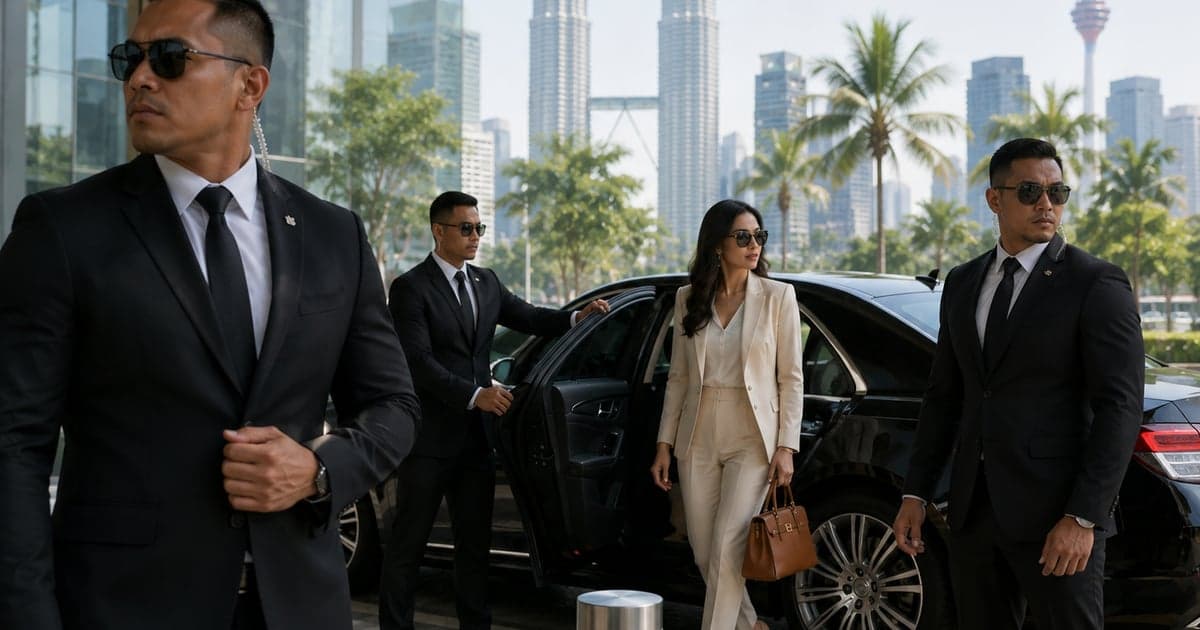
Close protection is the professional practice of keeping a specific person safe as they move through their day. In plain terms it is bodyguard work, but the modern discipline is broader than a large person standing near a client. A close protection officer (CPO) plans routes, studies venues before arrival, controls how the client gets in and out of buildings and vehicles, watches for threats, and is trained to react and extract the client if something goes wrong. The job is mostly quiet planning and awareness, with physical intervention as a last resort.
This guide covers legitimate personal-security services only: licensed bodyguards, executive protection, event and VIP security, residential teams, and secure travel provided by companies operating within Malaysian law. It has nothing to do with any other use of the word "escort".
Malaysia is, by regional and global standards, a safe place to live and do business. Most people here never need a personal detail, and a firm worth hiring will say so plainly rather than sell you cover you do not need. Where close protection does get used, it is usually for clear, time-bound reasons: a visiting executive or delegation, a high-net-worth family, a public figure or entertainer at an event, someone managing a credible personal threat or a stalking situation, or a company sending staff into a higher-risk assignment. For everyday risk, strong personal habits, covered in our personal safety guide, and good property security do most of the work.
How protection is organised in Malaysia
| Layer | Who provides it | Typical use |
|---|---|---|
| State protection | Royal Malaysia Police (PDRM) | Royalty, senior government officials, visiting heads of state |
| Auxiliary police (Polis Bantuan) | Companies and agencies authorised under the Police Act 1967 | Armed guarding and protection within a defined area of duty |
| Licensed security agency | Private companies licensed under the Private Agencies Act 1971 | Unarmed close protection, residential teams, event and executive security |
| Personal habits and home security | The individual | Baseline, everyday risk reduction |
The rest of this guide focuses on the two private routes most people can actually engage: a KDN-licensed security agency, and an auxiliary police unit where an armed element is genuinely required.
The Legal Framework: Private Agencies Act 1971 and KDN
Every legitimate close protection service in Malaysia traces back to one licence. The private security industry is governed by the Private Agencies Act 1971 (Akta Agensi Persendirian 1971) and regulated by the Ministry of Home Affairs, the Kementerian Dalam Negeri or KDN, through its private-security control division. A company must hold a valid Private Agency licence to lawfully sell guarding, escort or close protection services. This is the single most important thing to check before you engage anyone.
What the licence means
- The company has been vetted and approved by KDN to operate as a security agency.
- It is subject to conditions on ownership, management, training and conduct.
- It can be inspected, and the licence can be suspended or revoked for breaches.
- Providing paid security services without this licence is an offence, which is why an unlicensed operator is a legal liability to you as much as to themselves.
Ownership and control conditions. Private Agency licences are granted to Malaysian-controlled companies, and KDN sets equity, directorship and management conditions on who may hold and run a security agency. The specifics are set by policy and are updated over time, so a serious provider will be able to explain their licensing status and show the current document. Treat vagueness here as a red flag.
Training standards. Malaysia has steadily tightened guard training. Since 2018, security companies must ensure that at least 80 percent of their employees complete a certified security guard training course to keep their Private Agency licence renewal on track. Close protection sits above basic guarding and calls for additional, specialist training in threat assessment, secure driving, first aid and low-profile work, which the better firms invest in deliberately.
Foreign guards. The rules differ by region. Peninsular Malaysia permits the employment of Nepalese (Gurkha) security guards, a long-standing practice in the industry, while immigration rules in Sabah and Sarawak restrict foreign workers in the security sector. Close protection details working nationally need to account for this difference.
Where firearms and auxiliary police come in. The Private Agencies Act covers guarding and protection services, but it does not hand out the right to carry a gun. Armed capability is a separate track through the Police Act 1967 and auxiliary police status, covered in its own section below. For now, the key point is simple: a Private Agency licence lets a company provide close protection, and in the vast majority of cases that protection is unarmed.
When Hiring a Bodyguard Is Legal
The short answer is that hiring close protection in Malaysia is entirely legal, provided you hire it correctly. The legality does not turn on your reason for wanting protection. It turns on who you hire and how they operate.
Legal, when:
- The provider is a company holding a valid KDN Private Agency licence.
- The officers are employed and deployed by that company, not freelancing off the books.
- The scope stays within lawful protection: watching, warning, deterring, escorting, and reasonable defence of the client.
- Any armed element is delivered through properly authorised auxiliary police, not a private individual carrying a weapon.
On thin ice or outright illegal, when:
- The "bodyguard" or agency has no licence. This is the most common problem and the easiest to avoid.
- The detail carries firearms, batons or other weapons without lawful authority. Malaysia's firearms law is strict and unforgiving.
- Officers are asked to do more than protect: intimidation, debt collection, surveillance that breaches privacy, or detaining people. A protection officer is not a private enforcer, and a licensed firm will decline these tasks.
- The client instructs actions that would themselves break the law. Hiring protection does not create any special legal privilege for you or the officer.
Reasonable force, not police powers. A private close protection officer has the same legal rights as any other person to defend themselves and others and to use reasonable force in a genuine emergency. They cannot arrest, search or detain people as a matter of routine, and they cannot enforce the law. Real authority to carry weapons and act within a defined area comes only with auxiliary police appointment. Keeping this line clear protects both you and the officer, and any operator who blurs it is a liability.
If your situation involves a credible, ongoing threat, a licensed firm will also help you engage the police where appropriate. Close protection and a police report are complementary, and the better providers coordinate rather than replace formal channels.
Types of Close Protection Services
Close protection is not one product. Licensed firms in Malaysia offer a range of packages, and most real needs are met by a specific one rather than a permanent, round-the-clock detail.
1. Executive and corporate protection. The most common commercial use. A CPO or small team covers a visiting executive, board member or delegation: airport meet-and-assist, secure transport, venue advance work, and a low-profile presence through meetings and events. Corporate clients often want protection that is discreet enough not to alarm counterparties.
2. Event and VIP security. For public appearances, launches, concerts, weddings and private functions, a detail manages arrivals, crowd interface, backstage and green-room control, and safe departure. This blends close protection with event security and liaison with venue teams. Exclusive venues such as private members clubs and hotels usually have their own security that a good CPO will coordinate with rather than override.
3. Residential protection. A residential security team (RST) protects a family at home: access control, patrol, monitoring, and a response capability, often integrated with the property's cameras, alarms and gates. This is where close protection overlaps most with fixed-site security, and it works best when it is built on strong physical measures. Pair any residential detail with the fundamentals in our home security guide, because a bodyguard is far more effective behind good locks, lighting and cameras.
4. Secure travel and transport. Route planning, a security-trained driver, and an officer for the journey, whether that is a daily commute in the Klang Valley or travel to a higher-risk site. This often includes vehicle checks, timing variation, and a plan for what to do if the route is blocked.
5. Family and child protection. School runs, activities and daily movement for a family, delivered discreetly so children are not made anxious. Female CPOs are frequently requested here and for female principals, and reputable firms maintain trained women officers.
6. Threat and stalking response. Short-term protection for someone facing a specific, credible threat while formal channels catch up. Here the CPO works alongside, not instead of, a police report and any legal action.
| Service | Typical duration | Team size | Armed element |
|---|---|---|---|
| Executive protection | Days to weeks | 1 to 3 | Rare, usually unarmed |
| Event / VIP | Hours to a day | 2 to many | Rare |
| Residential team | Ongoing | Rotating shifts | Sometimes via auxiliary police |
| Secure travel | Per trip | 1 to 2 | Rare |
| Family / child | Ongoing | 1 to 2 | No |
| Threat response | Short term | 1 to 3 | Case by case |
Armed vs Unarmed: How Firearms Really Work Here
This is the single most misunderstood part of close protection in Malaysia, shaped mostly by films from countries with very different gun laws. Malaysia is a strict-control jurisdiction, and the practical reality is that your protection detail will almost certainly be unarmed.
The firearms law. Private firearms in Malaysia are governed by the Arms Act 1960 and the Firearms (Increased Penalties) Act 1971. Private ownership is rare and tightly licensed, and unlawful possession or discharge carries severe penalties. A private citizen, and an ordinary licensed security guard or close protection officer, does not carry a gun. This is not a gap in the market that a firm can fill for a fee. It is settled law.
How armed capability actually exists: auxiliary police. Where a genuine armed requirement exists, it is met through the auxiliary police framework (Polis Bantuan) under the Police Act 1967. The Inspector-General of Police, with the consent of the responsible Minister and the King, may appoint people to auxiliary police ranks. Companies and agencies that hold this authority can field sworn officers who may carry a company-registered firearm, subject to the same police application and approval process as any other, and only within their designated area of duty. Auxiliary police cannot enforce federal laws outside their authorised premises or area.
The scale of it. Around 153 government agencies, statutory bodies and private companies are authorised to operate auxiliary police units, with a combined strength of roughly 40,610 personnel. Well-known operators include large government-linked entities such as Petronas and Malaysia Airlines, and private operators like Resorts World Berhad at Genting Highlands. This is the legitimate channel for armed guarding at fixed, high-value sites.
What this means for you as a client
- For personal close protection, expect unarmed officers who rely on planning, awareness, positioning and evacuation rather than force.
- If you believe you need an armed element, you are really asking for an auxiliary police arrangement, usually tied to a location, and only some firms can provide it. Ask directly and expect a serious, documented answer.
- Be deeply sceptical of any operator who offers to provide armed private bodyguards outside these frameworks. That is not a premium service, it is a criminal exposure for everyone involved.
For the overwhelming majority of clients, unarmed protection built on good tradecraft is exactly the right answer, and it is what professional Malaysian details deliver every day.
How Licensed Firms Operate
The Malaysian private-security market is large and varied, running from major guarding companies with thousands of static guards to boutique outfits that specialise in executive protection. Close protection is a niche within it, so the firm you want is one that treats protection as a distinct, trained discipline rather than an upsell on manned guarding.
What a serious close protection firm looks like
- It holds and can show a current KDN Private Agency licence.
- Its CPOs have training beyond basic guarding: threat assessment, secure driving, emergency medical response, and low-profile operation.
- It conducts advance work, visiting venues and planning routes before an assignment rather than improvising on the day.
- It carries liability insurance and can explain what it covers.
- It vets its own officers and can describe how, including background checks and continuous supervision.
- It writes a clear scope and quote, and it declines tasks that stray outside lawful protection.
Structure of a detail. A single principal on a low-risk day may have one CPO who also drives. A higher-profile assignment scales up: a personal escort officer next to the principal, a security driver, and an advance officer clearing the next location. Residential work runs on shift rotation with a control point. The firm should be able to explain why it is proposing a given team size, and it should scale down as readily as up.
Coordinating with venues and events. Good CPOs work with, not against, the security already in place at hotels, malls, clubs and event venues. At exclusive members' venues in particular, house security runs the room and a professional CPO integrates quietly. Friction between a client's detail and venue security is usually a sign of an inexperienced operator.
A word on names. Rather than trust a brand, verify the licence. The market includes reputable specialists and, unfortunately, unlicensed operators who market themselves aggressively online. A firm's willingness to be transparent about its KDN licence, its training and its insurance tells you more than any logo. When in doubt, ask KDN or a lawyer to confirm the licence is genuine and current before you sign anything.
What Close Protection Costs
There is no single price for close protection in Malaysia, and any figure quoted before the task is understood should make you cautious. Reputable firms scope the assignment first, then quote in writing. Costs are unverifiable in the abstract because they move with the risk, so this section explains what drives price rather than inventing numbers.
The main cost drivers
| Driver | Effect on cost |
|---|---|
| Threat level | Higher assessed risk means more officers, more planning, higher price |
| Number of officers | Each additional CPO, driver or advance officer adds cost |
| Hours and duration | A few hours at an event costs far less than 24/7 cover over weeks |
| Vehicles and drivers | Security transport, extra vehicles and fuel add up |
| Advance work | Reconnaissance and route planning take paid time before the job |
| Armed element | An auxiliary police arrangement is specialised and more expensive |
| Location | Travel, accommodation and out-of-Klang-Valley logistics raise cost |
How to read a quote. A single unarmed CPO on a short day assignment is the entry point to the market. A residential security team running rotating shifts with a control point and secure transport sits at the other end and costs substantially more. Between those, price tracks the number of officer-hours and the logistics wrapped around them. What matters is not the headline rate but what the rate includes: hours, vehicles, advance work, overtime rules, and cancellation terms.
Getting a fair deal
- Get at least two written quotes from licensed firms for the same scope so you can compare like for like.
- Insist the quote itemises officers, hours, vehicles and any extras rather than giving one lump sum.
- Confirm insurance is included and understand the cover.
- Be wary of quotes that are far below the market. Underpricing usually means undertrained officers, no insurance, or an unlicensed operation.
- Agree payment terms and cancellation in writing before the assignment starts.
Spending on protection is spending on competence and preparation, so the cheapest quote is rarely the safest one, and the most expensive is not automatically the best. Match the package to a genuine, honestly assessed need.
How to Vet and Hire a Detail
Hiring close protection is a due-diligence exercise. The single biggest mistake is engaging someone who "looks the part" without checking whether they are licensed and trained. Work through this checklist before you commit.
Step 1: Verify the licence. Ask for the company's KDN Private Agency licence and confirm it is current. A legitimate firm shows this without hesitation. If you cannot verify a licence, stop there. This one step removes most of the risk.
Step 2: Check training and experience. Ask what specific close protection training the assigned officers hold beyond basic guard certification, and how much relevant experience they have. Threat assessment, secure driving and emergency medical response are the baseline for real CPO work.
Step 3: Confirm insurance. Ask for proof of liability insurance and understand what it covers. If an incident occurs, this is what stands between you and an uninsured loss.
Step 4: Understand vetting. Ask how the firm screens its own officers, including background checks and supervision. You are placing a person inside your private life, so their vetting matters as much as their muscle.
Step 5: Agree the scope in writing. Define exactly what the detail will and will not do. Legitimate protection is about deterrence, awareness and safe movement. Put it in a contract, and make sure nothing in the scope drifts into intimidation, surveillance or enforcement.
Step 6: Clarify armed or unarmed. Assume unarmed unless there is a documented auxiliary police arrangement, and get any armed element confirmed in writing with its legal basis.
Step 7: Test discretion and fit. For personal and family work, the officer's judgement, manners and ability to blend in matter enormously. Meet them first. A CPO you are uncomfortable around is the wrong CPO regardless of credentials.
Red flags that should end the conversation
- No licence, or reluctance to show one.
- Offers of armed private bodyguards outside the auxiliary police framework.
- Willingness to intimidate, surveil or detain people on your behalf.
- Quotes far below market, or pressure to pay cash with no contract.
- Vague answers about training, insurance or vetting.
Hiring well is mostly about patience and paperwork. The firms that answer these questions cleanly are the ones you want, and the ones that dodge them are telling you everything you need to know.
Becoming a Close Protection Officer
Close protection is also a career, and Malaysia has a steady demand for trained officers from the corporate, event and high-net-worth segments. If you are considering the field, here is how the pathway generally works and what the work actually involves.
The foundation. Most CPOs start in the wider security industry. Basic security guard certification is the entry credential, and since 2018 firms have been required to keep the large majority of their guards trained, which has raised the baseline across the industry. From there, close protection is a specialisation you build toward rather than start at.
Specialist skills that matter
- Threat and risk assessment, so you can read a venue, a route and a crowd.
- Secure and defensive driving, since much of the risk in a principal's day is on the road.
- Emergency medical response, because a CPO is often the first responder to a medical event, which is more common on the job than an attack.
- Advance and reconnaissance work, the quiet planning that prevents problems.
- Communication and etiquette, because most assignments are corporate or personal and demand a professional, low-profile presence.
- Physical intervention and self-defence, used as a last resort within the law.
The reality of the job. Good close protection is undramatic. It is early starts, long waits, meticulous planning, and the discipline to stay switched on when nothing is happening. Physical confrontation is rare and, in a strict-firearms country, always unarmed for private officers. The best CPOs are calm, observant and personable, and they make clients feel comfortable rather than guarded.
Working legally. As an officer, you work under a licensed agency, not as a freelance operator, and you stay within lawful protection. If you ever hold an auxiliary police appointment with a firearm, you operate strictly within your designated area and approval. Understanding and respecting these limits is what separates a professional from a liability.
Prospects. Demand is tied to Malaysia's role as a regional business hub, the flow of visiting executives and delegations, the events industry, and a growing high-net-worth population. Officers who invest in real training, languages and a clean, professional reputation are the ones who move from static guarding into steady close protection work.
The Outlook for Close Protection in Malaysia
These are forward-looking observations rather than guarantees, but the direction of the Malaysian close protection market looks steady and professionalising.
Standards keep rising. The push that took certified-guard training to an 80 percent threshold has lifted the industry floor, and close protection is following the same path toward more formal, specialist qualification. Expect clients to ask harder questions about training and licensing, and expect the better firms to compete on competence rather than muscle.
Corporate and event demand stays firm. Malaysia's position as a regional business and events hub keeps a reliable flow of visiting executives, delegations, conferences and high-profile functions, all of which generate discreet, short-term protection work. Executive protection that is professional and low-profile is where much of the growth sits.
Technology blends in. Modern details increasingly combine on-the-ground officers with cameras, access control and monitoring, which is why residential protection works best alongside solid property security. The fundamentals in our home security guide are becoming part of the same conversation as personal protection, not a separate one.
The unarmed norm holds. Malaysia's strict firearms law is not changing, so the market will continue to be built on unarmed professionalism, with armed capability confined to the auxiliary police framework at fixed, high-value sites. This keeps the emphasis where it belongs, on prevention, planning and judgement.
Licensing scrutiny tightens. As the industry matures, expect continued enforcement against unlicensed operators. For clients, that reinforces the one rule that never changes: verify the KDN licence first, and let everything else follow from there. Match protection to a genuine, honestly assessed need, and Malaysia's licensed close protection sector can deliver it safely and within the law.
Resources and Verification
Use official channels to verify a provider and understand the law before you engage any detail.
Regulators and authorities
| Body | Role |
|---|---|
| Ministry of Home Affairs (KDN) | Licenses private security agencies under the Private Agencies Act 1971 |
| Royal Malaysia Police (PDRM) | Auxiliary police appointments, firearms approvals, protection of officials |
| Immigration Department | Rules on foreign (including Nepalese) security workers |
Before you sign
- Ask for and verify the company's KDN Private Agency licence.
- Confirm training credentials for the assigned officers.
- Confirm liability insurance and what it covers.
- Get a written, itemised scope and quote.
- Confirm whether any element is armed and its legal basis.
Related reading on Malaysia4U
- Personal Safety Guide for everyday risk reduction that most people need before any detail.
- Home Security Guide for the property fundamentals that make protection effective.
- Private Members Clubs for the exclusive venues where executive and event protection often operates.
Emergency contacts
| Service | Number |
|---|---|
| Police / Emergency | 999 |
| Talian Kasih (welfare / threats) | 15999 |
When in doubt, treat the licence as the deciding factor. A verifiable KDN Private Agency licence, real training, proper insurance and a written scope are the four things that separate legitimate, lawful close protection from a costly and dangerous mistake.
This guide is general information about legitimate, licensed personal-security services in Malaysia and is not legal advice. Security licensing, firearms and auxiliary police rules change and are strictly enforced. Always verify a provider’s current KDN licence and confirm requirements with the Ministry of Home Affairs and qualified legal counsel before engaging any detail.
Sources & References
This guide is cross-referenced against primary official sources, regulatory references, and locally relevant materials.
- Ministry of Home Affairs (Kementerian Dalam Negeri, KDN) Licensing authority for private security agencies under the Private Agencies Act 1971
- Royal Malaysia Police (PDRM) Auxiliary police appointments under the Police Act 1967 and firearms approvals
- Attorney General’s Chambers (Federal Legislation) Private Agencies Act 1971, Arms Act 1960, Firearms (Increased Penalties) Act 1971, Police Act 1967
- Immigration Department of Malaysia Rules on foreign security workers, including Nepalese guards in Peninsular Malaysia
Further reading: Auxiliary police in Malaysia (overview)