
Key Takeaways
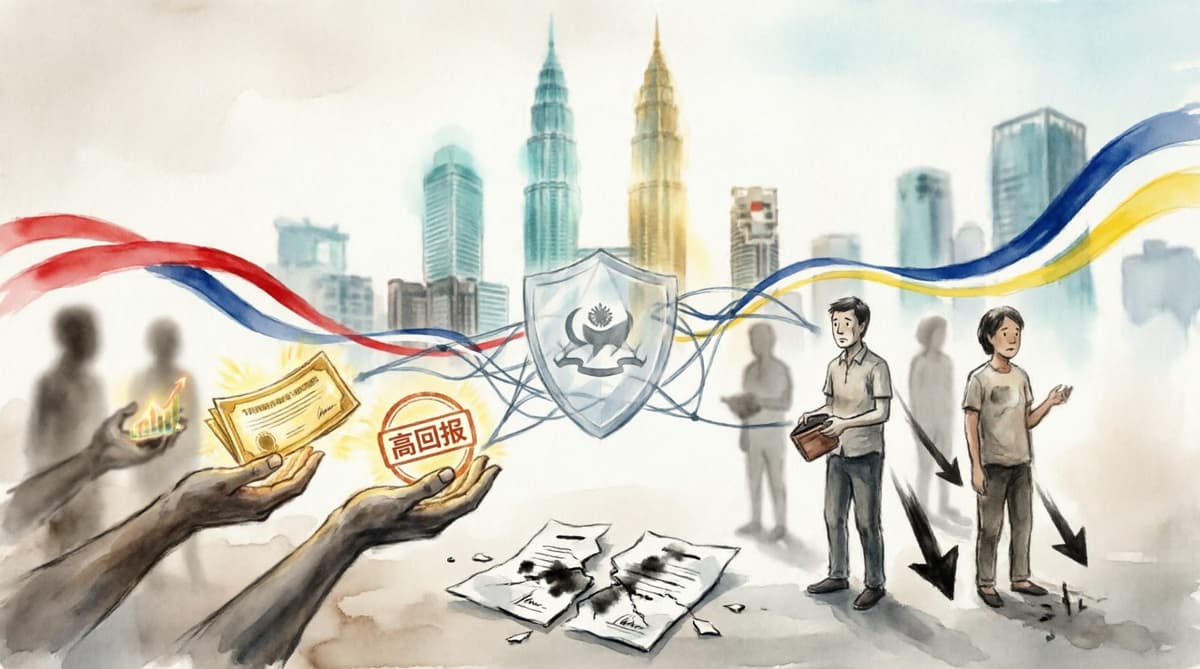
- →Malaysians lost RM2.97 billion to online scams in 2025, and non-existent investment schemes were the single biggest category at RM1.46 billion.
- →Before you invest, positively confirm a licence on the SC Investment Checker and Public Register, and check the SC Investor Alert List and BNM Financial Consumer Alert List. Absence from an alert list does not mean an entity is licensed.
- →Red flags: guaranteed high returns, urgency, referral bonuses, payment to a personal account, and demands for more money to unlock a withdrawal.
- →If you are scammed, call NSRC 997 immediately (now 24/7), tell your bank, and lodge a police report. No legitimate agency charges an upfront fee to recover your money.
Education, not financial advice. This guide is general scam-protection information for Malaysian readers and does not recommend any investment. Verify any licence directly with the SC or BNM before you invest, and if you have been scammed, call NSRC 997 immediately.
In This Guide
How big is the scam problem in Malaysia
Investment scams are the largest slice of Malaysia's online fraud losses. The Home Ministry reported that Malaysians lost RM2.97 billion to online scams in 2025, up from RM1.57 billion in 2024. Within that, non-existent investment schemes were the single biggest category.
| Scam category | 2025 losses | 2024 losses |
|---|---|---|
| Non-existent investment scams | RM1.46 billion | RM848.62 million |
| Telecommunications scams | RM802.47 million | (see note) |
| Love / romance scams | RM47.44 million | (see note) |
| All online scams (total) | RM2.97 billion | RM1.57 billion |
These figures come from different bodies (Home Ministry, Bank Negara Malaysia, NSRC) with different framings and reporting periods, so totals vary between reports. One account cited around RM2.8 billion for 2025 while the Home Ministry cited RM2.97 billion. Treat each number as attributed to its source and year rather than a single official tally.
The pattern behind the money is consistent. Victims are approached online, shown fake returns on a slick app or website, and allowed to withdraw a small amount early to build trust. Once a larger sum is in, withdrawals stop and the victim is asked for more. This guide covers how to check an investment before you put money in, and what to do if you have already paid.
Common investment scam types
Scams keep changing their branding, but they reuse a small set of structures. Learn the shapes and the specific promise stops mattering.
| Scam type | How it works | Tell-tale sign |
|---|---|---|
| Fake forex / gold / crypto schemes | An unregulated "broker" or trading group promises steady profits from forex, gold, or crypto trading you never really control | Offshore or no regulator, deposits to a personal account, a dashboard that only shows gains |
| Ponzi / money games | Fixed returns paid from new members' money, dressed up as a fund, co-op, or "AI trading" | Referral or recruitment bonuses, pays until recruitment slows, then collapses |
| Fake "licensed" apps | An app or site imitates a real broker or fund house, sometimes copying a genuine licence number | Download link sent by the promoter, not from the official app store or website |
| Clone firms | A scam uses a real licensed company's name, logo, and licence number | Contact details differ from the regulator's own records |
| Guaranteed-return funds | A "fund" promises fixed monthly returns with no risk | No legitimate investment can guarantee returns |
| Illegal deposit taking | An entity takes your "deposit" with a promised payout, without BNM authorisation | Not on any BNM or SC register |
| Pig butchering | A romance or friendship built over weeks that steers you into a fake investment | A new online friend or partner who introduces an investment |
Illegal deposit taking is regulated by BNM under the Financial Services Act 2013 and Islamic Financial Services Act 2013. Capital-market schemes (shares, unit trusts, funds, digital assets on registered platforms) are regulated by SC under the Capital Markets and Services Act 2007. Taking deposits or running an investment scheme without authorisation is an offence.
The SC Investor Alert List and Investment Checker
For anything that looks like a capital-market product (shares, unit trusts, funds, or crypto and digital assets on a registered platform), the Securities Commission Malaysia (SC) is your first stop.
Two checks, in this order:
- Positively confirm the licence. Use the SC Investment Checker (sc.com.my/investment-checker) and the Public Register of licensed and registered persons, published under Sections 77 and 79 of the Capital Markets and Services Act 2007. This tells you whether an entity or individual is actually licensed for a regulated activity. There is also a List of Licensed Intermediaries.
- Check the Investor Alert List (sc.com.my/investor-alert-list). This is a searchable list of unauthorised entities and individuals, including "potential clone" firms that impersonate licensed companies. It carried dated snapshots roughly weekly to monthly through late 2025 (for example, "as at 24/12/2025").
Read the SC's own caveat carefully. The Investor Alert List is not exhaustive, and absence from the list does not mean an entity is licensed. That is why the positive check on the Investment Checker and Public Register matters more than a clean result on the alert list. Investing through unauthorised parties means you are not protected under Malaysian securities laws.
SC public contact line: +603 6204 8999.
The BNM Financial Consumer Alert List
Bank Negara Malaysia (BNM) covers banking, forex, money-changing, and deposit-taking. If a scheme claims to be a bank, a licensed money changer, a forex dealer, or takes "deposits" with a promised payout, check BNM.
BNM Financial Consumer Alert List (FCA List): bnm.gov.my/financial-consumer-alert-list. It lists entities and schemes that are wrongly perceived or represented as being licensed or regulated by BNM.
The same caveat applies as with SC. The FCA List is not exhaustive, and removal from or absence from the list is not confirmation that an entity is licensed. Use it to catch known bad actors, then confirm any genuine claim of BNM regulation directly with BNM.
BNMTELELINK public line: 1-300-88-5465.
Which regulator for which product:
| If the pitch involves | Check with |
|---|---|
| Shares, unit trusts, funds, digital assets | SC (Investment Checker, Public Register, Investor Alert List) |
| Forex trading, gold trading, "deposits" with a payout | BNM (Financial Consumer Alert List) |
| A licensed company name you want to verify | The regulator's own website and phone number, never the promoter's |
SC and BNM have jointly cautioned the public against internet investment schemes and advised investing only with licensed parties. When in doubt, a scheme that dodges both registers is one to walk away from.
How to check if an investment is legit
A short routine catches most scams before any money moves. Do all of it, and do it yourself.
The checklist:
- Identify the product, then pick the regulator: SC for capital-market products, BNM for banking, forex, and deposit schemes.
- Positively confirm the licence on the SC Investment Checker and Public Register (or confirm any claimed BNM regulation with BNM). A licence you can find on the regulator's own site beats any certificate the promoter shows you.
- Search the alert lists: the SC Investor Alert List and the BNM Financial Consumer Alert List. Remember absence is not clearance.
- Verify contact details independently. Look up the company's real phone number and address on the regulator's website, then call that number. Do not use links, apps, or numbers the promoter sends you.
Watch for clone firms. A growing tactic is to copy a real licensed company's name, logo, and even its licence number, then set up a lookalike website or app. The licence number checks out because it belongs to the genuine firm. The giveaway is the contact route: the scammer's website, WhatsApp number, or bank account will not match what the regulator has on file. If the person licensed to that firm cannot be reached through the official channel, you are talking to an impostor.
You can also run a bank account number, phone number, or company name through Semak Mule (semakmule.rmp.gov.my), the PDRM Commercial Crime Investigation Department portal, to see if it has been reported for scam or mule activity.
Pig butchering and romance-investment scams
Pig butchering is the name for a romance-investment scam that has grown fast in Malaysia. The mechanics are patient and deliberate.
How it plays out:
- A stranger connects with you on social media, a dating app, or even a "wrong number" text, and builds a warm relationship over days or weeks.
- Once trust is established, they introduce an investment, usually crypto, on an app or platform they recommend.
- The platform shows healthy gains. You are encouraged to start small, and you can even withdraw a little at first, which feels like proof it works.
- You put in more. Then withdrawals freeze. To "release" your funds you are told to pay tax, fees, or a top-up. Each payment leads to another demand, until you stop or run out.
These operations are largely run by transnational syndicates working from scam compounds in parts of Southeast Asia, often using trafficked and forced labour. The person messaging you may be a victim too. Their losses feed into Malaysia's love-scam and investment-scam figures.
Protective habits: be suspicious of any new online contact who moves the conversation toward money, never invest through an app introduced by someone you have only met online, and treat a small successful "test" withdrawal as bait rather than proof. A genuine platform does not need a personal introduction from a romantic interest to let you in.
Red flags in every investment scam
Most scams trip at least one of these wires. One red flag is a reason to slow down. Several together is a reason to walk away.
| Red flag | Why it signals a scam |
|---|---|
| Guaranteed or fixed high returns | Legitimate investments carry risk and cannot guarantee returns |
| Pressure and urgency | "Limited slots", "today only", and countdowns exist to stop you from checking |
| Referral or recruitment bonuses | Paying you to bring in new members is the hallmark of a Ponzi or money game |
| Pay into a personal or third-party account | Regulated firms collect through the company, not an individual's bank account |
| Unregulated or offshore "broker" | No Malaysian regulator means no protection if it goes wrong |
| Celebrity or politician endorsements | Often faked, including deepfake videos and cloned news articles |
| "Pay more to unlock your withdrawal" | A demand for more money to release funds is a scam, every time |
The single most reliable rule is the first one. Anyone who guarantees a high return with no risk is either breaking the law or lying. Add the withdrawal trap: once you have to pay to get your own money out, the money is already gone and further payments only deepen the loss.
What to do if you have been scammed
Speed decides how much you can save. Funds can be moved out of the receiving account within hours, so act the moment you realise something is wrong.
Do this now, in order:
- Call NSRC 997. The National Scam Response Centre coordinates a war-room with banks and police to try to freeze and trace the funds. Under the current police-led setup, the 997 call is treated as initiating an official report. Call the moment money has left your account.
- Call your bank's fraud line and ask for a recall or hold on the transfer. The faster the bank flags the receiving account, the better the chance of a freeze.
- Lodge a police report and keep a copy. Even though 997 initiates a report, a formal report is useful for bank, insurance, and follow-up records.
- Preserve evidence: screenshots of chats, the website or app, transaction receipts, and the scammer's phone and bank account numbers.
- Report the entity to SC (for investment schemes) or BNM (for banking and forex), so it can be added to the alert lists.
The NSRC was announced on 14 October 2022 as a joint operation of the NFCC, PDRM, BNM, MCMC, and financial institutions and telcos. It expanded from 8am to 8pm daily to 24/7 operations during 2025 and is now police-led. Useful lines: NSRC 997, PDRM CCID Scam Response Centre 03-2610 1599 / 03-2610 1559, BNMTELELINK 1-300-88-5465.
Beware the recovery scam (the second hit)
After a scam, victims are often targeted a second time by a "recovery" offer. PDRM has warned about this repeatedly, in May 2025 and again in April 2026.
How the double scam works: syndicates identify people who have already lost money, then pose as fund-recovery specialists who can get it back for a fee. They frequently impersonate the NSRC or NFCC, wave fabricated "appointment letters", advertise on Facebook, and approach victims over WhatsApp. They ask for an upfront payment, often split across several bank accounts, and then vanish or keep asking for more.
The rule that keeps you safe: no legitimate agency charges an upfront fee to recover scammed money. Anyone who guarantees to recover your funds for a payment is running a second scam. The NSRC, NFCC, PDRM, SC, and BNM do not cold-call or WhatsApp victims to sell a paid recovery service.
If someone contacts you offering to recover your losses, do not pay and do not share more details. Report them the same way you would any scam: verify any claimed official identity through the regulator's or agency's own published number, and lodge a report. Recovery-scam cases are small in count but real; several have been logged with tens of thousands of ringgit lost on top of the original fraud.
Official tools and contacts, quick reference
Bookmark these. When a pitch lands, you can run the checks in a few minutes.
| Tool / line | Use it for | Where |
|---|---|---|
| SC Investment Checker | Confirm a capital-market licence | sc.com.my/investment-checker |
| SC Public Register | Licensed and registered persons | sc.com.my/regulation/licensing |
| SC Investor Alert List | Known unauthorised and clone entities | sc.com.my/investor-alert-list |
| BNM Financial Consumer Alert List | Fake banks, forex, deposit schemes | bnm.gov.my/financial-consumer-alert-list |
| Semak Mule (PDRM CCID) | Check a bank account, phone, or company | semakmule.rmp.gov.my |
| NSRC | Report a scam, freeze funds (24/7) | Call 997 |
| SC public line | Ask SC directly | +603 6204 8999 |
| BNMTELELINK | Ask BNM directly | 1-300-88-5465 |
| PDRM CCID Scam Response Centre | Commercial crime queries | 03-2610 1599 / 03-2610 1559 |
Two habits cover most of the risk. First, confirm a licence positively on the SC or BNM register before you send any money, and do it through the regulator's own website. Second, if you are ever asked to pay more to withdraw, or to pay a fee to recover a past loss, stop and treat it as a scam.
Sources & References
This guide is cross-referenced against primary official sources, regulatory references, and locally relevant materials.
- SC Investor Alert List
- SC Investment Checker
- SC Licensed and Registered Persons (Public Register)
- BNM Financial Consumer Alert List
- NFCC / NSRC official page (hotline 997)
- PDRM CCID Semak Mule portal
- BNM / SC joint caution on internet investment schemes
Further reading: Malay Mail: Online scam losses surge to RM2.97b in 2025 (Home Ministry) · Malay Mail: Police warn of double scam fake recovery offers · Fintech News Malaysia: NSRC moves to full 24-hour operations