
In This Guide
Malaysia's History & Heritage Overview
Malaysia possesses one of Southeast Asia's richest and most layered historical tapestries, spanning over two millennia of human civilization. From the ancient Hindu-Buddhist kingdoms that flourished centuries before European contact to the mighty Malacca Sultanate that controlled the most important maritime trade route in the world, from the colonial eras that shaped modern Malaysia to the dramatic story of independence in 1957, this nation's history is a compelling narrative of empires, trade, cultural fusion, and resilience.
Why Malaysia is a Premier Heritage Destination
For history enthusiasts and cultural travelers, Malaysia offers an extraordinary wealth of experiences. The country boasts four UNESCO World Heritage Sites, including two historic cities that represent perfectly preserved examples of multicultural heritage. The architectural legacy spans Malay palaces, Portuguese fortresses, Dutch civic buildings, British colonial structures, Chinese clan houses, and Indian temples, often standing within walking distance of each other.
| Heritage Aspect | Rating | Details |
|---|---|---|
| UNESCO World Heritage Sites | ★★★★★ | 4 sites including 2 historic cities |
| Architectural Diversity | ★★★★★ | Malay, Chinese, Indian, European influences |
| Museum Quality | ★★★★☆ | Over 100 museums nationwide |
| Heritage Preservation | ★★★★☆ | Active conservation efforts, some challenges |
| Accessibility | ★★★★★ | Heritage sites well-connected and visitor-friendly |
| Cultural Authenticity | ★★★★★ | Living heritage with active communities |
| Documentation | ★★★★☆ | Good signage and interpretation at major sites |
The Layers of Malaysian History
Understanding Malaysian history requires appreciating its distinct periods, each leaving indelible marks on the landscape and culture:
Pre-Historic Era (40,000 BCE - 200 CE)
Archaeological evidence suggests human habitation in the Malaysian region for at least 40,000 years. The Niah Caves in Sarawak have yielded some of Southeast Asia's oldest human remains, while the Lenggong Valley in Perak contains one of the longest records of early human civilization in a single location, earning UNESCO World Heritage status.
Hindu-Buddhist Period (200 - 1400 CE)
The influence of Indian civilization arrived through maritime trade, establishing powerful kingdoms like Langkasuka, Kedah Tua, and the Srivijaya empire. Archaeological sites throughout the peninsula reveal temples, inscriptions, and artifacts from this transformative period.
Malacca Sultanate Era (1400 - 1511)
The founding of Malacca in 1400 marked the beginning of a golden age. The sultanate became the dominant power in the region, controlling the Straits of Malacca and presiding over the spread of Islam throughout the Malay world.
Portuguese Period (1511 - 1641)
The Portuguese conquest of Malacca in 1511 initiated European colonization in Southeast Asia. Their 130-year rule left lasting architectural monuments and introduced Catholicism to the region.
Dutch Period (1641 - 1824)
The Dutch East India Company (VOC) captured Malacca from the Portuguese and ruled for nearly two centuries. Their distinctive red buildings and urban planning remain prominent features of Malacca today.
British Period (1786 - 1957)
British colonization began with Penang in 1786 and eventually encompassed the entire Malay Peninsula and Borneo territories. This era shaped modern Malaysia's legal system, education, infrastructure, and economy.
Japanese Occupation (1941 - 1945)
Three and a half years of Japanese military occupation during World War II left deep scars but also accelerated nationalist sentiments that would lead to independence.
Independence Era (1957 - Present)
The Federation of Malaya achieved independence in 1957, followed by the formation of Malaysia in 1963. The modern nation continues to navigate its multicultural heritage while building a contemporary identity.
Key Heritage Statistics
- 4 UNESCO World Heritage Sites (cultural and natural combined)
- 2 UNESCO-listed historic cities (Malacca and George Town)
- Over 100 registered museums throughout the country
- 200+ listed heritage buildings in George Town alone
- 8 listed National Heritage Sites
- Continuous history spanning 40,000+ years
- Architectural influences from 6+ distinct cultural traditions
- Active heritage conservation programs in major cities
Malaysia's UNESCO World Heritage Sites
1. Melaka and George Town, Historic Cities of the Straits of Malacca (2008)
Jointly inscribed, these two cities represent over 500 years of cultural exchange and architectural heritage resulting from their roles as trading ports.
2. Archaeological Heritage of the Lenggong Valley (2012)
One of the longest records of early human occupation in a single locality, with evidence spanning nearly 2 million years.
3. Kinabalu Park (2000)
While primarily recognized for natural heritage, Mount Kinabalu holds deep cultural significance for the indigenous Kadazan-Dusun people.
4. Gunung Mulu National Park (2000)
The caves and karst formations contain archaeological evidence of human habitation and cultural significance to the indigenous Penan and Berawan peoples.
What Makes Malaysian Heritage Unique
Malaysia's heritage stands apart because it represents a genuine meeting point of civilizations. Unlike many countries where heritage is predominantly from a single cultural tradition, Malaysia showcases the authentic blending of Malay, Chinese, Indian, and European cultures. This is not mere juxtaposition but true fusion, exemplified in the Peranakan (Baba Nyonya) culture, where Chinese and Malay traditions merged to create something entirely new.
The maritime heritage is equally significant. For centuries, the Straits of Malacca served as one of the world's most important trade routes, bringing merchants from China, India, Arabia, and eventually Europe. This constant flow of people and ideas created a cosmopolitan culture that remains evident today.
The Malacca Sultanate - Golden Age of Malay Civilization
The Founding and Rise of Malacca
The Malacca Sultanate represents the pinnacle of pre-colonial Malay civilization, a maritime empire that dominated Southeast Asian trade and politics in the 15th century. Its founding story blends historical fact with compelling legend, beginning with a prince named Parameswara who fled the collapsing Srivijaya empire.
According to the Malay Annals (Sejarah Melayu), Parameswara, a prince from Palembang, established a settlement at the mouth of the Malacca River around 1400 CE. Legend states he was resting under a tree when he witnessed a tiny mouse deer kick his hunting dog into the river. Impressed by this act of courage, he declared the site auspicious and named it after the tree under which he sat: Malacca (Melaka in Malay).
The Strategic Genius of Location
Malacca's rise to prominence was no accident of history but the result of brilliant strategic positioning. The port sat at the narrowest point of the Straits of Malacca, through which all maritime trade between China and India had to pass. Ships sailing with the monsoon winds would stop in Malacca to await the change of season, creating a natural entrepot where goods from across Asia converged.
Key Geographic Advantages:
- Control of the narrowest point of the Straits of Malacca
- Protected harbor ideal for anchoring merchant vessels
- Fresh water supply from the Malacca River
- Strategic stopping point for monsoon trade routes
- Distance from major power centers providing political autonomy
The Golden Age (1450-1511)
Under Sultan Mansur Shah and his successors, Malacca transformed from a small trading port into the wealthiest and most powerful maritime state in Southeast Asia. At its peak, the sultanate's influence extended throughout the Malay Peninsula, across to Sumatra, and into Borneo.
Evidence of Malacca's Prosperity:
- Population estimated at 100,000-200,000, rivaling major European cities
- 84 languages reportedly spoken in the port's markets
- Merchants from China, India, Arabia, Persia, Java, and beyond
- Sophisticated administrative and legal systems
- Patronage of arts, literature, and Islamic scholarship
- Control of the lucrative spice trade
- Diplomatic relations with China (received recognition from Ming Dynasty)
The Spread of Islam
Perhaps Malacca's most enduring legacy is its role in the Islamization of the Malay world. While Islam had reached the region earlier, it was through Malacca's prestige and power that the religion became established throughout Southeast Asia. The sultans positioned themselves as defenders and propagators of the faith, and conversion to Islam became intertwined with Malay identity.
The sultanate's legal code, the Undang-Undang Melaka, integrated Islamic principles with Malay customary law (adat), creating a system that influenced legal traditions throughout the region. Many aspects of this code persisted even under colonial rule and echo in modern Malaysian law.
Malacca's Administration System
The Malaccan court developed a sophisticated administrative structure that became the template for Malay political organization:
Key Court Positions:
- Sultan: Divine ruler with absolute authority
- Bendahara: Prime Minister and chief advisor
- Temenggung: Chief of police and military commander
- Laksamana: Admiral of the fleet
- Syahbandar: Port master overseeing trade
- Penghulu Bendahari: Chief treasurer
This hierarchy, along with court protocols and royal customs (adat istiadat), established the framework for Malay kingship that continues in Malaysia's constitutional monarchies today.
Historical Sites of the Sultanate Era
Sultanate Palace (Istana Kesultanan Melaka)
A meticulous reconstruction of the original 15th-century wooden palace, built without a single nail. The museum inside houses artifacts from the sultanate period, including weapons, royal regalia, costumes, and household items. The architecture itself, with its multi-tiered roof and elevated structure, exemplifies traditional Malay palace design.
- Location: Jalan Kota, near St. Paul's Hill
- Hours: 9:00 AM - 5:30 PM daily (closed Fridays 12:15-2:45 PM)
- Admission: RM5 adults, RM2 children
- Time needed: 1-1.5 hours
Hang Tuah Well (Perigi Hang Tuah)
Traditional well associated with the legendary warrior Hang Tuah, said to have been used during the sultanate era. While its historical authenticity is debated, the well represents the folk memory of Malacca's heroic age.
Bukit Cina (Chinese Hill)
The world's largest Chinese cemetery outside of China, with graves dating to the early Malaccan period. Legend connects the site to Princess Hang Li Po, a Chinese bride sent to Sultan Mansur Shah by the Ming Emperor. The site demonstrates the long-standing Chinese presence in Malacca and the diplomatic ties between the sultanate and China.
- Location: Jalan Puteri Hang Li Poh
- Access: Free, open 24 hours
- Notable: Sam Po Kong Temple, Hang Li Poh's Well
Kesang River Archaeological Sites
Ongoing archaeological work along the Kesang River has revealed artifacts from the sultanate period, including ceramics, coins, and structural remains that illuminate daily life in 15th-century Malacca.
The Fall of Malacca
The Portuguese conquest of Malacca on August 24, 1511, marked the end of the sultanate's golden age and the beginning of European colonization in Southeast Asia. Portuguese forces under Afonso de Albuquerque attacked with a fleet of 18 ships and approximately 1,400 soldiers. Despite fierce resistance, the city fell after a month of fighting.
The last Sultan, Mahmud Shah, fled first to Pahang, then to the Johor-Riau area, where his descendants established the Johor Sultanate, which continues to this day. The spirit of the Malaccan legacy persisted, and the Malay states never fully accepted Portuguese rule.
Legacy of the Malacca Sultanate
The sultanate's influence extends far beyond its brief existence:
- Established Malay as the lingua franca of maritime Southeast Asia
- Spread Islam throughout the Malay world
- Created the template for Malay governance and court culture
- Developed the concept of "Tanah Melayu" (Malay Land) as a political entity
- Influenced legal traditions across the region
- Established trade patterns that continued for centuries
- Left a historical memory that shaped Malay identity and nationalism
The Malay Annals, written during and after the sultanate period, remain foundational texts for understanding Malay culture and history, still studied today and recognized as important works of world literature.
Colonial Era - Portuguese, Dutch, and British Periods
Three Empires, Five Centuries of Transformation
Malaysia's colonial history spans over 450 years and three European powers, each leaving distinct marks on the physical landscape and cultural fabric of the nation. Understanding these periods is essential for appreciating the heritage that visitors encounter today, from the fortress walls of A Famosa to the colonial bungalows of Cameron Highlands.
The Portuguese Period (1511-1641)
The Portuguese arrival in Southeast Asia was driven by the lucrative spice trade. Under the command of Afonso de Albuquerque, they conquered Malacca in 1511, making it only the second European colonial possession in Asia (after Goa in India).
Portuguese Goals and Methods:
- Monopolize the spice trade (particularly cloves, nutmeg, pepper)
- Spread Catholicism through missionary work
- Establish strategic military bases along trade routes
- Intermarry with local populations to create loyal "Portuguese-Asian" communities
A Famosa (Porta de Santiago)
The Portuguese immediately constructed A Famosa (Portuguese for "The Famous"), a massive fortress to protect their conquest. At its peak, A Famosa was one of the largest Portuguese fortifications in Asia, encompassing the entire hill (later called St. Paul's Hill) and housing the colonial administration, church, hospital, and military barracks.
Today, only the iconic gateway (Porta de Santiago) survives, having been saved from complete demolition by Stamford Raffles in 1808. This gateway is Malaysia's most recognized colonial monument and a symbol of Malacca itself.
- Location: Base of St. Paul's Hill, Malacca
- Access: Free, visible 24 hours
- Photography: One of Malaysia's most photographed landmarks
St. Paul's Church (Igreja de Nossa Senhora)
The Portuguese built this church atop St. Paul's Hill in 1521, making it the oldest church in Southeast Asia. St. Francis Xavier, the famous missionary, was briefly buried here in 1553 before his remains were transferred to Goa. Today, the roofless ruins remain, surrounded by ancient tombstones of Portuguese and Dutch notables.
- Location: St. Paul's Hill summit
- Access: Free, dawn to dusk
- Time needed: 30 minutes including hill climb
Portuguese Settlement (Kampung Portugis)
Not a historical site but a living heritage community, the Portuguese Settlement is home to descendants of Portuguese colonizers who intermarried with local populations. The Kristang (Cristao) community maintains a distinct Creole language, Catholic faith, and cultural traditions, including unique cuisine and annual festivals.
- Location: 3 km from Malacca city center
- Highlights: Portuguese Square, seafood restaurants
- Events: Festa San Pedro (June), San Juan Festival
The Dutch Period (1641-1824)
The Dutch East India Company (Vereenigde Oost-Indische Compagnie or VOC) captured Malacca from the Portuguese in 1641 after a siege lasting several months. Unlike the Portuguese, the Dutch were primarily interested in trade rather than religious conversion or territorial expansion.
Dutch Administrative Philosophy:
- Commercial efficiency over religious mission
- Minimal interference in local customs and religion
- Strategic control of trade routes
- Orderly urban planning and civic architecture
The Stadthuys
The iconic red building complex known as the Stadthuys (Town Hall) is the most prominent Dutch heritage site in Malaysia and one of the oldest surviving Dutch colonial buildings in Asia. Built between 1641 and 1660, the Stadthuys served as the official residence of Dutch governors and later British administrators.
The building exemplifies Dutch colonial architecture with its thick walls, heavy timber doors, wrought iron hinges, and distinctive terracotta red color (originally applied to distinguish Dutch buildings). Today, it houses the History and Ethnography Museum.
- Location: Dutch Square (Red Square), Malacca
- Hours: 9:00 AM - 5:30 PM daily (closed Fridays 12:15-2:45 PM)
- Admission: RM10 adults
- Time needed: 1-2 hours
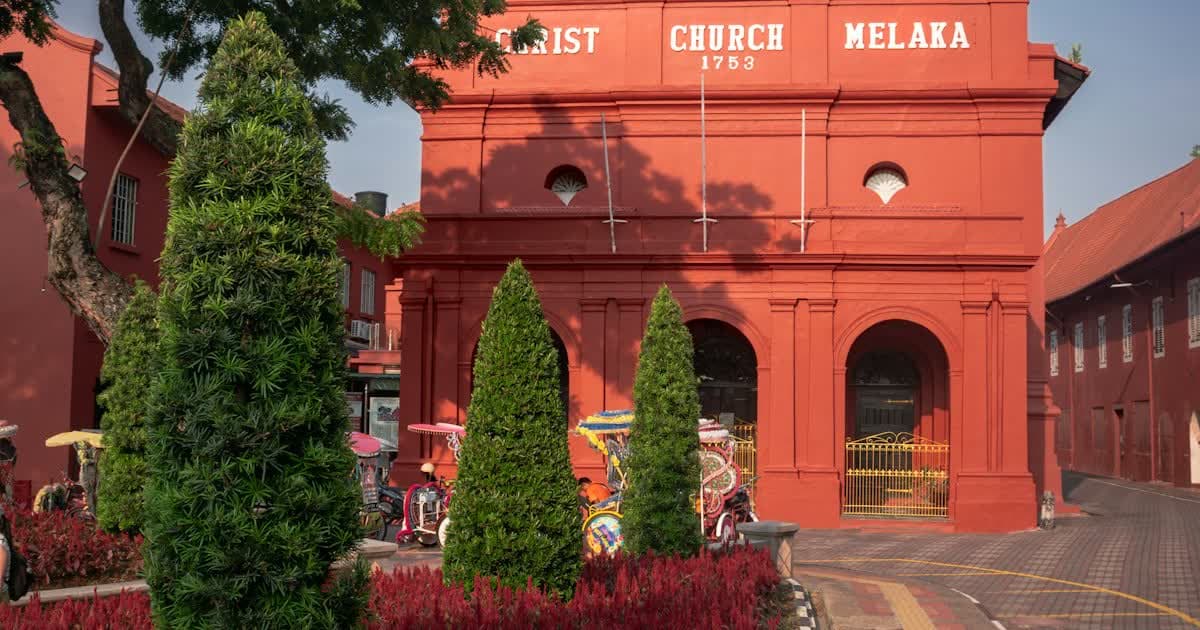
Christ Church Melaka
Constructed in 1753 to commemorate a century of Dutch rule, Christ Church features Dutch Reformed architecture and remains an active Anglican church today. Notable features include the original handmade pews, a Bible from 1773, and ceiling beams made from single trees.
- Location: Dutch Square, adjacent to Stadthuys
- Access: Free, respectful visitors welcome during non-service hours
- Sunday services: 8:30 AM (English), 10:30 AM (Tamil/Mandarin)
Dutch Square (Red Square)
The heart of Dutch Malacca, this plaza is surrounded by colonial buildings, all painted the distinctive terracotta red. The Victorian-era fountain, clock tower, and surrounding structures create one of Malaysia's most photographed scenes.
Other Dutch Heritage:
- Dutch graveyard with ornate 17th-century tombstones
- Malacca River improvements and bridges
- Land records and cadastral systems still in use
- Street layouts in the old town area
The British Period (1786-1957)
British involvement in Malaysia began with the acquisition of Penang in 1786 and eventually expanded to encompass the entire Malay Peninsula and Borneo territories. The British period lasted the longest of any colonial power and had the most profound impact on modern Malaysia.
Key British Acquisitions:
- Penang (1786) - leased from Kedah Sultan
- Singapore (1819) - acquired by Stamford Raffles
- Malacca (1824) - exchanged with Dutch for Bencoolen
- Straits Settlements formed (1826) - Penang, Malacca, Singapore
- Federated Malay States (1895) - Perak, Selangor, Negeri Sembilan, Pahang
- Unfederated Malay States - Johor, Kedah, Perlis, Kelantan, Terengganu
- British North Borneo (1881) - Sabah
- Sarawak under Brooke family (1841-1946)
Architectural Legacy of British Malaya
The British introduced a range of architectural styles that dramatically transformed Malaysian cities:
Colonial Civic Buildings
The British constructed grand civic buildings to project imperial power and administrative efficiency. Key examples include:
- Sultan Abdul Samad Building, Kuala Lumpur (1897)
- Kuala Lumpur Railway Station (1910)
- High Court, Kuala Lumpur (1915)
- Town halls in Penang, Ipoh, and other cities
Shophouse Architecture
The quintessential urban form of British Malaya, shophouses combined ground-floor commercial space with upper-floor residential quarters. Covered five-foot ways provided pedestrian shelter from tropical sun and rain. Regional variations developed, with Penang and Malacca shophouses showing distinct characteristics.
Colonial Bungalows
Hill stations like Cameron Highlands, Fraser's Hill, and Penang Hill feature English-style bungalows adapted for the tropical climate. These often-preserved buildings evoke the era of planters, administrators, and colonial leisure.
Railway Heritage
The British developed an extensive railway network, and many heritage stations survive:
- Kuala Lumpur Railway Station (Moorish/Indo-Saracenic style)
- Ipoh Railway Station ("Taj Mahal of Ipoh")
- Butterworth Station
- Numerous smaller heritage stations
Rubber and Tin Industries
The economic transformation under British rule centered on rubber plantations and tin mining. Heritage sites include:
- Former tin mining areas (Kinta Valley, Klang Valley)
- Historic rubber estate buildings
- Mining museums (Kinta Tin Mining Museum)
- Plantation bungalows and factories
Impact of Colonial Rule
The colonial period's legacy is complex and contested:
Administrative and Legal Systems:
- Westminster-style parliamentary democracy
- Common law legal tradition
- Civil service structures
- Land administration systems
Economic Transformation:
- Introduction of rubber and palm oil industries
- Development of tin mining
- Creation of modern banking and commerce
- Infrastructure development (roads, railways, ports)
Social Changes:
- Mass migration from China and India
- Creation of plural society
- English-medium education
- Urbanization patterns
Challenges:
- Racial categorization and divide-and-rule policies
- Economic exploitation
- Cultural displacement
- Social hierarchies
Understanding the colonial period helps visitors appreciate both the architectural heritage they encounter and the complex historical processes that shaped modern Malaysia. The built environment of Malaysian cities is largely a product of this era, making colonial history visible in everyday surroundings.
Penang Heritage - George Town UNESCO World Heritage Site
George Town: Living UNESCO World Heritage
George Town, the capital of Penang, stands as one of Southeast Asia's most remarkable heritage cities. Inscribed as a UNESCO World Heritage Site in 2008 (jointly with Malacca), the historic core of George Town preserves an exceptional example of a multicultural trading port, with its built heritage and living traditions substantially intact.
What makes George Town extraordinary is both the preservation of old buildings and the continuation of living heritage. Unlike many heritage cities that have become museums or tourist showcases, George Town remains a functioning urban environment where traditional trades, religious practices, and community life continue in the same spaces they have occupied for generations.
UNESCO Recognition
George Town and Malacca were jointly inscribed under the criterion: "Melaka and George Town, historic cities of the Straits of Malacca, have developed over 500 years of trading and cultural exchanges between East and West in the Straits of Malacca. The influences of Asia and Europe have endowed the towns with a specific multicultural heritage that is both tangible and intangible."
George Town's Heritage Value:
- Over 5,000 buildings in the core zone
- 200+ individually gazetted heritage buildings
- Continuous use since the late 18th century
- Living multicultural communities
- Tangible and intangible heritage integration
- Authentic urban fabric largely intact
The Core and Buffer Zones
Core Zone (109.38 hectares):
The UNESCO-protected core zone encompasses the oldest parts of George Town, from the waterfront to the boundaries of the original settlement. This area contains the highest concentration of heritage buildings and is subject to strict conservation guidelines.
Key streets in the core zone:
- Beach Street (Lebuh Pantai) - banking and commercial heritage
- Pitt Street (Jalan Masjid Kapitan Keling) - Street of Harmony
- Armenian Street (Lebuh Armenian) - galleries and cultural venues
- Chulia Street (Lebuh Chulia) - Indian Muslim heritage
- Campbell Street (Lebuh Campbell) - local markets
- Love Lane - boutique hotels and cafes
Buffer Zone (150.04 hectares):
Surrounding the core zone, the buffer zone provides additional protection and manages development that might impact the heritage area.
Street of Harmony (Jalan Masjid Kapitan Keling)
This remarkable street exemplifies Penang's multicultural heritage, hosting the most important religious buildings of four faiths within a single stretch:
Kapitan Keling Mosque (1801)
The largest and oldest mosque in Penang, named after the Kapitan (headman) of the South Indian Muslim community. The distinctive Indo-Moorish architecture combines Indian, Moorish, and British influences.
Sri Mahamariamman Temple (1833)
Penang's oldest Hindu temple, dedicated to the goddess Mariamman. The ornate gopuram (entrance tower) features thousands of sculpted deities and mythological figures.
Goddess of Mercy Temple (Kuan Yin Teng, 1728)
One of Malaysia's oldest Chinese temples, predating British settlement. The temple is dedicated to Kuan Yin, the Goddess of Mercy, and remains actively used by the Hokkien and Cantonese communities.
St. George's Church (1818)
The oldest Anglican church in Southeast Asia, built by convict labor in Georgian colonial style. The distinctive white building with its pavilion and columns is a landmark of British colonial heritage.
This concentration of sacred sites demonstrates the tolerance and coexistence that characterized Penang's development.
The Clan Jetties (Pengkalan Weld)
One of George Town's most distinctive heritage features, the Clan Jetties are waterfront settlements built on stilts over the sea. These communities were established by Chinese immigrants in the 19th century, with each jetty associated with a specific clan or surname group.
The Seven Clan Jetties:
- Chew Jetty (Seh Chew Keo): The largest and most visited, with temples, shops, and a vibrant community
- Lim Jetty (Seh Lim Keo): Second largest, more residential
- Tan Jetty (Seh Tan Keo): Known for its shrine to the Jade Emperor
- Lee Jetty (Seh Lee Keo): Active fishing community
- Yeoh Jetty (Seh Yeoh Keo): Smaller, residential
- Mixed Clan Jetty (Keo Poh): No single clan dominance
- New Jetty (Sin Keo): More recent development
Visiting Tips:
- Best visited early morning or late afternoon
- Chew Jetty is the most accessible for tourists
- Respect residents' privacy
- Small donations to temples appreciated
- Watch for uneven walkways
Khoo Kongsi
The most elaborate of Penang's Chinese clan houses, Khoo Kongsi represents the wealth and influence of the Khoo clan in 19th-century Penang. The ornate assembly hall, temple, and theater showcase the highest levels of Chinese craftsmanship, with intricate carvings, gilded decorations, and ceramic figures imported from China.
- Location: 18 Cannon Square
- Hours: 9:00 AM - 5:00 PM daily
- Admission: RM10 adults, RM5 children
- Time needed: 1 hour
- Highlights: Main hall ceiling, stone dragons, clan theater
Cheong Fatt Tze Mansion (The Blue Mansion)
This stunning indigo-blue mansion exemplifies Straits Eclectic architecture, combining Chinese design principles with European materials and Malay influences. Built in the 1880s by wealthy merchant Cheong Fatt Tze, the 38-room mansion has been meticulously restored and now operates as a boutique hotel.
- Location: 14 Leith Street
- Tours: Daily at 11:00 AM, 2:00 PM, 3:30 PM
- Admission: RM17 for guided tour
- Time needed: 1 hour (tour)
- Note: Interior only accessible via guided tour
Penang Peranakan Mansion
A museum showcasing the distinctive Baba Nyonya (Peranakan) culture, housed in a restored mansion belonging to Chung Keng Kwee, a 19th-century tycoon. The collection includes furniture, costumes, jewelry, and household items illustrating the unique hybrid culture of the Straits Chinese.
- Location: 29 Church Street
- Hours: 9:30 AM - 5:00 PM daily
- Admission: RM20 adults
- Time needed: 1-1.5 hours
Street Art and Murals
George Town has gained international attention for its street art, which has become a major draw for visitors. The art falls into two categories:
Interactive Murals by Ernest Zacharevic:
Commissioned in 2012, these paintings incorporate real objects and encourage visitor interaction:
- "Little Children on a Bicycle"
- "Boy on a Bike"
- "Kids on Swing"
- "Brother and Sister on a Swing"
Steel Rod Sculptures by Sculpture at Work:
52 sculptures depicting local scenes, trades, and history, each with informative captions:
- Scattered throughout the heritage zone
- Offer historical and cultural context
- Form a self-guided walking trail
Important Note: While the street art has boosted tourism, some heritage advocates worry about the balance between contemporary art and historical preservation. Visitors should appreciate both aspects of George Town's character.
Heritage Walking Routes
Heritage Trail (2-3 hours):
The official heritage trail covers major sites including Fort Cornwallis, Clan Jetties, Street of Harmony, and key heritage buildings. Maps available at tourist offices.
Armeniam Street Walk (1 hour):
Focus on galleries, cafes, and cultural venues along Armenian Street and surrounding lanes.
Little India Walk (45 minutes):
Explore the Indian Muslim quarter along Chulia Street and surroundings, including textile shops, restaurants, and religious sites.
Waterfront Walk (1 hour):
From the ferry terminal along the Esplanade to Fort Cornwallis, taking in colonial-era landmarks and sea views.
Penang Heritage Festivals
- George Town Festival (August): Month-long arts and culture festival
- Chinese New Year (Jan/Feb): Elaborate celebrations in heritage areas
- Thaipusam (Jan/Feb): Procession from Penang Street temples
- Hungry Ghost Festival (August): Chinese opera and offerings
- Deepavali (Oct/Nov): Little India illuminations
Pre-Colonial History - Ancient Kingdoms and Early Civilizations
Before the Sultans: Malaysia's Ancient Past
Long before the Malacca Sultanate or European colonization, the Malaysian region was home to sophisticated civilizations influenced by Indian and Chinese cultures. This pre-colonial history, spanning roughly from the 2nd century CE to the founding of Malacca in 1400, reveals a fascinating chapter of Malaysian heritage that is often overshadowed by later periods.
Prehistoric Malaysia
Human presence in the Malaysian region dates back at least 40,000 years, with significant archaeological discoveries revealing continuous occupation:
Lenggong Valley (UNESCO World Heritage Site)
Located in Perak, the Lenggong Valley contains one of the world's longest records of early human occupation in a single locality. Key discoveries include:
- Perak Man (10,000 BCE): Southeast Asia's oldest complete skeleton, discovered in Gua Gunung Runtuh cave
- Stone tools spanning 1.83 million years: Among the oldest in the world
- Open-air and cave sites: 4 archaeological sites inscribed by UNESCO
- Paleolithic workshops: Evidence of tool-making activities
The Lenggong Archaeological Museum displays key finds and provides context for this remarkable heritage.
- Location: Lenggong, Perak (200 km north of Kuala Lumpur)
- Hours: 9:00 AM - 5:00 PM (closed Fridays 12:15-2:45 PM)
- Admission: RM5 adults
Niah Caves (Sarawak)
One of Southeast Asia's most important archaeological sites, Niah Caves has yielded:
- Human remains dating to 40,000 BCE
- Evidence of continuous habitation for 40,000 years
- Prehistoric rock paintings
- Ancient burial sites
The Hindu-Buddhist Kingdoms
From approximately the 2nd to 14th centuries CE, the Malaysian region was profoundly influenced by Indian civilization. This influence arrived through maritime trade and cultural exchange rather than military conquest, creating a synthesis of local and Indian traditions.
Langkasuka Kingdom (2nd - 14th Century CE)
One of the earliest recorded kingdoms in the Malay Peninsula, Langkasuka was located in the northern regions around modern-day Kedah and southern Thailand. Chinese records from the 2nd century CE describe diplomatic missions from Langkasuka to the Chinese court.
Key Features of Langkasuka:
- Hindu-Buddhist religious practices
- Sanskrit-influenced culture
- Maritime trading economy
- Diplomatic relations with China and India
- Capital possibly at Nakhon Si Thammarat (Thailand) or Kedah
Kedah Tua (Ancient Kedah)
Archaeological sites around the Bujang Valley in Kedah have revealed the most extensive evidence of Hindu-Buddhist civilization in Malaysia. Over 100 temple sites, known locally as candi, have been discovered.
Bujang Valley Archaeological Park:
This heritage park preserves and displays the remains of ancient temples, with reconstructed structures and an archaeological museum.
Notable Sites:
- Candi Bukit Batu Pahat (Temple 8): Best-preserved Hindu temple
- Candi Pendiat: Buddhist remains
- Candi Pengkalan Bujang: Riverside temple complex
- Archaeological Museum: Artifacts including lingams, Buddhist sculptures, Chinese ceramics
Archaeological Evidence:
- Temple foundations dating to 5th century CE
- Hindu and Buddhist iconography
- Sanskrit inscriptions
- Trade goods from India, China, and the Middle East
- Beads, ceramics, and metalwork
- Location: Merbok, Kedah (90 km from Penang)
- Hours: 9:00 AM - 5:00 PM (closed Fridays 12:00-2:45 PM)
- Admission: RM5 adults
- Time needed: 2-3 hours
Srivijaya Empire (7th - 13th Century CE)
While centered in Sumatra, the Srivijaya Empire extended its influence over the Malay Peninsula, controlling maritime trade through the Straits of Malacca. This Mahayana Buddhist empire left cultural and linguistic influences throughout the region.
Srivijaya's Impact on Malaysia:
- Spread of Buddhism throughout the region
- Sanskrit loan words in Malay language
- Maritime trade networks
- Buddhist monastery sites
- Cultural connections to Indonesia
Archaeological Evidence of Early Trade
The Malaysian region's strategic position on maritime routes meant exposure to international trade from very early times:
Trade Goods Found in Malaysian Sites:
- Chinese ceramics (Tang Dynasty onwards)
- Indian beads and jewelry
- Middle Eastern glass
- Bronze and iron implements
- Gold and silver artifacts
- Semiprecious stones
Evidence of Local Production:
- Iron smelting sites
- Boat-building traditions
- Pottery manufacture
- Metalworking
Santubong Archaeological Site (Sarawak)
Near Kuching, Santubong has revealed evidence of ancient trading communities and iron smelting industries:
- Chinese ceramics from 9th-13th centuries
- Iron smelting furnaces
- Gold artifacts
- Hindu-Buddhist objects
- Trading post remains
The Transition to Islam
The 13th to 15th centuries saw a gradual transition from Hindu-Buddhist to Islamic traditions, with the founding of Malacca marking a decisive turning point:
Evidence of Early Islam:
- Terengganu Inscription Stone (1303 CE): Earliest evidence of Malay-language Islamic inscription
- Conversion of rulers before general populations
- Continuation of pre-Islamic customs in court culture
- Gradual replacement of Sanskrit with Arabic influences
Terengganu Inscription Stone
This stone, discovered in Terengganu, bears an inscription dated to 1303 CE proclaiming Islamic law. It is considered the earliest evidence of Islamic administration in the Malay world and is now displayed at the National Museum in Kuala Lumpur.
Indigenous Peoples and Their Heritage
Before and alongside the development of Indianized kingdoms, indigenous peoples inhabited the Malaysian region. Their descendants continue to maintain distinct cultural traditions:
Peninsular Malaysia (Orang Asli):
- Negrito groups (Semang): Oldest inhabitants
- Senoi groups: Agricultural traditions
- Proto-Malay groups: Shared ancestry with coastal Malays
Sabah:
- Kadazan-Dusun peoples
- Murut communities
- Bajau sea nomads
Sarawak:
- Iban (formerly called Sea Dayak)
- Bidayuh (Land Dayak)
- Orang Ulu groups
- Penan hunter-gatherers
Visiting Pre-Colonial Sites
| Site | Location | Best Feature | Time Needed |
|---|---|---|---|
| Lenggong Valley | Perak | Prehistoric archaeology | Half day |
| Bujang Valley | Kedah | Hindu-Buddhist temples | 3-4 hours |
| Niah Caves | Sarawak | Ancient human remains | Full day |
| Santubong | Sarawak | Iron age trading site | 2-3 hours |
| National Museum | KL | Terengganu Stone | 2 hours |
Why Pre-Colonial History Matters
Understanding pre-colonial history enriches appreciation of Malaysia in several ways:
- Reveals the depth of civilization before European contact
- Explains cultural influences still present in Malay tradition
- Provides context for the region's strategic importance
- Demonstrates sophisticated governance and trade systems
- Shows the gradual, peaceful spread of Islam
- Highlights indigenous contributions to Malaysian identity
The archaeological evidence of these early civilizations is still being discovered, with new sites and artifacts regularly emerging. Visitors interested in this period can explore museums, archaeological parks, and research institutions throughout the country.
Independence Story - Merdeka 1957 and the Birth of Malaysia
The Road to Independence
The story of Malaysian independence is one of negotiation, nationalism, and nation-building that culminated in the historic declaration of Merdeka (independence) on August 31, 1957. Unlike many colonial independence movements, Malaysia's transition from British rule was achieved largely through political negotiation rather than armed conflict, though it was not without struggle and sacrifice.
The Rise of Nationalism
Malaysian nationalism developed gradually through the late 19th and early 20th centuries, gaining momentum after World War II:
Early Nationalist Movements:
- Educational reform movements (1900s-1930s)
- Malay intelligentsia and journalists
- Chinese associations and guilds
- Indian nationalist influences
- Islamic reform movements
Impact of Japanese Occupation (1941-1945)
The Japanese invasion shattered the myth of European invincibility and inadvertently accelerated nationalist sentiments:
- British forces surrendered in just 70 days
- Japanese promoted "Asia for Asians" ideology
- Different ethnic communities had varying experiences
- Malayan Communist Party resistance formed
- Economic hardship united populations
- Political awareness increased dramatically
Post-War Developments:
The returning British found a transformed political landscape:
- Malayan Union proposal (1946): Sparked Malay nationalist response
- Formation of UMNO (United Malays National Organisation) in 1946
- Rejection of Malayan Union due to fears of citizenship changes
- Federation of Malaya established (1948)
- Malayan Emergency (1948-1960): Communist insurgency
- Gradual advancement toward self-government
Key Figures of Independence
Tunku Abdul Rahman (1903-1990)
"Father of Independence" and first Prime Minister, Tunku Abdul Rahman led the negotiations with Britain and declared independence in 1957. An aristocrat from Kedah, educated in England, he combined Malay traditional leadership with modern political skills.
Key Contributions:
- President of UMNO (1951-1971)
- Led Alliance coalition to victory (1955)
- Negotiated independence terms in London
- Declared Merdeka at Stadium Merdeka
- First Prime Minister (1957-1970)
- Championed racial harmony and cooperation
Tun Tan Cheng Lock (1883-1960)
Founder of the Malayan Chinese Association (MCA) and key figure in Chinese political participation. His cooperation with UMNO established the Alliance model of multi-ethnic political coalition.
Tun V.T. Sambanthan (1919-1979)
President of the Malayan Indian Congress (MIC), representing Indian community interests in the independence process and ensuring multi-ethnic representation in the new nation.
Tun Abdul Razak (1922-1976)
Deputy to Tunku Abdul Rahman and second Prime Minister, he was instrumental in drafting the independence constitution and establishing the new nation's institutions.
The Alliance Formula
The success of Malayan independence owed much to the unique Alliance coalition, which united the three major ethnic communities:
- UMNO: United Malays National Organisation
- MCA: Malayan Chinese Association
- MIC: Malayan Indian Congress
This coalition won overwhelming victory in the 1955 elections, proving to the British that Malayans could govern themselves through democratic cooperation. The Alliance model established the power-sharing principle that continues to influence Malaysian politics today.
The London Negotiations
Tunku Abdul Rahman led a delegation to London in January-February 1956 to negotiate independence terms:
Key Issues Negotiated:
- Date of independence (August 31, 1957)
- Defense arrangements
- Economic agreements
- Constitutional framework
- Citizenship provisions
- Position of Malay Rulers
The negotiations were largely successful, with Britain agreeing to a smooth transfer of power. The resulting constitution balanced the interests of different communities while establishing the framework for democratic governance.
Merdeka Declaration - August 31, 1957
At midnight on August 31, 1957, at Stadium Merdeka in Kuala Lumpur, Tunku Abdul Rahman proclaimed independence before a crowd of 20,000:
"In the name of God, the Compassionate, the Merciful... I, Tunku Abdul Rahman Putra, Prime Minister of the Federation of Malaya, with the concurrence of Their Highnesses the Rulers of the Malay States, do hereby proclaim and declare on behalf of the people of the Federation of Malaya that as from the thirty-first day of August, nineteen hundred and fifty-seven, the Federation of Malaya shall be and is hereby declared to be a fully independent sovereign country within the Commonwealth of Nations."
The crowd responded with the cry of "Merdeka!" (Independence!) seven times, a moment forever etched in Malaysian national memory.
Formation of Malaysia (1963)
The story did not end in 1957. On September 16, 1963, the Federation of Malaya merged with Singapore, Sabah, and Sarawak to form Malaysia:
Key Events:
- Proposal by Tunku Abdul Rahman (1961)
- Cobbold Commission to assess Borneo opinions
- United Nations assessment
- Opposition from Philippines and Indonesia (Konfrontasi)
- Singapore's departure (1965)
- Solidification of current Malaysian federation
Independence Heritage Sites
Stadium Merdeka (Independence Stadium), Kuala Lumpur
The site of the historic independence declaration, Stadium Merdeka remains a symbol of national pride. The stadium hosted the ceremony and continues to be used for significant national events.
- Location: Jalan Stadium, Kuala Lumpur
- Visits: Exterior viewing; interior for events only
- Nearby: Stadium Negara, Chinese Assembly Hall
Dataran Merdeka (Independence Square), Kuala Lumpur
The ceremonial heart of the nation, this vast square was formerly the Selangor Club's cricket ground. At midnight on August 31, 1957, the Union Jack was lowered and the Malayan flag raised here for the first time.
Key Features:
- 95-meter flagpole (one of world's tallest)
- Sultan Abdul Samad Building backdrop
- Victorian fountain
- Heritage buildings surrounding the square
- Underground mall (Dataran Merdeka)
- Location: Jalan Raja, Kuala Lumpur
- Access: Free, open 24 hours
- Best time: Evening when buildings are illuminated
- Events: National Day celebrations (August 31)
Tunku Abdul Rahman Putra Memorial
Located near Lake Gardens, this memorial honors the Father of Independence with exhibits on his life and contributions.
- Location: Jalan Dato Onn, Kuala Lumpur
- Hours: 9:00 AM - 6:00 PM (closed Fridays 12:00-3:00 PM)
- Admission: Free
Memorial Sites by Region
| Site | Location | Significance |
|---|---|---|
| Tunku Abdul Rahman Birthplace | Alor Setar, Kedah | Childhood home |
| Carcosa Seri Negara | Kuala Lumpur | Colonial governor's residence |
| Independence Memorial | Melaka | Regional independence history |
| Old Parliament House | Kuala Lumpur | Early governance |
| National Monument | Kuala Lumpur | Remembering those who died in conflict |
National Day Celebrations
August 31st is celebrated as National Day (Hari Kebangsaan) with elaborate celebrations:
In Kuala Lumpur:
- Parade at Dataran Merdeka
- Military displays
- Cultural performances
- Fireworks
- Building illuminations
Nationwide:
- State-level celebrations
- Flag-raising ceremonies
- Patriotic events
- Community gatherings
Visitors during late August can witness the patriotic spirit as the country prepares for National Day. Malaysia Day (September 16) celebrates the formation of Malaysia and is also a public holiday.
The Legacy of Independence
The independence movement established several enduring principles:
- Multi-ethnic cooperation as the foundation of governance
- Constitutional monarchy with democratic parliament
- Federal structure respecting state autonomy
- Citizenship framework for diverse populations
- Foundation for economic development
Understanding the independence story provides context for contemporary Malaysia, explaining the political structures, inter-ethnic relations, and national symbols that visitors encounter throughout the country.
Museums - Exploring Malaysian History Through Collections
Malaysia's Museum Landscape
Malaysia hosts over 100 museums covering every aspect of the nation's history, culture, and heritage. From world-class national institutions to specialized local collections, these museums provide essential context for understanding Malaysian civilization. This guide highlights the most significant museums for history enthusiasts.
National Museum (Muzium Negara), Kuala Lumpur
The flagship museum of Malaysia, the National Museum houses the country's most important historical collections and provides a comprehensive overview of Malaysian history from prehistoric times to the present.
Building Architecture:
The museum building itself is significant, designed in the traditional Malay palace style with features including:
- Minangkabau-style roof
- Large murals on the facade depicting Malaysian history
- Opened in 1963
- Major renovation completed in 2006
Permanent Galleries:
Gallery A - Early History:
- Prehistoric artifacts from Lenggong and Niah
- Hindu-Buddhist period objects
- Bujang Valley discoveries
- Terengganu Inscription Stone (oldest Islamic inscription)
Gallery B - Malay Kingdoms:
- Malacca Sultanate artifacts
- Royal regalia
- Traditional Malay culture
- Court traditions and customs
Gallery C - Colonial Era:
- Portuguese, Dutch, British periods
- Independence movement
- Japanese Occupation
- Multi-ethnic development
Gallery D - Modern Malaysia:
- Federation formation
- Economic development
- Contemporary culture
- National achievements
Practical Information:
- Location: Jalan Damansara, Kuala Lumpur
- Hours: 9:00 AM - 6:00 PM daily
- Admission: RM5 adults, RM2 children
- Time needed: 2-3 hours
- Audio guide: Available in multiple languages
- Facilities: Cafe, museum shop, parking
Islamic Arts Museum Malaysia (IAMM), Kuala Lumpur
The largest museum of Islamic arts in Southeast Asia, IAMM houses over 7,000 artifacts spanning 1,400 years of Islamic civilization. While the focus is art rather than history per se, the collection illuminates Islamic cultural heritage with implications for Malaysian history.
Major Collections:
- Architecture Gallery: Models of famous mosques worldwide
- Quran and Manuscripts: Rare manuscripts and calligraphy
- Ceramics: Chinese Islamic ceramics
- Textiles: Including Malaysian songket
- Metalwork: Arms, armor, and decorative objects
- Jewelry: Pieces from across the Islamic world
- Malay World Gallery: Malaysian Islamic heritage specifically
Highlights:
- Scale model of Masjid al-Haram (Mecca)
- Ottoman Turkish gallery
- Living room of a Damascus house
- Southeast Asian Islamic arts
- Contemporary Islamic art exhibitions
Practical Information:
- Location: Jalan Lembah Perdana (near Lake Gardens)
- Hours: 10:00 AM - 6:00 PM daily
- Admission: RM14 adults (foreigners)
- Time needed: 2-3 hours
- Restaurant: Award-winning Middle Eastern cuisine
- Shop: High-quality Islamic arts
Penang State Museum
Housed in a heritage building dating to 1821, the Penang Museum provides an excellent introduction to Penang's history and multicultural heritage.
Collections:
- Early history and archaeology
- Colonial period artifacts
- Multicultural heritage objects
- Penang in World War II
- Chinese community history
- Indian community heritage
- Independence movement
Practical Information:
- Location: Farquhar Street, George Town
- Hours: 9:00 AM - 5:00 PM (closed Fridays 12:15-2:45 PM)
- Admission: RM1 adults
- Time needed: 1-2 hours
Peranakan (Baba Nyonya) Museums
The Peranakan (Straits Chinese) culture represents a unique heritage deserving special attention. Several excellent museums focus on this distinctive community:
Baba Nyonya Heritage Museum, Malacca
A restored Peranakan townhouse displaying authentic furnishings, costumes, and household items in their original context. The guided tours explain Peranakan customs, weddings, and daily life.
- Location: 48-50 Jalan Tun Tan Cheng Lock, Malacca
- Hours: 10:00 AM - 5:00 PM daily
- Admission: RM18 adults (includes guided tour)
- Time needed: 1 hour
Penang Peranakan Mansion
A wealthy merchant's mansion now housing extensive Peranakan collections including furniture, costumes, jewelry, and ceremonial objects.
- Location: 29 Church Street, George Town
- Hours: 9:30 AM - 5:00 PM daily
- Admission: RM20 adults
- Time needed: 1-1.5 hours
Pinang Peranakan Mansion vs Baba Nyonya Museum Comparison:
| Aspect | Malacca Baba Nyonya | Penang Peranakan |
|---|---|---|
| Style | Original townhouse | Grand mansion |
| Tours | Guided only | Self-guided |
| Collection size | Intimate | Extensive |
| Photography | Restricted | Allowed |
| Time needed | 1 hour | 1.5 hours |
| Atmosphere | Family home | Museum display |
War Museums and Memorials
National Monument (Tugu Negara), Kuala Lumpur
Bronze sculpture honoring those who died fighting for Malaysia's freedom, particularly during the Malayan Emergency (1948-1960). The sculptural group, designed by Felix de Weldon (who also created the Iwo Jima Memorial), depicts seven soldiers symbolizing the qualities of Malaysian defenders.
- Location: Lake Gardens, Kuala Lumpur
- Access: Free, open 7:00 AM - 6:00 PM
- Time needed: 30 minutes
Penang War Museum
Located in a former British fort on Bukit Batu Maung, this museum explores World War II in Penang, particularly the Japanese Occupation. The underground tunnels and military structures add atmosphere to the exhibits.
- Location: Batu Maung, Penang (20 km from George Town)
- Hours: 9:00 AM - 6:00 PM daily
- Admission: RM20 adults
- Time needed: 2 hours
Sandakan Memorial Park, Sabah
Commemorating the infamous Sandakan Death Marches during World War II, where nearly 2,500 Australian and British prisoners of war died. The memorial stands on the site of the former POW camp.
- Location: Sandakan, Sabah
- Hours: 7:00 AM - 5:00 PM daily
- Admission: Free
- Time needed: 1-2 hours
Submarine Museum (Muzium Kapal Selam), Malacca
A decommissioned French-built submarine now serving as a museum, offering insights into Cold War-era Malaysian maritime defense.
- Location: Klebang, Malacca
- Hours: 9:00 AM - 5:00 PM daily
- Admission: RM10 adults
- Time needed: 1 hour
Regional and Specialized Museums
Sarawak Museum, Kuching
One of Southeast Asia's finest ethnographic museums, with world-class collections of Borneo indigenous cultures, natural history, and archaeology. The original building dates to 1891.
- Location: Jalan Tun Haji Openg, Kuching
- Hours: 9:00 AM - 4:45 PM (closed Fridays)
- Admission: Free
- Time needed: 2-3 hours
Sabah Museum, Kota Kinabalu
Comprehensive collection covering Sabah's indigenous peoples, natural history, and archaeology. The building is designed in traditional longhouse style.
- Location: Jalan Muzium, Kota Kinabalu
- Hours: 9:00 AM - 5:00 PM (closed Fridays 12:00-2:00 PM)
- Admission: RM15 adults
- Time needed: 2 hours
Kinta Tin Mining Museum, Kampar
Chronicles the tin mining industry that shaped modern Perak and Malaysia. Housed in a restored tin dredge building with period equipment.
- Location: Kampar, Perak
- Hours: 9:00 AM - 5:00 PM (closed Mondays)
- Admission: RM5 adults
- Time needed: 1-1.5 hours
Museum of Asian Art (University of Malaya)
Academic collection of Asian ceramics and art, particularly strong in Chinese trade ceramics found in Malaysian archaeological sites.
- Location: University of Malaya, Kuala Lumpur
- Hours: 9:00 AM - 5:00 PM (weekdays only)
- Admission: Free
- Time needed: 1 hour
Museum Tips for Visitors
- Timing: Most museums close for Friday prayers (12:00-2:45 PM)
- Photography: Policies vary; ask before photographing
- Air conditioning: Museums provide relief from heat
- Audio guides: Available at major museums
- Combine visits: Many museums cluster in the same areas
- Special exhibitions: Check websites for temporary shows
- School holidays: Avoid if seeking quiet visits
Heritage Architecture - Shophouses, Temples, Mosques & Colonial Buildings
Architectural Heritage of Malaysia
Malaysia's built heritage represents one of the most diverse architectural legacies in Asia, reflecting the country's position as a cultural crossroads. From pre-colonial Malay palaces to elaborate Chinese temples, from ornate Indian shrines to grand European colonial structures, the architectural landscape tells the story of Malaysia's multicultural development.
Traditional Malay Architecture
The indigenous Malay architectural tradition developed sophisticated responses to the tropical climate while expressing cultural values and social hierarchies.
Key Characteristics:
- Elevated structures: Houses raised on stilts for ventilation and flood protection
- Pitched roofs: Steep angles for rapid water runoff
- Open verandahs: Transitional spaces between interior and exterior
- Natural materials: Timber, bamboo, palm leaves (atap)
- Minimal walls: Maximizing cross-ventilation
- Orientation: Often facing Mecca for prayer convenience
Traditional House Types:
Rumah Melaka (Malacca House):
- Long, narrow floor plan
- Front staircase with roof
- Tiled roof replacing original thatch
- Found throughout central peninsular
Rumah Negeri Sembilan:
- Distinctive curved "buffalo horn" roof (bumbung panjang)
- Influenced by Minangkabau ancestors
- Multi-tiered roof structure
- Matrilineal family organization reflected in design
Rumah Kutai (Perak):
- Oldest surviving Malay house type
- Extremely tall peaked roof
- Simple rectangular plan
- Rare surviving examples in Kuala Kangsar
Malay Palaces:
Royal palaces (istana) elaborated on vernacular traditions:
- Larger scale and finer materials
- Ceremonial halls (balai)
- Hierarchical spatial organization
- Royal yellow color for roofing
- Ornate wood carvings (ukiran)
Notable Examples:
- Istana Jahar, Kelantan: Royal customs and traditions museum
- Istana Seri Menanti, Negeri Sembilan: Tallest wooden palace in Malaysia
- Istana Besar, Johor: Combining Malay and European elements
- Reconstructed Sultan's Palace, Malacca: Based on historical records
Chinese Architecture in Malaysia
Chinese immigrants brought architectural traditions that adapted to the Malaysian context while maintaining essential cultural elements.
Clan Associations (Kongsi):
Grand assembly halls combining ancestral temple, meeting hall, and community center:
- Ornate roofs with ceramic figures
- Gilded interiors with carved panels
- Central altar for ancestor worship
- Stone lions at entrance
- Dragon columns
Best Examples:
- Khoo Kongsi, Penang: Most elaborate in Malaysia
- Teochew Temple (Han Jiang), Penang: Teochew community center
- Hainan Temple, Malacca: Hainanese community heritage
- Cheng Hoon Teng, Malacca: Oldest Chinese temple in Malaysia (1645)
Temple Architecture:
Hokkien Style:
- Elaborate swallowtail roofs
- Ceramic ridge ornaments
- Red as dominant color
- Intricate door gods
Cantonese Style:
- More restrained decoration
- Grey brick and ceramic details
- Carved stone balustrades
Key Temple Elements:
- Main hall (tian gong)
- Side chambers for deities
- Central courtyard (tianijng)
- Entry pavilions
- Ritual furnaces
Shophouse Architecture
The quintessential urban form of Malaysian cities, shophouses represent a unique hybrid tradition combining Chinese building organization with Malay climate responses and European materials.
Shophouse Characteristics:
- Ground floor for commerce, upper floors residential
- Continuous five-foot way (covered walkway)
- Narrow frontage, deep plan
- Interior courtyards (airwells) for ventilation
- Party walls between adjacent units
Evolution of Shophouse Styles:
Early Shophouse (1780s-1840s):
- Simple facades
- Timber construction
- Attap (palm leaf) roofing
- Minimal ornamentation
Southern Chinese Style (1840s-1900s):
- Brick and timber
- Clay tile roofing
- Simple pilasters
- Carved panels and transoms
Straits Eclectic (1890s-1940s):
- European ornamental influences
- Elaborate plasterwork
- Decorative tiles
- Colorful facades
- Louvered windows
Art Deco (1930s-1950s):
- Streamlined forms
- Geometric patterns
- Curved corners
- Ventilation blocks
- Moderne lettering
Regional Variations:
| Region | Distinguishing Features |
|---|---|
| Penang | European Neoclassical influence, elaborate tiles |
| Malacca | Dutch and Portuguese details, Portuguese tiles |
| Singapore | Ornate Straits Eclectic style |
| Ipoh | Art Deco influence, mining wealth expressed |
| Kuching | Brooke-era colonial influence |
Indian Architecture
Hindu temples in Malaysia follow South Indian traditions, particularly the Dravidian style:
Key Elements:
- Gopuram: Ornate entrance towers covered in painted stucco figures
- Mandapa: Columned hall for ceremonies
- Garbha Griha: Inner sanctum housing the deity
- Prakara: Boundary walls defining sacred space
Notable Hindu Temples:
- Sri Mahamariamman Temple, KL: Kuala Lumpur's oldest Hindu temple
- Sri Mahamariamman Temple, Penang: Street of Harmony landmark
- Batu Caves Temple Complex: Malaysia's most important Hindu shrine
- Arulmigu Sri Rajakaliamman: Glass temple in Johor
Sikh Architecture:
Gurdwaras (Sikh temples) feature distinctive domes and white facades:
- Gurdwara Sahib, Penang: Historic Sikh community center
- Tatt Khalsa Diwan, KL: Major Kuala Lumpur gurdwara
Islamic Architecture
Mosque architecture in Malaysia shows evolution from vernacular to Middle Eastern and contemporary styles:
Traditional Malay Mosques:
- Tiered pyramidal roofs (similar to vernacular houses)
- Wooden construction
- Minimal decoration
Examples:
- Masjid Kampung Laut, Kelantan: Oldest surviving mosque in Malaysia
- Masjid Tranquerah, Malacca: Traditional Sumatran style
Mughal/Indo-Saracenic Style:
- Onion domes
- Minarets
- Pointed arches
- Often introduced during British period
Examples:
- Masjid Kapitan Keling, Penang: Indo-Moorish masterpiece
- Masjid Jamek, KL: Mughal-style landmark
- Ubudiah Mosque, Kuala Kangsar: Golden-domed royal mosque
Contemporary Mosques:
Modern Malaysian mosques often blend traditional elements with contemporary design:
- National Mosque (Masjid Negara), KL: Modernist landmark
- Blue Mosque (Sultan Salahuddin), Shah Alam: Southeast Asia's largest mosque
- Crystal Mosque, Terengganu: Steel and glass contemporary design
Colonial Architecture
British Colonial Styles:
Anglo-Indian / Indo-Saracenic:
Combining British forms with Indian and Moorish elements:
- Sultan Abdul Samad Building, KL
- Kuala Lumpur Railway Station
- Ipoh Railway Station
Palladian / Neoclassical:
Formal European symmetry and columns:
- High Court, KL
- Penang City Hall
- Victoria Memorial Hall, Penang
Tudor / Arts and Crafts:
Mock-Tudor buildings in hill stations:
- Cameron Highlands rest houses
- Fraser's Hill bungalows
- Penang Hill houses
Tropical Colonial:
Adapted for climate:
- Deep verandahs
- High ceilings
- Louvered windows
- Raised foundations
Portuguese Heritage:
A Famosa fortress and St. Paul's Church in Malacca represent 16th-century Portuguese military and religious architecture.
Dutch Heritage:
The Stadthuys complex in Malacca exemplifies Dutch civic architecture with thick walls, heavy timber, and the distinctive red color.
Visiting Heritage Architecture
Best Areas for Shophouses:
- George Town, Penang (UNESCO zone)
- Malacca old town (UNESCO zone)
- Ipoh old town
- Kuala Lumpur Petaling Street area
- Kuching old town
Guided Architecture Tours:
Available in George Town and Malacca through heritage organizations and tour operators. Recommended for understanding architectural details and history.
Conservation Challenges:
Heritage buildings face pressures from development, neglect, and inappropriate renovation. Visitors can support heritage preservation by patronizing heritage businesses and supporting conservation organizations.
Borneo Heritage - Indigenous Cultures and History
The Unique Heritage of Malaysian Borneo
The states of Sabah and Sarawak, occupying the northern portion of Borneo island, possess heritage traditions distinct from Peninsular Malaysia. Home to dozens of indigenous ethnic groups with diverse languages, customs, and material cultures, Borneo's heritage represents some of the most distinctive traditions in Southeast Asia.
Historical Context
Borneo's history differs significantly from the peninsula:
- Limited direct influence from Hindu-Buddhist civilizations
- Indigenous animist traditions persisted longer
- Coastal Muslim sultanates from 15th century onward
- Unique colonial history: Sarawak under the Brooke Rajahs, Sabah under British North Borneo Company
- Indigenous peoples remained majority populations
- Head-hunting traditions until early 20th century
- Longhouse communities as basic social units
Major Indigenous Groups
Sarawak:
Iban (Sea Dayak):
- Largest indigenous group in Sarawak (30% of population)
- Traditionally rice farmers and warriors
- Famous for elaborate textiles (pua kumbu)
- Historical head-hunting traditions
- Longhouse communities remain important
- Rich oral literature and music traditions
Bidayuh (Land Dayak):
- Concentrated in southwest Sarawak
- Distinctive barrel-shaped skull houses (baruk)
- Agricultural traditions
- Complex traditional religion
- Known for bamboo-based crafts
Orang Ulu (Upriver People):
Collective term for various groups including:
- Kayan: Known for elaborate beadwork and aristocratic traditions
- Kenyah: Similar to Kayan, with stratified society
- Kelabit: Highland rice farmers, largely Christian
- Penan: Former nomadic hunter-gatherers
Melanau:
- Coastal people historically important in sago production
- Unique tall houses on stilts
- Mix of Muslim, Christian, and animist traditions
- Distinctive festivals and ceremonies
Sabah:
Kadazan-Dusun:
- Largest indigenous group in Sabah (30% of population)
- Rice farmers with elaborate harvest festival (Tadau Kaamatan)
- Important Mount Kinabalu mythology
- Bobohizan (priestesses) maintain ritual traditions
- Rich musical traditions including sompoton (mouth organ)
Murut:
- Traditionally inhabiting interior highlands
- Last group to abandon head-hunting
- Known for lansaran (trampoline) ceremonies
- Communal longhouses
- Expert hunters and warriors
Bajau:
- Sea-faring people of coastal areas
- "Sea Gypsies" tradition of boat-dwelling
- Expert horsemen in west coast areas
- Important fishing communities
- Distinctive boat-building traditions
Rungus:
- Northern Sabah longhouse communities
- Distinctive beadwork and metalwork
- Maintain traditional animist practices
- Known for gong ensembles
Longhouse Culture
The longhouse represents the fundamental social unit of many Borneo peoples. These extended communal dwellings can house an entire village under one roof, with individual family apartments opening onto a shared gallery.
Longhouse Features:
- Raised on hardwood pillars
- Running 100-200 meters or more
- Common gallery (ruai) for community life
- Individual family rooms (bilik)
- Head gallery for trophy skulls (historically)
- Hierarchical layout reflecting social status
Visiting Longhouses:
Sarawak:
- Iban longhouses: Batang Ai region, Lemanak River
- Bidayuh longhouses: Annah Rais near Kuching
- Kelabit longhouses: Bario Highlands (air access only)
- Kayan/Kenyah longhouses: Upper Rejang River
Sabah:
- Rungus longhouses: Kudat area
- Murut longhouses: Interior areas accessible from Keningau
Visiting Etiquette:
- Remove shoes before entering
- Ask permission for photography
- Bring gifts (food, household items)
- Accept offered rice wine (tuak) graciously
- Dress modestly
- Participate in offered activities
- Consider homestay for authentic experience
Head-Hunting Heritage
The practice of taking enemy heads was central to the social and spiritual life of many Borneo peoples until the early 20th century. While long discontinued, the cultural significance remains important for understanding Borneo heritage.
Cultural Context:
- Heads believed to contain spiritual power
- Required for various ceremonies and life transitions
- Demonstrated warrior prowess
- Accumulated community spiritual power
- Displayed in special skull galleries
Historic Artifacts:
Museums in Sarawak and Sabah display head-hunting related artifacts, and some longhouses still maintain historical skull collections as heritage items.
Sarawak Museum Exhibits:
The Sarawak Museum in Kuching has extensive collections related to head-hunting practices, displayed in cultural context rather than sensationalized.
The White Rajahs of Sarawak
Sarawak's unique history under the Brooke family (1841-1946) created a distinctive colonial experience:
James Brooke (Raja, 1841-1868):
An English adventurer who helped the Sultan of Brunei suppress a rebellion and received Sarawak as reward. He established personal rule over the territory, eventually independent of both Brunei and Britain.
Charles Brooke (Raja, 1868-1917):
Expanded territory and established the administrative and legal foundations of the state.
Vyner Brooke (Raja, 1917-1946):
Last White Raja, ceded Sarawak to Britain after Japanese Occupation.
Brooke Era Heritage:
- Fort Margherita, Kuching: Defensive fort and museum
- Astana: Former Rajah's palace (visible from river)
- Sarawak Museum: Founded by Charles Brooke
- Court House: Neo-Classical administrative building
- Old Post Office: Colonial-era structure
The Brooke Gallery
Located in Fort Margherita, this museum chronicles the White Rajah period with artifacts, documents, and personal effects.
- Location: Fort Margherita, Kuching
- Hours: 9:00 AM - 4:45 PM (closed Fridays)
- Admission: RM20 adults
- Time needed: 1-1.5 hours
Indigenous Arts and Crafts
Textiles:
- Pua kumbu (Iban): Ikat-dyed ceremonial blankets
- Beadwork: Intricate patterns on cloth, baskets, baby carriers
- Bark cloth: Traditional material, now rare
Woodcarving:
- House decorations
- Funeral poles (kelirieng)
- Masks for ceremonies
- Sape (stringed instrument)
Metalwork:
- Brass cannons
- Mandau (sword) with decorated hilts
- Jewelry and ornaments
Basketry:
- Utilitarian and ceremonial baskets
- Distinct patterns by ethnic group
- Natural dyes
Where to See Traditional Crafts:
- Sarawak Cultural Village
- Sabah Museum
- Mari-Mari Cultural Village (Sabah)
- Main Bazaar, Kuching
- Sunday Market, Kuching (Satok Market)
- Handicraft centers in both states
Indigenous Festivals
Gawai Dayak (June 1-2):
Harvest festival celebrated by Iban and Bidayuh. Major celebration with traditional food, rice wine (tuak), dancing, and ceremonies.
Tadau Kaamatan (May 30-31):
Kadazan-Dusun harvest festival with elaborate rituals, beauty pageants, and the selection of the Unduk Ngadau (harvest queen).
Kelabit Highland Festival:
Cultural celebration in Bario with traditional sports, music, and food.
Pesta Kalimaran (February):
Murut festival with traditional games including lansaran (trampoline) competitions.
Visiting during these festivals provides extraordinary cultural experiences, though accommodation should be booked well in advance.
Heritage Sites Summary
| Site | Location | Focus | Time Needed |
|---|---|---|---|
| Sarawak Cultural Village | Kuching | All ethnic groups | Half day |
| Mari-Mari Cultural Village | Kota Kinabalu | Sabah peoples | 3-4 hours |
| Sarawak Museum | Kuching | Comprehensive | 2-3 hours |
| Sabah Museum | Kota Kinabalu | Sabah heritage | 2 hours |
| Fort Margherita | Kuching | Brooke period | 1-1.5 hours |
| Monsopiad Cultural Village | Penampang, Sabah | Kadazan warrior | 2 hours |
Heritage Towns - Taiping, Ipoh, Kuching & Beyond
Beyond Malacca and George Town: Malaysia's Heritage Towns
While the UNESCO-listed cities of Malacca and George Town attract the most international attention, Malaysia possesses numerous other towns with significant heritage value. These secondary heritage destinations often offer more authentic experiences, less tourist congestion, and rewarding exploration for those willing to venture beyond the usual circuit.
Taiping, Perak - Malaysia's First Modern Town
Taiping holds a unique place in Malaysian history as the site of many national firsts during the British colonial period. Once the capital of Perak and the center of the tin mining industry, Taiping retains an atmosphere of faded colonial grandeur combined with genuine local charm.
Historical Significance:
- First modern town planned by the British in Malaya
- Site of first railway line in Malaya (1885)
- First museum in Malaya (Perak Museum, 1883)
- First Lake Garden in Malaya
- First English school
- First public library
- Capital of Perak until 1937
Heritage Highlights:
Lake Gardens (Taman Tasik Taiping):
Created in 1880 on former tin mining land, these gardens remain one of Malaysia's most beautiful parks. Ancient rain trees line the lakeshores, some over 100 years old.
Perak Museum:
Malaysia's first museum, founded in 1883, houses excellent natural history and ethnography collections. The Victorian building is heritage-listed.
- Hours: 9:00 AM - 5:00 PM (closed Fridays 12:00-2:45 PM)
- Admission: RM2 adults
- Time needed: 1-1.5 hours
Old Town Walking:
The town center retains colonial-era buildings including:
- Old Rest House (1894)
- King Edward VII School (1906)
- All Saints Church (1886)
- Taiping Prison (1879, Malaysia's oldest)
- Heritage shophouses along Jalan Kota
Burmese Pool:
Natural jungle pool used for recreational swimming during the colonial era.
Maxwell Hill (Bukit Larut):
Malaysia's oldest hill station, accessible only by government Land Rover. Colonial bungalows and cooler temperatures.
Practical Information:
- Location: 90 km north of Ipoh
- Getting there: Train to Taiping station, bus from major cities
- Best time: Avoids weekend crowds
- Stay duration: 1-2 days recommended
Ipoh, Perak - The Tin Mining Capital
Perak's state capital and Malaysia's third-largest city, Ipoh developed during the tin mining boom of the late 19th and early 20th centuries. Recent years have seen heritage revival transforming Ipoh into a destination for heritage tourism and culinary exploration.
Historical Context:
- Rapid growth during tin mining era (1880s-1930s)
- Wealthy mining families built elaborate mansions
- Important trading center connecting coast and interior
- Mix of Cantonese, Hakka, and other Chinese communities
- Declined after tin prices collapsed (1980s)
- Recent heritage revival and gentrification
Heritage Highlights:
Old Town (West of Kinta River):
The colonial core contains fine examples of Straits Eclectic and Art Deco architecture:
- Railway Station ("Taj Mahal of Ipoh," 1917)
- Town Hall (1916)
- High Court (1928)
- Birch Memorial Clock Tower (1909)
- FMS Bar & Restaurant building
- Heritage shophouses along Jalan Sultan Yusuf
New Town (East of Kinta River):
Developed later but containing significant heritage:
- Concubine Lane (Lorong Panglima) - narrow shopping lane
- Kong Heng Square - revitalized heritage area
- Art galleries and cafes in restored shophouses
- Antique shops and handicraft stores
Cave Temples:
Ipoh's limestone hills host important Chinese temples:
- Sam Poh Tong: Largest cave temple in Malaysia
- Perak Tong: Paintings and Buddha statues
- Kek Lok Tong: Gardens and lake
Kellie's Castle:
Unfinished mansion built by Scottish planter William Kellie Smith in the 1910s. The eccentric Moorish-style structure was abandoned after his death.
- Location: 25 km south of Ipoh
- Hours: 9:00 AM - 6:00 PM daily
- Admission: RM10 adults
- Time needed: 1 hour
Practical Information:
- Location: 200 km north of Kuala Lumpur
- Getting there: Train (2 hours from KL), bus, driving
- Food: Famous for Chinese cuisine (white coffee, bean sprouts chicken, hor fun)
- Stay duration: 1-2 days recommended
Kuching, Sarawak - City of Cats and Heritage
The capital of Sarawak retains significant heritage from its unique history under the White Rajahs. The compact old town along the Sarawak River contains well-preserved colonial buildings and Chinese shophouses in a relaxed atmosphere.
Historical Significance:
- Capital under Brooke White Rajahs (1841-1941)
- Trading port connecting interior and coast
- Mix of Malay, Chinese, and indigenous populations
- Relatively undamaged in World War II
- Strong heritage conservation culture
Heritage Highlights:
Waterfront:
- The Astana (former Rajah's palace, visible from south bank)
- Fort Margherita (Brooke-era fortress)
- Square Tower (1879)
- Promenade and riverfront park
Main Bazaar:
The oldest street in Kuching, lined with shophouses containing antique shops, galleries, and cafes. Excellent for browsing indigenous crafts.
Colonial Buildings:
- Old Courthouse (1871): Victorian Gothic with Brooke-era extensions
- Round Tower: Former dispensary
- General Post Office (1931)
- Pavilion Building (1909)
Chinese Heritage:
- Tua Pek Kong Temple (1770s): Oldest temple in Sarawak
- Chinese History Museum: In old Chinese Court building
- Shophouses along Carpenter Street
- Hong San Si Temple
Indian and Malay Heritage:
- Old State Mosque (1968, replacing 1847 original)
- Indian Mosque
- Malay kampong areas
- Satok Market (Sunday)
Practical Information:
- Location: West Sarawak coast
- Getting there: Flights from major cities, no rail connection
- Best time: Avoid heavy monsoon (November-February)
- Stay duration: 2-3 days minimum
- Day trips: Sarawak Cultural Village, Bako National Park
Other Heritage Towns Worth Visiting
Kota Bharu, Kelantan:
- Traditional Malay culture stronghold
- Istana Jahar (Royal Customs Museum)
- Handicraft workshops
- Central Market (Siti Khadijah Market)
- Islamic heritage
Alor Setar, Kedah:
- Birthplace of Tunku Abdul Rahman
- Zahir Mosque (one of Malaysia's grandest)
- Kedah Royal Museum
- Balai Besar (Great Hall)
- Nobat Tower
Kuala Terengganu:
- Chinatown heritage (Kampung Cina)
- State Museum complex (largest in Southeast Asia)
- Crystal Mosque
- Islamic heritage sites
- Traditional boat-building
Kota Kinabalu, Sabah:
- Filipino Market
- Signal Hill Observatory
- Atkinson Clock Tower (1905)
- Post-war reconstruction heritage
Sandakan, Sabah:
- Agnes Keith House (colonial writer's home)
- English Tea House
- Japanese Cemetery
- Former capital heritage
Heritage Town Comparison
| Town | Best For | Time Needed | Unique Feature |
|---|---|---|---|
| Taiping | Colonial heritage, nature | 1-2 days | Malaysia's firsts |
| Ipoh | Architecture, food | 1-2 days | Tin mining legacy |
| Kuching | Brooke era, indigenous culture | 2-3 days | White Rajah history |
| Kota Bharu | Malay culture | 1-2 days | Traditional crafts |
| Alor Setar | Royal heritage | 1 day | Independence history |
Tips for Heritage Town Visits
- Slow down: Heritage towns reward patient exploration
- Walk: Most heritage areas are compact and walkable
- Talk to locals: Stories and memories enrich the experience
- Support heritage businesses: Cafes and shops in restored buildings
- Avoid weekends: Less crowded for photography and exploration
- Combine purposes: Heritage towns often have excellent food cultures
- Check opening hours: Many sites close for Friday prayers
- Hire local guides: Available through tourism offices for deeper insight
Heritage Trails - Self-Guided Walks and Guided Tours
Exploring Malaysia's Heritage on Foot
Heritage trails offer the ideal way to discover Malaysia's historical sites, allowing visitors to absorb atmosphere, appreciate architectural details, and encounter the living culture that makes these places special. This chapter provides practical guidance for both self-guided walks and organized heritage tours across Malaysia's key destinations.
George Town Heritage Trails
George Town's compact UNESCO core zone is ideal for walking exploration, with several established trails:
The Official Heritage Trail (3-4 hours):
Marked by blue plaques, this trail covers the essential sites:
Route:
- Fort Cornwallis (starting point)
- Esplanade
- City Hall and Town Hall
- St. George's Church
- Penang Museum
- Goddess of Mercy Temple
- Kapitan Keling Mosque
- Cheong Fatt Tze (Blue) Mansion
- Acheen Street Mosque
- Khoo Kongsi
- Armenian Street
- Little India
- Clan Jetties
Practical Tips:
- Maps available at tourist information centers
- Best started early morning (8-9 AM) to avoid heat
- Include breakfast stop at local kopitiam
- Allow for spontaneous detours
- Wear comfortable walking shoes
- Carry water and umbrella
Street Art Trail (2 hours):
Follow the murals and iron sculpture artworks:
Key Locations:
- Ernest Zacharevic murals (Armenian Street area)
- Steel rod sculptures (throughout old town)
- Free maps at tourist offices and most cafes
- Best for photography in morning light
Little India Walk (1 hour):
Focus on the Indian Muslim heritage quarter:
Route:
- Queen Street
- Chulia Street
- King Street
- Pitt Street (southern end)
Highlights:
- Textile shops
- Spice vendors
- Indian restaurants
- Mosques and temples
- Flower garland sellers
Malacca Heritage Trails
Malacca's heritage sites cluster conveniently in the historic center:
Dutch Square and St. Paul's Hill Walk (2-3 hours):
Route:
- Dutch Square (Stadthuys, Christ Church)
- Porta de Santiago (A Famosa)
- St. Paul's Church (hilltop)
- Sultanate Palace Museum
- Malacca Stamp Museum
- Maritime Museum
- Independence Memorial
Jonker Street and Heeren Street Walk (1.5-2 hours):
Route:
- Jonker Street (from river to Jalan Hang Jebat)
- Cheng Hoon Teng Temple
- Sri Poyyatha Vinayagar Temple
- Kampung Kling Mosque
- Baba Nyonya Heritage Museum
- Heeren Street heritage houses
Night Market (Friday-Sunday evenings):
Jonker Street transforms into a vibrant night market on weekend evenings, though heritage sites are closed. Good for atmosphere and food, less so for heritage appreciation.
Riverside Walk (1 hour):
The Malacca River has been cleaned and beautified:
- Walking paths both banks
- Interpretive panels
- Historic bridges
- River cruise boats available
Kuala Lumpur Heritage Trails
The capital's heritage sites are more dispersed but clusters can be walked:
Merdeka Square and Surroundings (2 hours):
Route:
- Merdeka Square (Dataran Merdeka)
- Sultan Abdul Samad Building
- St. Mary's Cathedral
- National Textile Museum
- Kuala Lumpur City Gallery
- Royal Selangor Club
- National History Museum
Chinatown Heritage Walk (2 hours):
Route:
- Petaling Street Market entrance
- Sri Mahamariamman Temple
- Guan Di Temple
- Chan See Shu Yuen Temple
- Petaling Street covered market
- Madras Lane food stalls
- Heritage shophouses
Lake Gardens Heritage Walk (2-3 hours):
Route:
- National Museum
- Tun Abdul Razak Memorial
- National Monument
- Carcosa Seri Negara (viewing)
- Bird Park (optional entry)
- Islamic Arts Museum
Ipoh Heritage Trails
Old Town Walk (1.5-2 hours):
Route:
- Railway Station (starting point)
- Town Hall
- High Court
- Birch Memorial
- St. Michael's Institution
- Anglo-Chinese School
- Heritage shophouses
New Town Walk (1.5 hours):
Route:
- Concubine Lane
- Kong Heng Square
- Market Lane
- Panglima Lane
- Heritage cafes and galleries
Kuching Heritage Trails
Waterfront and Main Bazaar (2 hours):
Route:
- Square Tower
- Courthouse
- Sarawak Steamship Building
- Main Bazaar
- Tua Pek Kong Temple
- Chinese History Museum
- Round Tower
South Bank Walk (1 hour):
Cross by sampan (traditional boat) to view:
- Fort Margherita
- Astana (exterior only)
- Kampung Boyan
Organized Heritage Tours
For deeper understanding, consider guided tours:
George Town Walking Tours:
- Penang Heritage Trust: Expert-led tours focusing on architecture and history
- Penang Walking Tours: Various themed walks
- Food Trail Tours: Combining heritage and cuisine
Malacca Tours:
- Malacca River Cruise: Narrated boat tour
- Trishaw Tours: Traditional cycle rickshaw with commentary
- Walking Tours: Available through tourist office
Kuala Lumpur:
- Heritage Walking Tours: Various operators
- Free Walking Tours: Tip-based tours
- Specialized Tours: Architecture, colonial history, food
General Guided Tour Benefits:
- Access to locked or private heritage sites
- Historical context and stories
- Local knowledge and recommendations
- Skip-the-line at popular attractions
- Photography tips
Heritage Tour Costs:
| City | Tour Type | Duration | Typical Price |
|---|---|---|---|
| George Town | Walking | 2-3 hours | RM80-150 |
| Malacca | Trishaw | 45 min | RM40-60 |
| Malacca | River cruise | 45 min | RM25-30 |
| Kuala Lumpur | Walking | 2-3 hours | RM80-120 |
| Kuching | Walking | 2 hours | RM60-100 |
Self-Guided Trail Resources
Mobile Apps:
- George Town Heritage App
- Visit Melaka App
- Various walking tour apps
Printed Materials:
- Heritage trail maps at tourist offices (usually free)
- Guidebooks with walking routes
- Museum-produced guides
Online Resources:
- Penang Heritage Trust website
- UNESCO World Heritage Site documentation
- State tourism websites
- Heritage organization blogs
Photography Tips for Heritage Sites
- Golden hour: Early morning and late afternoon for best light
- Blue hour: Just after sunset for atmospheric shots
- Avoid midday: Harsh shadows, crowded sites
- Permission: Ask before photographing in religious sites
- People: Request permission for portraits
- Details: Capture architectural elements, textures
- Context: Include environmental shots
- Respect: Some sites prohibit photography entirely
Accessibility Considerations
- Many heritage sites have uneven surfaces
- Temples often require stair climbing
- Colonial buildings may lack elevators
- Trishaw and river cruises offer alternatives
- Some sites have wheelchair access
- Check in advance for specific needs
Seasonal Considerations
Best Months (Peninsula):
- March to early October (avoiding monsoon)
- February to April (less humid)
Challenging Periods:
- School holidays (crowded)
- Public holidays (many closures)
- Friday afternoons (site closures)
- Monsoon season (outdoor walking difficult)
Best Times of Day:
- Early morning (7-10 AM): Cool, quiet, good light
- Late afternoon (4-6 PM): Softer light, returning activity
- Early evening: Atmospheric, many sites closing
What to Bring on Heritage Walks
Essential:
- Comfortable walking shoes
- Water bottle
- Sun protection (hat, sunscreen)
- Rain cover (umbrella or poncho)
- Camera or phone
- Small cash for donations and purchases
- Modest clothing (for religious sites)
Useful:
- Printed or downloaded maps
- Guidebook or app
- Notebook for notes
- Snacks for energy
- Tissues
- Hand sanitizer
Creating Your Own Heritage Itinerary
- Prioritize: Decide which periods and themes interest you most
- Cluster: Group nearby sites for efficient exploration
- Pace: Don't overschedule; allow for discovery
- Eat well: Heritage cities have excellent food cultures
- Rest: Schedule breaks during hottest hours
- Evening: Many heritage areas have evening activities
- Return: Some sites reward multiple visits
- Record: Keep notes or journal of experiences
Top 10 Most-Reviewed Museums & Historical Sites in Malaysia
Ranked by Google review count, updated weekly
- 1.
The National Museum of Malaysia
Department of Museum, Muzium Negara, Jln Damansara, Perdana Botanical Gardens, Kuala Lumpur
4.314.5k - 2.
Science Centre Singapore
15 Science Centre Rd, Singapore
4.610.7k - 3.
Pinang Peranakan Mansion
29, Church St, Georgetown, George Town
4.56.3k - 4.
Terengganu State Museum
Terengganu State Museum, Bukit Losong
4.55.2k - 5.
National Art Gallery
Lembaga Pembangunan Seni Visual Negara, 2, Jalan Temerloh, off, Jln Tun Razak, Kuala Lumpur
4.54.9k - 6.
Kampung Budaya Sarawak
Sarawak Cultural Village, Pantai Damai Santubong, Kampung Budaya Sarawak, Kuching
4.44.8k - 7.
Samudera Museum
Muzium Samudera, Jln Merdeka, Banda Hilir, Melaka
4.24.7k - 8.
Borneo Cultures Museum
Dewan Tun Abdul Razak, Persekitaran Muzium Negeri Sarawak, Jalan Tun Abang Haji Openg, Kuching
4.74.6k - 9.
Penang History Gallery
95, Bishop St, Georgetown, George Town
4.92.6k - 10.
Baba & Nyonya Heritage Museum
48-50, Jalan Tun Tan Cheng Lock, Melaka
4.42.4k
Heritage site opening hours and admission fees may change. Verify current information before visiting. Respect local customs and traditions at religious and cultural sites.
Sources & References
Data in this guide is cross-referenced against the following official sources.
- National Museum (Muzium Negara) Malaysian history exhibitions, archaeological findings
- National Archives of Malaysia Historical documents, colonial records, independence archives
- National Heritage Department UNESCO World Heritage Sites, heritage conservation
- Department of Orang Asli Development (JAKOA) Indigenous peoples history and cultural heritage