
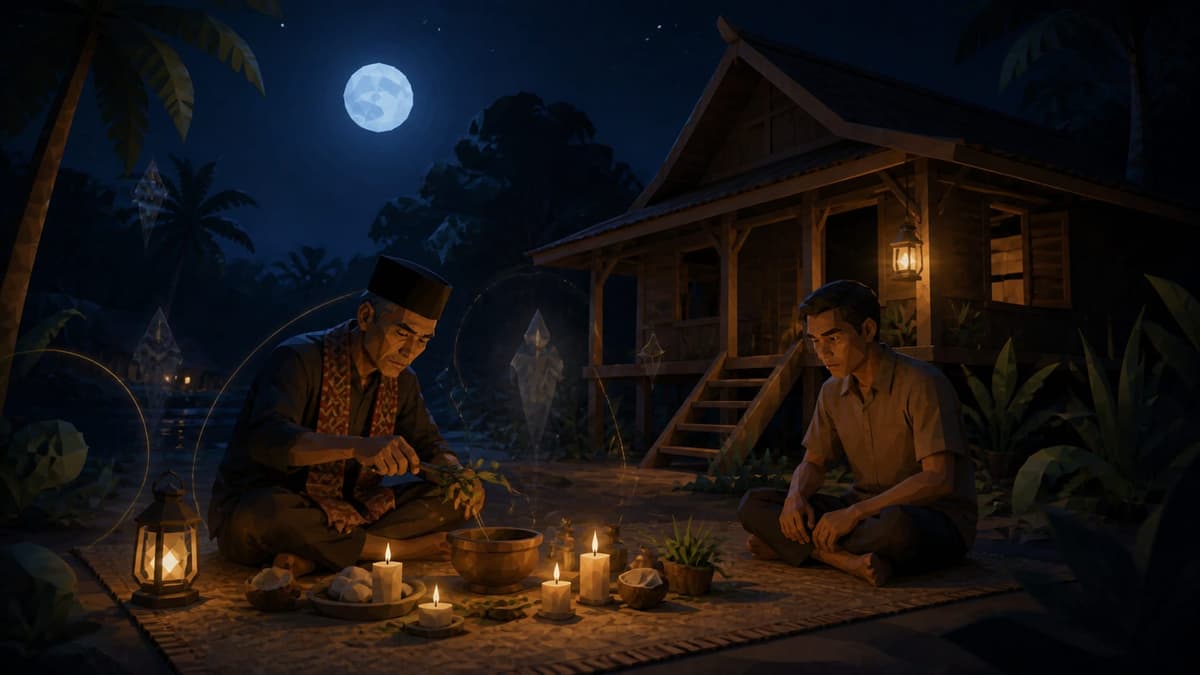
Key Takeaways
- →Malaysia holds four living spiritual-practitioner worlds side by side: the Malay *bomoh* and *dukun*, the Chinese *tang-ki* medium and feng shui master, the Hindu temple medium and *jothidam* astrologer, and a modern urban tarot, reiki and astrology scene now run on TikTok and Zoom.
- →This page is a cultural and consumer-awareness reference. It describes beliefs and practices at a reporting level, gives no ritual instruction, and names only well-documented public cases.
- →Malaysian religious authorities (JAKIM and the state muftis) hold that *sihir* and consulting practitioners is *haram* and can amount to *syirik* for Muslims. Malaysia has no specific witchcraft law, so fraud is prosecuted under Penal Code cheating provisions such as sections 415 and 420.
- →Real financial, physical and sexual harm is reported across communities. Curse-removal scams have cost victims six figures in ringgit. Anyone facing illness or distress should seek licensed medical and mental-health care.
- →As of 2026 belief in the unseen remains widespread and normalised at festivals, while the marketplace for paid readings has moved online and rebranded around wellness and self-care language.
This is a cultural and consumer-awareness reference. It describes beliefs and practices respectfully and at a reporting level. It contains no spells, incantations, ritual steps or recipes, and it gives no method for casting, breaking or protecting against anything. If you are unwell or in distress, please see a doctor or a licensed mental-health service.
In This Guide
Belief in the unseen across a plural society
Malaysia is a multi-ethnic, multi-faith country, and belief in an unseen world runs through all of its communities. Malay Muslims, Chinese who blend Buddhism with Taoism and folk-deity worship, Tamil Hindus, and the Orang Asli and Bornean indigenous peoples each carry their own vocabulary for spirits, luck, protection and misfortune. Alongside these older layers sits a younger, city-based scene of tarot readers, astrologers and energy healers who reach clients through a phone screen.
This guide treats four communities with equal weight: (1) the Malay bomoh, dukun and pawang; (2) Chinese tang-ki mediums, the Datuk Kong cult, and feng shui and BaZi consultants; (3) Hindu temple priests, trance mediums and jothidam astrologers; and (4) the modern urban tarot, astrology, reiki and spiritual-influencer market. A short section also frames the distinct Orang Asli and Bornean healer traditions in their own terms.
The approach here is anthropological and consumer-facing. Practices are described as beliefs held by real communities, without mockery and without instruction. The page states each faith's mainstream position as a matter of record, explains how Malaysian law actually handles the space, and points readers toward medical, mental-health and police resources where harm occurs. Where research flagged something as rumour or as unverified, it is either phrased carefully or left out.
The Malay bomoh tradition and its vocabulary
The bomoh is the general Malay term for a traditional shaman-healer, historically a herbalist and geomancer who also recited charmed formulas. Malay folk-medical theory frames illness as an imbalance among elements (commonly given as fire, water, earth and wind), and healing aims to restore balance. Related roles carry different specialisms.
| Practitioner | Role |
|---|---|
| Bomoh | General shaman-healer: herbs, Malay geomancy (tajul muluk), diagnosis of spirit-illness, protection and blessing. |
| Dukun | The Indonesian equivalent term: healer, spirit medium, custom (adat) expert and diviner. |
| Pawang | Specialist in weather, wild animals and nature, for example pawang hujan (rain) or pawang buaya (crocodile). Recorded by the British administrator Frank Swettenham in late-19th-century Malaya. |
| Bidan | Traditional midwife (bidan kampung), handling childbirth, confinement (pantang) and infant care. |
| Tok guru | An honorific for a respected Islamic religious teacher. This is not a shaman, and conflating the two is a common error. |
Practitioners describe a spectrum from ilmu putih (white or benign knowledge) to ilmu hitam (black or harmful knowledge). The boundary is defined by intent and outcome rather than by a separate profession, and communities treat it as porous, which is part of what fuels suspicion.
The belief-vocabulary below is given descriptively. No method is described for any of it.
| Term | What it refers to |
|---|---|
| Sihir | The umbrella term for sorcery or harmful magic. |
| Santau | A feared "poison sorcery" belief in which a victim is made internally ill by magically charged matter. Its Indonesian cognate is santet. Reported only as a belief. |
| Susuk | Charm needles of gold alloy believed to be inserted under facial or body tissue as talismans for beauty, attraction, protection or pain relief. Belief holds that beauty effects fade if the needle is removed, and that susuk must be taken out before death. |
| Jampi / mantera | Charmed incantations recited by the practitioner. Contents are not reproduced here. |
| Pukau | A belief in a stupefying charm said to make a victim compliant or unaware, often invoked by robbery and con victims. |
| Pelet / ilmu pengasih | Love or attraction magic said to compel affection. |
| Ilmu kebal | A belief in bodily invulnerability to blades or bullets, culturally tied to silat martial arts and warrior lore. |
Malay folklore also describes familiars, kept spirits believed to serve a master. These are recorded here as folklore, at belief level only. The toyol is an undead-infant spirit said to steal money for its keeper, offered as a folk explanation for sudden unexplained wealth. The pelesit (a cricket-form familiar historically linked to Kedah) and the more powerful polong are said to afflict victims, and a saka is an inherited familiar passed down a family line, sometimes as an unwanted burden. The grisly origin stories attached to some of these are deliberately omitted.
Chinese practitioners: tang-ki, Datuk Kong, feng shui and BaZi
Chinese religious life in Malaysia blends Buddhism, Taoism, Confucian ancestor veneration and folk-deity cults under one temple roof. Roughly 3 to 4% of Chinese Malaysians are recorded in the census as practising Taoism or Chinese folk religion (about 1% of the national population), though real adherence is likely higher because many register as Buddhist on the census.
The tang-ki (Hokkien tâng-ki; Mandarin jitong) is a spirit medium believed to be chosen by a deity to serve as its earthly vehicle. During temple ceremonies the entranced medium is consulted for healing advice, blessings, dispute guidance and auspicious dates. Self-mortification, including cheek and tongue piercing while entranced, is a documented feature of some possession rituals, where participants hold that the deity prevents pain. The tradition is strongest in Penang and among Hokkien, Teochew and Hainanese communities. Its most public annual window is the nine-day Nine Emperor Gods Festival (the "Vegetarian Festival"), a major centre of which is the Ampang temple in Selangor, where mediums called masong perform these austerities.
Datuk Kong (Na Tuk Kong) shrines are the clearest example of Chinese-Malay syncretism. These local guardian spirits fuse the Malay honorific Datuk with the Chinese Kong (respected elder), and merge Chinese land-spirit veneration with the pre-Islamic Malay reverence for guardian spirits (penunggu) and venerated graves (keramat). Tradition holds each Datuk was once a real person, often a chief, healer or silat warrior. The small roadside shrines, painted red or yellow, often hold a statue in Malay dress with sarong, songkok and keris. Offerings trace the cult's Malay-Muslim roots, and pork is strictly forbidden at the shrine. A related figure, Tua Pek Kong ("Grand Uncle"), is a prosperity deity whose Penang cult is traced to a Hakka settler, Zhang Li, traditionally said to have arrived around the mid-1700s, with the Tanjung Tokong temple treated as its origin point.
Everyday temple divination uses kau chim (a shaken bamboo tube of numbered fortune sticks mapped to printed oracle verses) and jiaobei (crescent moon-blocks cast to confirm a divine yes). These are the cheapest, most self-service forms of Chinese fortune-telling, used even by otherwise secular Chinese Malaysians at Chinese New Year.
Feng shui advises on the siting and orientation of homes, businesses and graves to work with qi, balancing yin and yang and the five elements using the bagua trigrams and the luopan compass. BaZi, the Four Pillars of Destiny, reads a person's destiny from the year, month, day and hour of birth, and is used for marriage compatibility, auspicious dates, business timing and naming children. Commercial visibility is high and mainstream. Two internationally known figures are Malaysian: Lillian Too, the feng shui author and founder of the World of Feng Shui retail business, and Joey Yap, founder of the Mastery Academy of Chinese Metaphysics, whose annual forecast events are a fixture around Chinese New Year.
Indian and Hindu practitioners: temple mediums and jothidam
Malaysian Hindus numbered about 1.97 million, or 6.1% of the population, in the 2020 census, and roughly 92.5% are ethnically Indian and overwhelmingly Tamil. Hindu spiritual life runs on two registers. Agamic or temple-Brahmanical Hinduism uses Sanskrit liturgy and formal temples such as the Murugan shrine at Batu Caves and Sri Maha Mariamman in Kuala Lumpur, with priests (pujari, Tamil pusari) drawn mainly from the Brahmin varna. Folk Hinduism, described in the sources as the most prevalent variety, is the register where trance mediums, guardian-deity worship and folk-magic belief live, often served by non-Brahmin pusari at village, estate and roadside shrines.
Trance mediumship is highly public. The oracle-medium (in South Indian usage the velichappadu, "light-giver") enters trance after worship, dances to drums, and is believed to let the deity speak through him or her, delivering guidance to devotees. This is embedded in the festival calendar. At Thaipusam (2026 date: Sunday, 1 February), which honours Murugan, drumming and chanting help devotees enter trance to carry the kavadi vow, from milk-pots to the vel kavadi attached by skewers and hooks through the skin, together with cheek and tongue piercing. In Malaysia the festival draws thousands to Batu Caves and is a public holiday. This piercing and trance is a religious vow fulfilled publicly, distinct from sorcery. Worship of the mother-goddess Mariamman, and of fierce guardian deities such as Muniandy, Muneeswaran and Madurai Veeran, also carries mediumship, firewalking and vow-offerings, especially at estate and roadside shrines.
Jothidam is the Tamil name for Hindu astrology (Jyotisha). A jothidar reads a birth chart (jathagam), sets auspicious timing (muhurtham) for weddings and business, matches marriage compatibility, and gives predictive guidance, using the twelve houses, planetary periods (dasas), the 27 lunar mansions (nakshatras) and the nine Navagraha including Rahu and Ketu. A newborn's birth star commonly sets the first syllable of the child's name. This is a mainstream, socially respectable consumer service. Palmistry (Tamil kai rekai), within the Indian Samudrika Shastra tradition, and numerology, used for lucky numbers and auspicious name-spellings, are openly advertised alongside it.
A strand of folk belief also attributes misfortune to directed harmful magic, with Tamil terms such as sooniyam and seivinai for hexing, pilli for a sent affliction, and kan drishti for the evil eye. These are reported here as cultural terminology at belief level, with no methods given. Within the community, organisations such as the Malaysia Hindu Sangam have long campaigned to move estate worship toward standardised Agamic ritual, which makes folk mediumship and black-magic belief contested inside Hinduism itself.
Orang Asli and Bornean indigenous healers
The Orang Asli of the peninsula and the indigenous peoples of Sabah and Sarawak carry their own healer-medium traditions, which are animist or Christianised rather than Malay-Muslim. They deserve their own frame rather than being folded into "bomoh."
Among some Orang Asli and older Malay usage, the term poyang refers to a shaman-healer and spirit-medium. In Sarawak, the manang is the Iban (Dayak) shaman, a healer and spirit-medium central to traditional Iban healing rites. In Sabah, the Kadazan-Dusun bobohizan (also bobolian) is a ritual specialist and priestess who officiates rice-spirit and healing ceremonies. These roles sit inside distinct cosmologies and community structures, and detailed group-by-group practice varies. Research for this guide could not verify fine ritual detail for each community from a single authoritative source, so the roles are named at a summary level and treated with respect as living or recently living traditions rather than curiosities.
The modern tarot, astrology, reiki and spiritual-influencer scene
A visible, informal spiritual-services economy now runs alongside both mainstream medicine and the older practitioners. A Nikkei Asia report ("From temples to TikTok," published around 2024 to 2025) described a new set of self-styled healers working from suburban shop lots and homes, offering sessions on TikTok livestreams and claiming to cleanse unseen forces through a phone screen. This modern layer of tarot, Western and Vedic astrology, numerology, reiki, crystals and "manifestation" sits on top of the traditional layer, and its branding leans toward wellness, therapy and self-care language.
The audience skews younger, urban and multi-ethnic, concentrated in the Klang Valley, Penang and Johor Bahru, and often young women seeking clarity on career and relationships. One frequently profiled public reader, Sarah May Low, an ex-advertising professional, explicitly markets tarot as "young, hip, trendy" and as a form of therapy. Crystal retailers founded around 2017 to 2020 target the same manifestation-minded market.
Prices vary widely and many are self-listed by vendors rather than independently audited, so treat specific figures as indicative:
| Service | Indicative price (as of 2025 to 2026) |
|---|---|
| Tarot tuition | From about RM10 per hour; structured courses far higher (one vendor lists about RM1,500). |
| Chinese BaZi reading | One vendor lists about RM288 (simple) to RM588 (detailed); feng shui property visits run higher. |
| Crystal bracelets and jewellery | Roughly RM44 to RM450 or more. |
| Tarot deck and cloth | A Rider-Waite deck about RM60, a reading cloth about RM45. |
| 1:1 tarot or astrology session | Often booking-on-request with no published rate; treat any single figure as unverified. |
Distribution has moved to TikTok livestreams, Instagram, WhatsApp, Zoom and booking apps. The influencer model blends content marketing, paid one-to-one readings, subscription groups and course upsells. Each community has its own online layer: Malay Islamic alternative-treatment centres and TikTok healers, Chinese metaphysics consultancies that spike around Chinese New Year, and Tamil Nadi and jothidam readers now delivering by Zoom. Reiki and per-session energy-healing rates were generally not published in the material reviewed.
Religion and the law
Each faith community takes its own view, and Malaysian civil law adds a further layer.
The Islamic position. In mainstream Sunni Islam as taught by Malaysian religious authorities, sihir is haram, and both practising it and consulting practitioners for it are treated as grave sins that can amount to syirik, associating partners with God. The scriptural anchor commonly cited is Surah al-Baqarah (Qur'an 2:102). Susuk is commonly ruled haram, and fortune-telling, tarot, astrology and numerology are treated as prohibited because knowledge of the unseen (ghaib) is held to belong to God alone. The Department of Islamic Development (JAKIM), the state muftis and the National Fatwa Committee reflect this position, and the Jabatan Mufti Wilayah Persekutuan has issued rulings to this effect. The sanctioned alternative is ruqyah (Qur'anic recitation) and proper medical care. Muslim acceptance of the bomoh declined during the Islamisation period of the 1970s and 1980s, and practice continued privately.
Other faiths. Christianity and Judaism broadly prohibit divination on scriptural grounds. Chinese folk practice, by contrast, integrates divination culturally through the I Ching, feng shui, BaZi and kau chim. Hindu tradition accepts formal astrology (jyotisha) and possession-based oracle practice. Because Malaysia's Syariah courts have no authority over non-Muslims, the internal Hindu debate is between Agamic reform and folk practice rather than a sihir prohibition.
Malaysian law. There is no Malaysian criminal offence of "witchcraft" as such. Prosecutions run on ordinary law. Fraud is charged under the Penal Code, commonly section 415 (cheating) and section 420 (cheating and dishonestly inducing delivery of property), when a practitioner takes money for false promises. Culpable homicide, murder (sections 300 to 302) and grievous-hurt provisions apply when rituals cause death or injury. Separately, state Syariah enactments can apply to Muslims for practices deemed against aqidah. Legitimate traditional medicine is regulated under the Traditional and Complementary Medicine Act 2016 (Act 775), which received royal assent on 2 March 2016 and whose practitioner registration went live in Phase 2 on 1 March 2021, so a registered practitioner is a checkable credential and a self-styled bomoh outside that framework is unregulated. On the medical side, susuk needles are documented in Malaysian radiology and dental practice as an incidental X-ray finding.
For the wider spirit-and-folklore world these beliefs draw on (pontianak, hantu, orang bunian and the rest), see the companion Malaysian folklore guide.
Well-documented public cases and the TikTok-era shift
A small number of cases are documented enough to name.
Mona Fandey (1993). Nur Maznah binti Ismail, a failed pop singer who released the album Diana in 1987, worked as a bomoh with her husband, Mohamad Nor Affandi Abdul Rahman. Pahang state assemblyman Mazlan Idris, seeking political advancement, agreed to pay for a purported talisman and met the couple on 2 July 1993. His dismembered body was found on 22 July 1993. The trial in Temerloh was one of Malaysia's last jury trials. All three, including their assistant Juraimi Hassan, were sentenced to death on 9 February 1995 and executed at Kajang Prison on 2 November 2001. It remains the landmark Malaysian bomoh-murder case.
The Raja Bomoh and MH370 (2014). Ibrahim Mat Zin, who styled himself "Raja Bomoh Sedunia," performed widely photographed rituals at Kuala Lumpur International Airport during the March 2014 search for the missing flight MH370, using bamboo "binoculars" and coconuts. JAKIM stated his methods contradicted Islamic teaching, and the then Youth and Sports Minister Khairy Jamaluddin called the spectacle humiliating. It was an embarrassment covered internationally rather than a criminal case. He reappeared with similar stunts in later years, including reports around KLIA2 in 2017, though legal specifics of those follow-ups are not firmly established.
Regional context (Indonesia, 1998). In East Java, centred on Banyuwangi, vigilante mobs killed an estimated 150 to 300 people accused of being sorcerers between February and October 1998. It is included as comparative context to show that sorcery accusation itself drives violence, and is not evidence of any accused person's guilt.
Celebrity susuk rumours. Malaysian and regional entertainment circles have long carried rumours that certain celebrities use beauty-susuk. These circulate as gossip and are labelled here as rumours. This guide does not attach such claims to any named individual.
The modern shift. As of 2026 the marketplace has moved online. Consultations that once happened at a shrine or a village house now run on TikTok livestreams, Zoom and WhatsApp, and the same shift has enabled a wave of remote curse-removal scams described in the next section.
Scams, red flags and healthier alternatives
This section is about how bad actors exploit belief. The harm falls into three patterns reported across communities.
Financial exploitation. In one 2025 case in Terengganu, a 51-year-old single-mother seamstress lost about RM103,000 in cash and jewellery to a social-media curse-removal scammer. In Tangkak, Johor in 2025, a man in his 70s lost about RM445,000 in cash and jewellery to a bogus bomoh offering "spiritual cleansing," a case charged under section 420 of the Penal Code. In Sibu, Sarawak in 2025, an elderly woman lost about RM60,000 to a fake family-curse ritual after being approached in a market. These street and social-media cases, often targeting elderly women, match the well-documented "blessing scam" pattern linked to a China-based syndicate.
Abuse under a ritual pretext. Malaysian courts have convicted practitioners who committed sexual assault while claiming to perform a "cleansing." In 2025 the Court of Appeal upheld a 12-year jail term and five strokes for a medium who raped a teacher during such a ritual. Reported cases of this kind stretch back years, and the pattern typically involves isolating the victim.
Medical neglect. Oncologists describe a recurring, deadly pattern in which patients with early-stage, survivable cancers defer or refuse treatment for traditional or alternative healing until it is too late. One publicly recounted case involved a patient who lost her home and about RM60,000 to a healer's costly instructions.
Red flags of a scam practitioner.
- Demands for large cash, gold or jewellery "for the ritual," or to place valuables somewhere.
- Promises that money will be multiplied or returned within a set period.
- A cold approach in a market or on social media claiming you or your family carry a deadly curse.
- Pressure toward secrecy and isolation, and away from a second opinion.
- Any sexual demand framed as part of "cleansing."
- Telling you to stop or skip medical treatment.
- No registration under the Traditional and Complementary Medicine framework and no verifiable credentials.
Healthier and safer alternatives. For any physical illness, see a doctor or a Ministry of Health clinic, and check that any traditional practitioner is registered with the T&CM Council. For emotional distress there are national services, including Talian Kasih 15999 (24-hour crisis and abuse line), Befrienders KL on 03-7627 2929 (emotional support and suicide prevention), Talian HEAL 15555 (Ministry of Health tele-counselling) and the Malaysian Mental Health Association. Report fraud to the police on 999 or the National Scam Response Centre on 997, and report any suspected sexual crime to the police. Confirm these numbers before relying on them.
Where belief sits as of 2026
Belief in the unseen is neither dying nor confined to villages. At Thaipusam, the Nine Emperor Gods Festival and Mariamman festivals, trance and vow-piercing draw crowds and mainstream media coverage every year. Datuk Kong shrines still stand at roadsides and building sites. Feng shui and BaZi forecasts remain a media-and-events industry around Chinese New Year, and marriage matching by a jothidar is routine in Tamil families.
What has changed is the marketplace and the language around it. Paid readings have moved to TikTok, Instagram, Zoom and WhatsApp, and the modern urban layer markets itself in the vocabulary of wellness, clarity and self-care. That same reach has powered a wave of remote curse-removal scams that have cost individual victims six figures in ringgit.
The faith positions have not moved. Malaysian Islamic authorities continue to hold that sihir and consulting practitioners is prohibited for Muslims, Hindu reformers continue to push estate worship toward Agamic standards, and civil law continues to reach this space only through fraud, homicide and hurt provisions rather than any witchcraft statute. For readers, the practical takeaway is steady: the culture is worth understanding on its own terms, and anyone being asked for large secret payments, told to keep silent, or told to abandon medical care is looking at a warning sign and should step back.
Nothing here is a religious ruling, a legal opinion, or medical advice. Descriptions of any faith's position are reported as fact, not endorsed or preached. No living private individual is accused of witchcraft or fraud; only long-public figures and reported court cases are named. Terms and helpline numbers current as of 2026 should be reconfirmed before you rely on them.
Sources & References
Data in this guide is cross-referenced against the following official sources.
- Nikkei Asia: From temples to TikTok Reporting on Malaysia's evolving spiritual-healing scene and TikTok-era self-styled healers (published c. 2024 to 2025).
- Jabatan Mufti Wilayah Persekutuan (Al-Afkar / Irsyad Hukum rulings) Official Federal Territory mufti rulings reflecting the prohibition of sihir, fortune-telling and numerology for Muslims.
- Malay Mail / New Straits Times / The Borneo Post (2024 to 2025 scam and court reporting) Contemporaneous Malaysian outlet reporting on curse-removal scams (Terengganu, Tangkak, the 2025 Sibu market case) and ritual-pretext abuse convictions.
- Traditional and Complementary Medicine Act 2016 (Act 775) The statute establishing the T&CM Council and practitioner register, with Phase 2 registration live from 1 March 2021.
Further reading: Wikipedia: Bomoh · Wikipedia: Mona Fandey · Wikipedia: Susuk · Wikipedia: Tongji (spirit medium) · Wikipedia: Na Tuk Kong · Wikipedia: Hinduism in Malaysia · Wikipedia: Thaipusam · Wikipedia: Jyotisha · Wikipedia: Four Pillars of Destiny (BaZi)