
Key Takeaways
- →Malaysia has no full dispensing separation yet - doctors can still dispense medicine, so retail pharmacists mainly sell OTC and Group C ("pharmacy-only") items plus dispense against private prescriptions.
- →Antibiotics and controlled drugs legally require a prescription; painkillers, antihistamines, and common OTC items are freely available. Medicines are cheap by global standards (often 50-80% less than the US/UK).
- →Major chains: Guardian, Watsons, BIG Pharmacy, Caring (BIG and Caring merged in 2023 into the BIG Caring Group), Alpro, and Health Lane - plus thousands of independents. Confirm a product is registered by checking its NPRA MAL number and the FarmaTag security hologram (verify it free with the NPRA FarmaChecker app).
- →Bringing your own meds? Personal supply is usually fine, but ADHD stimulants, strong opioids, and some sleeping pills are controlled - carry a doctor's letter and check DCA / Pharmacy Board rules first.
In This Guide
Malaysia Pharmacy Landscape Overview
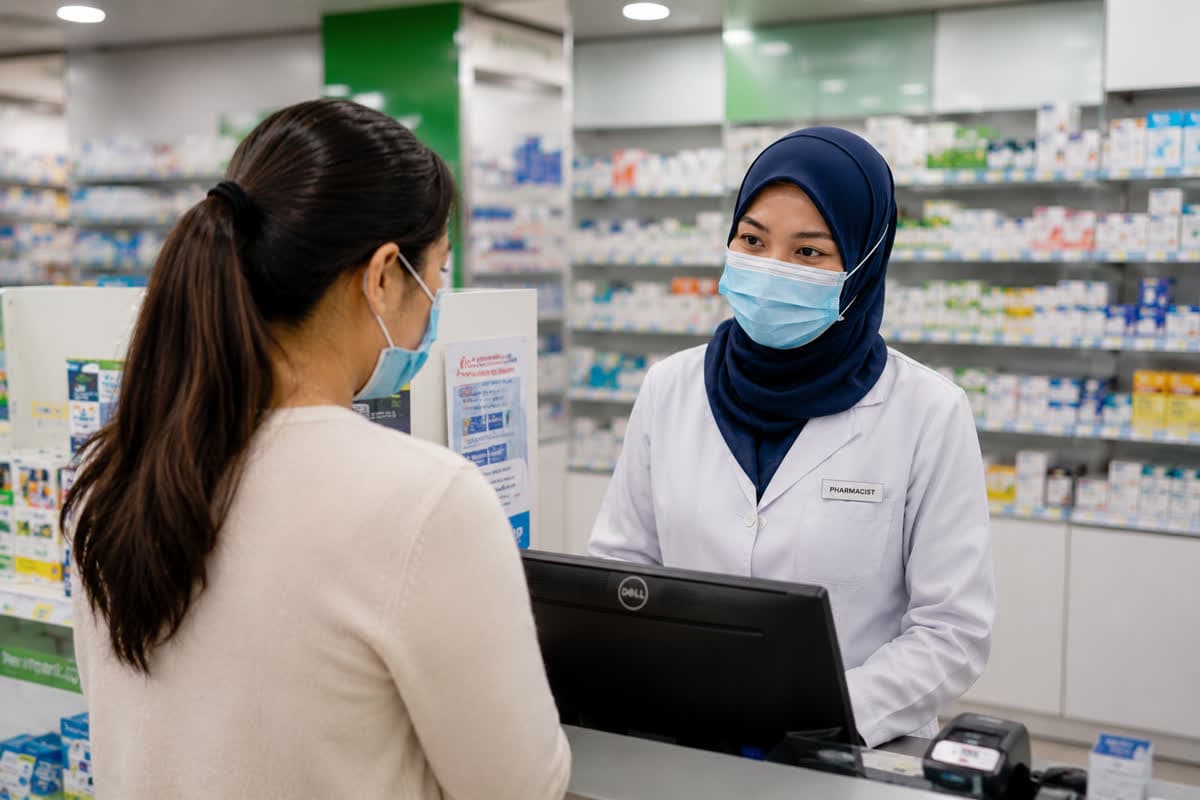
Pharmacies are everywhere in Malaysia - in shopping malls, on shophouse rows, inside hospitals, and increasingly online. For visitors and residents alike, a pharmacy is often the fastest, cheapest first stop for minor health needs. But how pharmacies work here differs in one important way from many Western countries, and understanding that difference explains almost everything about buying medicine in Malaysia.
The Big Difference: No Full Dispensing Separation (Yet)
In most developed countries, doctors prescribe and pharmacists dispense - the two roles are legally separated. Malaysia has not yet fully implemented this "dispensing separation" (pemisahan dispensing). Doctors in private clinics can - and routinely do - dispense medicine directly to patients. This is why a typical GP visit in Malaysia bundles the consultation and the medicine into one payment, and why you may leave a clinic with a bag of pills but no written prescription.
The consequence for community (retail) pharmacies is significant: because clinics keep their own dispensing revenue, retail pharmacists earn most of their living from over-the-counter (OTC) sales, pharmacy-only medicines, health-and-beauty products, and supplements, rather than from filling doctors' prescriptions. Dispensing separation has been debated for over three decades - doctors and pharmacists first signed a memorandum on it back in 1985 - and repeated proposals (including a 2025 push to make prescriptions mandatory) have run into strong resistance from the medical profession. As of mid-2026 it is still not in force in the private sector.
The Three Main Settings Where You Get Medicine
| Setting | Who runs it | What you get |
|---|---|---|
| Community / retail pharmacy | Private (chains + independents) | OTC medicines, pharmacy-only (Group C) items, prescriptions, supplements, personal care |
| Clinic dispensary | GP / private clinic | Medicine dispensed directly by the doctor after consultation |
| Hospital pharmacy | Government or private hospital | Medicine tied to hospital/specialist treatment; government ones heavily subsidised for citizens |
What a Community Pharmacist Can Do For You
Malaysian community pharmacists are university-trained health professionals, not shop assistants. Without you seeing a doctor, a pharmacist can:
- Recommend and sell OTC treatment for minor ailments (coughs, colds, mild pain, allergies, indigestion, minor skin conditions)
- Supply "pharmacy-only" medicines that legally require a pharmacist's involvement
- Counsel you on how to take your medicine, dosing, side effects, and interactions
- Check blood pressure, blood glucose, or BMI (many offer these free or cheaply)
- Advise whether your symptoms actually need a doctor
Who Uses Pharmacies and Why
- Tourists: quick relief for travel bugs, motion sickness, sunburn, insect bites - far cheaper than a clinic
- Expats: repeat supplies of maintenance medicines, familiar international OTC brands
- Locals: everyday OTC, supplements, and increasingly chronic-disease support and health screening
Language and Access
English is widely spoken in urban pharmacies, and staff commonly speak Malay, Mandarin, and Tamil too. Store hours are generous - mall pharmacies typically run 10am to 10pm, and some outlets in major cities operate 24 hours.
Pro Tip: For a minor complaint, walk into a pharmacy and describe your symptoms to the pharmacist before paying for a doctor's appointment. It is free advice, and you only pay if you buy something.
Regulation & The Law
Pharmacy in Malaysia is governed by a stack of laws and a national regulator. You do not need to memorise these, but knowing the framework helps you understand why certain medicines are freely available and others are locked behind a prescription - and how to check that a product is legitimate.
The Pharmacy Board of Malaysia (Lembaga Farmasi Malaysia)
The Pharmacy Board of Malaysia is the statutory body that registers pharmacists and regulates the profession. Every practising pharmacist must be registered with the Board and hold an Annual Retention Certificate. The Board sits under the Pharmaceutical Services Programme of the Ministry of Health (MOH).
The National Pharmaceutical Regulatory Agency (NPRA)
The NPRA (Bahagian Regulatori Farmasi Negara) is the arm of the MOH that evaluates, registers, and monitors the quality, safety, and efficacy of pharmaceutical products, health supplements, traditional medicines, and cosmetics. Its key outputs that you will actually encounter:
- MAL registration number - every registered pharmaceutical product carries a "MAL" number (e.g. MAL19993456A) printed on the packaging. The first digits encode the year and month of registration and the final letter indicates the product category. Traditional/health products carry a "MAL" number too.
- FarmaTag hologram - a security sticker on registered products (it replaced the older "Meditag" hologram from 1 September 2019). See the Safety & Counterfeits section.
- FarmaChecker app & QUEST3+ Product Search - the free FarmaChecker app scans the FarmaTag to confirm authenticity, and the online QUEST3+ Product Search lets you check any product's registration status.
- Product recalls and safety alerts - the NPRA publishes lists of unregistered, adulterated, or counterfeit products.
The Core Laws
| Law | What it covers |
|---|---|
| Poisons Act 1952 | The backbone: classifies medicines into poison "groups/schedules", governs sale, storage, and who may supply them |
| Registration of Pharmacists Act 1951 | Who may call themselves a pharmacist and practise |
| Sale of Drugs Act 1952 | Prohibits sale of adulterated/misbranded drugs; supports the Control of Drugs and Cosmetics Regulations |
| Control of Drugs and Cosmetics Regulations 1984 | The regulations requiring product registration with the Drug Control Authority (DCA) / NPRA before sale |
| Dangerous Drugs Act 1952 | Controls narcotics and other dangerous drugs (opioids, etc.); strict penalties |
| Poisons (Psychotropic Substances) Regulations 1989 | Controls psychotropics such as many sleeping pills and stimulants |
| Medicines (Advertisement and Sale) Act 1956 | Controls how medicines and treatments may be advertised to the public |
The Pharmacy Bill and 2025 Amendments (What's Changing)
The laws above are old - most date from the 1950s. For years the Ministry of Health has been drafting a single, modern Pharmacy Bill (Rang Undang-Undang Farmasi) to consolidate and replace the Registration of Pharmacists Act 1951, Poisons Act 1952, Sale of Drugs Act 1952, and the Medicines (Advertisement and Sale) Act 1956. As of mid-2026 that consolidating Bill has not yet been enacted.
What did happen recently is the Poisons (Amendment) Bill 2025, passed by the Dewan Rakyat to strengthen enforcement powers and tighten controls on poisons and prohibited substances (including in vape products). Notably, a blanket "mandatory prescription" rule was not written into this amendment. Separately, in August 2025 the Domestic Trade and Cost of Living Ministry - not the Health Ministry - moved (via the National Action Council on Cost of Living, NACCOL) to require doctors' prescriptions, itemised billing, and drug-price display in private clinics. This sparked strong opposition from private GPs and a legal challenge from doctors, and Health Minister Dzulkefly Ahmad signalled a cautious, "hybrid and flexible" approach rather than a hard cut-over. Bottom line: full dispensing separation is still not in force in the private sector - so the practical picture in this guide still holds.
The Drug Control Authority (DCA)
The DCA (Pihak Berkuasa Kawalan Dadah) is the decision-making body, supported technically by the NPRA, that approves products for registration under the Control of Drugs and Cosmetics Regulations 1984. No pharmaceutical product may legally be manufactured, imported, or sold in Malaysia without DCA registration.
Enforcement
The Pharmacy Enforcement Division of the MOH polices the laws above - raiding sellers of unregistered products, illegal online sellers, and outlets breaching poison rules. Penalties under the Poisons Act and Sale of Drugs Act can include heavy fines and imprisonment. Offences under the Dangerous Drugs Act 1952 are far more serious - Malaysia treats drug trafficking extremely harshly.
Why This Matters To You
- If a product has no MAL number and no FarmaTag hologram, treat it as suspect.
- Prescription-only medicines sold with "no questions asked" online are being sold illegally.
- Bringing in controlled substances without documentation can expose you to the Dangerous Drugs Act, not just a customs fine.
Pro Tip: You can verify any product's registration status on the NPRA website (QUEST3+ Product Search) or by scanning its FarmaTag with the free FarmaChecker app. If a supplement or medicine claims dramatic results but you cannot find its MAL number, do not buy it.
Types of Medicine & Poison Scheduling
Malaysia classifies medicines using "poison" schedules under the Poisons Act 1952. This is what determines whether you can grab something off the shelf, must ask a pharmacist, or need a doctor's prescription. The terminology can be confusing, so here is the practical version.
The Practical Three-Tier Reality
For everyday purposes, medicines fall into three access levels:
| Access level | What it means | Examples |
|---|---|---|
| OTC / General Sale | Freely available, even in supermarkets and convenience stores | Paracetamol (small packs), simple antacids, lozenges, some vitamins |
| Pharmacy-only (Group C) | Must be supplied by/under a pharmacist; kept behind or near the counter | Many stronger analgesics, certain antihistamines, some cough medicines, emergency contraception, larger pack sizes |
| Prescription-only / Controlled | Requires a valid prescription from a registered doctor | Antibiotics, most psychiatric medicines, strong painkillers, sleeping pills, most chronic-disease medicines |
The Poison Schedule Groups (the technical basis)
The Poisons List sorts listed poisons into Groups A, B, C and D, based on how they may be supplied. The ones you will actually meet as a consumer are:
- Group B poisons - prescription-only medicines: a registered pharmacist may only sell them by retail against a valid prescription from a registered doctor, dentist, or vet. Most antibiotics and prescription drugs sit here.
- Group C poisons - "pharmacy-only" medicines that a pharmacist may sell without a prescription, but must supply personally (kept behind or near the counter) and record where required.
- Group A poisons - the most restricted at retail: broadly supplied wholesale (e.g. from a licensed wholesaler to a licensed pharmacist) rather than sold over an ordinary shop counter.
- Group D poisons - can only be sold as a dispensed medicine, with the sale recorded in the Poisons Book, or supplied on the same terms as a Group C poison.
- Non-poison / OTC - general-sale medicines outside the poison list, available more widely including in supermarkets.
There are also specific schedules for Psychotropic substances (under the Poisons (Psychotropic Substances) Regulations) and Dangerous Drugs (under the Dangerous Drugs Act 1952) covering narcotics and high-abuse-potential drugs, which have the strictest controls and record-keeping.
What You Can Buy Without a Prescription
Commonly available OTC / pharmacy-only: - Pain and fever relief: paracetamol, ibuprofen, aspirin - Antihistamines: cetirizine, loratadine, chlorpheniramine - Cough, cold, and flu remedies - Antacids, anti-diarrhoeals (ORS, loperamide), laxatives - Topical antifungals, antiseptics, mild hydrocortisone cream - Eye drops (lubricating), motion-sickness tablets - Emergency contraception (pharmacist-assessed) - Vitamins and registered supplements
What Requires a Prescription
- Antibiotics (all) - legally prescription-only
- Strong/opioid painkillers (tramadol, codeine combinations above OTC strength)
- Benzodiazepines and other sleeping pills
- ADHD stimulants (methylphenidate, etc.)
- Most antidepressants, antipsychotics, and other psychiatric medicines
- Most maintenance medicines for chronic disease at treatment doses
The Antibiotics Reality Check
Antibiotics are prescription-only by law. Historically, enforcement was patchy and some outlets sold them over the counter, but Malaysia has been tightening this significantly under its National Antimicrobial Resistance action plan. Do not assume you can walk in and buy a course - and more importantly, self-medicating with antibiotics is medically risky and drives resistance.
Pro Tip: If you are unsure whether something needs a prescription, just ask at the pharmacy counter. A pharmacist will tell you immediately and, for many complaints, can offer a legal non-prescription alternative.
Major Pharmacy Chains
Malaysia's retail pharmacy market is a mix of large health-and-beauty chains, dispensing-focused chains, and thousands of independents. Knowing the character of each helps you pick the right one for your need - a mall beauty run versus filling a prescription.
The Big Players
Guardian
- One of the two largest health-and-beauty chains in Malaysia, part of the DFI Retail Group - Around 500+ outlets, heavily mall-based - Strong in personal care, cosmetics, and OTC; a pharmacist is on duty at pharmacy-licensed branches - Frequent member promotions and own-brand products
Watsons
- The other giant health-and-beauty chain, with one of the largest store counts in the country (several hundred outlets) - Big skincare, K-beauty, and supplements range alongside pharmacy - Monthly promotions and a member card that earns points toward vouchers - Convenient and everywhere, but leans retail/beauty rather than heavy dispensing
BIG Pharmacy & Caring (BIG Caring Group)
- BIG Pharmacy acquired Caring Pharmacy in 2023 (Caring was previously owned by 7-Eleven Malaysia Holdings), forming the BIG Caring Group - now the country's largest pharmacy operator by store count, with over 620 outlets across BIG Pharmacy, Caring, Georgetown Pharmacy, Wellings and Ting brands - The group filed a draft prospectus in 2026 for a Bursa Malaysia Main Market listing (reportedly seeking up to about RM3 billion to pare acquisition debt and fund expansion), on revenue of roughly RM3.4 billion for the year to June 2025 - so it may already be a listed company by the time you read this - The main brands still trade under their own names in stores - BIG Pharmacy is a "medicine-first", value-focused chain - often the keenest prices on medicines and supplements - Caring has a strong community-pharmacy and dispensing focus with competitive pricing - good for prescriptions, chronic-medicine supplies, and pharmacist counselling
Alpro Pharmacy
- Grew from a strong base in the southern states (Johor) and expanded nationally - Professional, pharmacist-led service; good chronic-disease and counselling programmes
Health Lane Family Pharmacy
- Established community-pharmacy chain with a family-health focus - Good OTC range, supplements, and pharmacist advice
Independents
- Thousands of neighbourhood pharmacies ("Farmasi ...") - Often the most knowledgeable pharmacist-owners, willing to advise and price-match - Great for regular relationships and repeat supplies
Quick Comparison
| Chain | Rough outlets | Positioning | Loyalty programme | Best for |
|---|---|---|---|---|
| Guardian | ~550 | Health & beauty | Membership card / points | Personal care, OTC, mall convenience |
| Watsons | ~550-600 | Health & beauty | Watsons Member (points to vouchers) | Skincare, K-beauty, supplements, deals |
| BIG Pharmacy | part of 620+ group | Value dispensing | Member pricing / app | Cheapest medicine and supplements |
| Caring | part of 620+ group | Community/dispensing | CARiNG membership | Prescriptions, value, counselling |
| Alpro | 200+ | Community/dispensing | Alpro membership + app | Professional counselling, chronic care |
| Health Lane | 150+ | Community | Member scheme | Family health, OTC, advice |
| Independents | thousands | Community | Varies (often none) | Personal advice, price flexibility |
Where to Find Them
Chains cluster in shopping malls, on high streets, and near medical clusters. In smaller towns, independents dominate. Government-hospital and Klinik Kesihatan pharmacies serve the public system separately (see the Government Pharmacy section).
Pro Tip: For beauty and everyday OTC, Guardian and Watsons are convenient and run frequent promotions. For prescriptions, chronic-disease medicine, and genuine pharmacist counselling, a Caring, BIG, Alpro, or a trusted independent is usually the better bet - and often cheaper on the actual medicine.
Pharmacy & Health Essentials
Shop pharmacy items, vitamins, and supplements - from Malaysia's leading health & beauty retailer or direct-retail supplement brands at transparent prices.

Malaysia's leading health & beauty retailer. Pharmacy, skincare, supplements, and wellness essentials.
Vitamins, supplements & health products direct — real brands at transparent prices, no MLM markup or recruitment. Ships to Malaysia.
Medicine Prices & Costs
One of the best things about Malaysia for travellers and expats is how cheap medicine is. Many everyday medicines cost a fraction of US or UK prices, and generics are widely available and trusted.
Why Malaysian Medicine Is Cheap
- Strong local generics industry and competitive pricing
- Lower overall cost base than Western markets
- Broad availability of OTC medicines that need prescriptions elsewhere
- Competition between large chains keeps prices keen
Typical OTC Prices (approximate, RM)
| Item | Typical price (RM) |
|---|---|
| Paracetamol 500mg (pack of 10-20) | 3 - 10 |
| Ibuprofen 200-400mg (pack) | 8 - 20 |
| Antihistamine, e.g. loratadine/cetirizine (pack of 10) | 8 - 25 |
| Cough syrup (bottle) | 10 - 30 |
| Antacid tablets/liquid | 8 - 25 |
| Oral rehydration salts (sachets) | 5 - 15 |
| Plasters / basic first-aid | 5 - 20 |
| Lozenges (pack) | 8 - 20 |
| Hydrocortisone / antifungal cream (tube) | 10 - 30 |
| Vitamin C or multivitamin (bottle) | 20 - 60 |
| Sunscreen SPF50 | 30 - 80 |
| Pregnancy test kit | 8 - 25 |
| Digital thermometer | 15 - 40 |
| Face masks (box of 50) | 10 - 30 |
Typical Prescription / Chronic Medicine Prices (approximate, RM per month)
| Medicine type | Typical monthly cost (RM) |
|---|---|
| Blood pressure medicine (generic) | 20 - 80 |
| Cholesterol medicine (statin, generic) | 25 - 90 |
| Diabetes medicine (metformin, generic) | 20 - 60 |
| Common antibiotic course (generic) | 15 - 50 |
| Inhaler (asthma reliever) | 25 - 70 |
| Acid-reflux medicine (omeprazole, generic) | 20 - 60 |
| Combined oral contraceptive pill | 15 - 45 |
| Thyroid medicine (levothyroxine, generic) | 15 - 45 |
Generics vs Brand
Generic and branded medicines contain the same active ingredient and both must be NPRA-registered. Generics are typically much cheaper - sometimes a fraction of the brand price - and are a normal, accepted choice. Simply ask the pharmacist: "Is there a generic version?"
| Brand | Generic | |
|---|---|---|
| Active ingredient | Same | Same |
| NPRA registered | Yes | Yes |
| Price | Higher | Lower (often much) |
| Quality standard | Meets standard | Meets standard (bioequivalent) |
Why It's a Bargain for Tourists
If you are visiting from the US, UK, Australia, or Europe, stocking up on OTC essentials in Malaysia can be dramatically cheaper - just check what is legal to take home, and keep everything in original packaging.
Price Transparency
Prices are usually shelf-labelled for OTC items. For prescription and behind-the-counter medicines, ask before you buy - it is fair to compare between two nearby pharmacies, as chain pricing on the same generic can differ noticeably. Malaysia does not have uniform fixed retail pricing on most medicines, so shopping around genuinely saves money.
Pro Tip: For chronic medicines you take monthly, ask a value-focused chain (BIG, Caring) or an independent for the generic and compare against the brand. The savings over a year can be substantial, and the medicine is therapeutically equivalent.
How Prescriptions Work
Because Malaysia has not adopted full dispensing separation, the prescription experience here is different from what many visitors expect. Here is how it actually works.
The Clinic Model (Most Common)
At a typical private GP clinic, the doctor examines you and then dispenses the medicine directly at the clinic. You often will not receive a written prescription at all - you pay one combined fee for the consultation plus medicine and leave with your tablets in labelled envelopes.
If you specifically want a written prescription (for example, to fill it more cheaply at a pharmacy, or to keep a record), ask the doctor for one. You are entitled to request it, though some clinics prefer to dispense in-house.
The Hospital Model
At hospitals (public and private), doctors prescribe and the hospital pharmacy dispenses. You can sometimes ask to fill a prescription outside, but hospital dispensing is standard and, for many drugs, more convenient because they hold specialist stock.
Filling a Prescription at a Community Pharmacy
If you do have a written prescription (from a Malaysian doctor, or sometimes a foreign one for continuing therapy), a community pharmacy can dispense it. Bring: - The original prescription (or a clear photo/printout for repeat items where allowed) - ID/passport - For controlled items, the pharmacist will record the supply
Repeat and Chronic Medicines
For ongoing maintenance medicines (blood pressure, cholesterol, diabetes), you have options: - Continue with the clinic or hospital that manages your condition - Take your prescription or an old labelled box to a community pharmacy; pharmacists can often counsel and supply repeat quantities of certain non-controlled maintenance medicines - Controlled medicines still require a fresh doctor's prescription each time
Private vs Government Prescriptions
- Government (public) prescriptions are filled at the government hospital/clinic pharmacy, heavily subsidised for citizens; foreigners pay more but still modest amounts.
- Private prescriptions are filled at private clinics, hospital pharmacies, or community pharmacies at market prices.
Can You Just Walk In and Ask a Pharmacist?
Yes - and you should, for minor issues. A community pharmacist can legally recommend and supply OTC and pharmacy-only medicines without any prescription, and will tell you if your problem needs a doctor. This is faster and cheaper than a clinic for common complaints.
What a Prescription Should Contain
- Patient name
- Medicine name, strength, dose, and quantity
- Directions for use
- Prescriber's name, signature, and registration
- Date
Pro Tip: If you take regular medication, ask your home doctor for a prescription that uses the generic (international non-proprietary) name, not just a local brand. That makes it far easier for a Malaysian pharmacist to match the exact medicine.
Buying & Bringing Medicine as a Tourist or Expat
Whether you are visiting for two weeks or relocating, the two questions that matter are: what can I buy here, and what can I bring in? Getting the second one wrong can cause serious problems at the border.
Buying Medicine as a Visitor
- No local prescription is needed for OTC and pharmacy-only items - just describe your need to the pharmacist.
- Bring the generic name of anything you take regularly; brand names differ between countries.
- For prescription-only medicines, you will generally need a Malaysian doctor's prescription (a quick GP or teleconsult visit is cheap).
- Stock up on cheap OTC essentials - but only take home what is legal in your destination.
Bringing Your Own Medicine Into Malaysia
Generally allowed (with care):
- A reasonable personal supply - commonly interpreted as up to about a one-month supply, or a documented longer supply for a chronic condition - Keep medicines in their original, labelled packaging - Carry a copy of your prescription or a signed doctor's letter stating the condition and medicine
Controlled - requires documentation and possibly prior approval:
These fall under the Poisons (Psychotropic Substances) Regulations or the Dangerous Drugs Act 1952: - ADHD stimulants - methylphenidate (Ritalin/Concerta), amphetamine-based medicines - Strong opioid painkillers - morphine, oxycodone, tramadol, codeine at higher strengths - Benzodiazepine sleeping pills / sedatives - diazepam, alprazolam, zolpidem, etc.
For these, carry a doctor's letter and prescription (in English, or translated, naming the medicine, dose, and quantity). The useful rule of thumb from the Ministry of Health's own traveller guidance: a one-month supply of psychotropic substances for personal use carried in your luggage is exempt from needing an import authorisation, provided you have a valid prescription (under Regulation 4(1) of the Poisons (Psychotropic Substances) Regulations 1989). Bring more than a month's supply, or carry a Dangerous-Drugs-class medicine, and you should apply in advance for an Import Authorisation issued by the Pharmacy Enforcement Division of the Ministry of Health - check with them or the NPRA before you travel.
Strictly prohibited:
- Cannabis and CBD products in any form (oils, gummies, vapes) - illegal, with severe penalties - Any product intended for trafficking quantities - Unregistered "medicines" with no legitimate medical basis
Quantity Guidance
| Category | Rule of thumb |
|---|---|
| OTC / general medicine | Personal quantities, original packaging |
| Prescription (non-controlled) | Up to ~1 month, or documented chronic supply, with prescription |
| Controlled (psychotropic/narcotic) | Doctor's letter + prescription; check if prior approval needed; minimal quantity |
| Cannabis / CBD | Never - illegal |
Practical Border Tips
- Declare medicines if asked; do not hide controlled items
- Keep the doctor's letter accessible in your carry-on
- Never carry someone else's controlled medication
- If in doubt about a specific drug, email the NPRA before travelling
Pro Tip: Malaysia treats controlled-substance offences very seriously. If your regular medication is a stimulant, strong opioid, or sedative, sort out documentation - and ideally a prior confirmation from the authorities - well before you fly.
Online Pharmacy & E-Commerce
Online health shopping is booming in Malaysia, but there is a clear legal line between what can and cannot be sold online. Knowing it protects you from counterfeits and scams.
What's Legal Online
- OTC medicines, supplements, personal care, and general health products - freely sold by chains and marketplaces
- Telemedicine + e-pharmacy services where an online doctor consultation leads to a prescription, which a licensed pharmacy then dispenses and delivers
What's Not Legal Online
- Selling prescription (poison) medicines directly to consumers with no consultation and no pharmacist involvement
- Advertising or selling unregistered products (no MAL number), or products making illegal claims (miracle cures, unapproved weight-loss or sexual-health pills)
Legitimate Platforms
- DoctorOnCall - a well-known Malaysian telehealth platform that combines online doctor consultations with a licensed pharmacy for prescriptions and delivery
- Chain pharmacy online stores - Guardian, Watsons, Caring, BIG, and others sell OTC and health products online
- Hospital pharmacy apps / services for existing patients
Telepharmacy and Delivery
Telepharmacy - remote pharmacist counselling and medicine delivery - has grown, especially since the pandemic. Reputable services will: - Require a valid prescription for any prescription medicine - Have a registered pharmacist available for counselling - Dispense from a licensed premises
Red Flags for Counterfeits and Illegal Sellers
- Prescription drugs offered on social media, chat apps, or random marketplace listings with "no prescription needed"
- Prices that are implausibly low
- No MAL number, no FarmaTag hologram, foreign-only packaging
- Sellers who cannot name a licensed pharmacy or pharmacist
- "Miracle" supplements promising rapid weight loss, sexual enhancement, or disease cures - these are frequently adulterated with undeclared, dangerous ingredients (the NPRA regularly issues alerts on these)
How to Shop Online Safely
- Buy OTC/supplements only from known chains or reputable marketplaces
- For prescription medicine, use a telehealth service that involves a real consultation and a licensed pharmacy
- Verify the product's MAL registration on the NPRA site if unsure
- Avoid anything sold via DM/social media with no consultation
Pro Tip: If a website or seller offers prescription-only medicine (antibiotics, sedatives, ED drugs) with no doctor and no questions, walk away. It is illegal, and the product may be fake or dangerous.
Traditional & Complementary Medicine and Supplements
Malaysia's multicultural society means traditional and complementary medicine (T&CM) and health supplements are hugely popular and widely sold in pharmacies. They are regulated - but differently from conventional medicines - so it pays to know what the labels mean.
What Counts as T&CM
- Traditional Chinese Medicine (TCM) - herbal formulas, tonics
- Malay traditional medicine (Jamu) - herbal remedies and tonics
- Ayurvedic / Indian traditional products
- Homeopathic products
- Health supplements - vitamins, minerals, fish oil, probiotics, herbal extracts
Regulation & Registration
Traditional medicines and health supplements sold in Malaysia must be registered with the NPRA under the Control of Drugs and Cosmetics Regulations 1984, just like conventional medicines. Registered products carry: - A MAL registration number (traditional/supplement products typically have a MAL number ending in a code indicating the category) - The FarmaTag hologram on the packaging (verifiable with the free FarmaChecker app)
Registration checks quality and safety and screens for undeclared or banned ingredients - it does not mean the product is proven to cure anything. Traditional products are approved based on traditional use, not clinical efficacy trials.
The Adulteration Problem
A recurring safety issue is supplements and "traditional" products secretly spiked with undeclared conventional drugs - for example, steroids in "herbal" joint remedies, sibutramine in slimming products, or sildenafil in "natural" sexual-health pills. The NPRA regularly publishes alerts naming such products. This is exactly why the MAL number and FarmaTag matter, and why implausible claims are a warning sign.
Halal Considerations
Many Malaysian Muslims look for halal-certified supplements and medicines (JAKIM halal logo), particularly regarding gelatin capsules, glycerin, and animal-derived ingredients. Many pharmacies stock halal-certified vitamins and supplements, and staff can point them out. Note that in a genuine medical necessity, Islamic rulings generally permit otherwise-restricted ingredients where no alternative exists - but for everyday supplements, halal options are widely available.
Where to Buy
- Pharmacies stock mainstream supplements and many T&CM products
- Dedicated TCM shops (e.g. long-established herbal chains) for traditional formulas
- Reputable direct-retail supplement sellers for transparent, non-MLM pricing
Buying Supplements Wisely
- Check for the MAL number and FarmaTag hologram
- Be sceptical of dramatic health claims
- Tell your doctor/pharmacist what supplements you take - some interact with prescription medicines
- Prefer transparent-priced retail over multi-level-marketing products with inflated prices and recruitment pitches
Pro Tip: Supplements are not a substitute for medicine. If you take prescription medication, run any new supplement past a pharmacist first - herbal products can meaningfully interact with blood thinners, blood-pressure drugs, and more.
Government Pharmacy & The Public System
Alongside the private retail market, Malaysia runs an extensive public pharmacy system through government hospitals and health clinics. For citizens it is remarkably cheap, and it offers services worth knowing about even if you use private pharmacies day to day.
Where Government Pharmacies Are
- Government hospital pharmacies (Farmasi Hospital) - dispense medicine tied to hospital and specialist care
- Klinik Kesihatan pharmacies - the pharmacy inside government primary-care health clinics
- Outpatient dispensing counters for follow-up and chronic medicines
Extremely Low Cost for Citizens
Public healthcare, including medicine, is heavily subsidised for Malaysian citizens - outpatient charges are famously nominal (a few ringgit), and prescribed medicine is typically included or minimal. Foreigners pay higher "non-citizen" rates but these remain modest by international standards.
Value-Added Services (VAS)
Government pharmacies have rolled out patient-friendly services to reduce hospital queues, including:
| Service | What it does |
|---|---|
| Ubat Melalui Pos (UMP) | Medicine-by-mail - repeat chronic medicines posted to your home |
| Drive-through pharmacy | Collect pre-packed repeat medicine without parking and queuing |
| Locker / pickup collection | Scheduled collection of prepared medicine |
| Appointment-based dispensing | Reduced waiting for refills |
Ubat Melalui Pos (Medicine by Mail)
For stable chronic patients under government follow-up, the Ubat Melalui Pos (UMP / medicine-by-post) service mails repeat supplies to your address, so you do not have to return to the hospital pharmacy each cycle. Enrolment is arranged through the treating government facility.
MySejahtera and Digital Health
The MySejahtera app - widely used in Malaysia - has expanded beyond its pandemic origins into broader health services (appointments, health records, programmes). It is a useful touchpoint for the public system, though routine dispensing still happens at the facility.
Who Can Use It
- Citizens / PR - fully subsidised, minimal charges
- Foreigners - can use government facilities at higher (still modest) rates; longer waits are common
- Emergencies - treated regardless of nationality or ability to pay upfront
Trade-offs
- Pros: very cheap, safe, pharmacist-staffed, VAS conveniences for chronic patients
- Cons: queues and waiting times, limited to the medicines on the government formulary, less choice of brand
Pro Tip: If you are a resident managing a chronic condition through a government clinic, ask about Ubat Melalui Pos or drive-through refills - they save hours of queuing for routine repeat medicine.
Becoming a Pharmacist in Malaysia
If you are curious about the profession - or considering it as a career - here is a concise overview of how one becomes a licensed pharmacist in Malaysia.
The Education Path
- Pharmacy degree - a recognised Bachelor of Pharmacy (BPharm), typically four years, from a Malaysian Pharmacy Board-accredited university (public or private) or an approved overseas institution.
- Provisional registration - graduates register provisionally with the Pharmacy Board of Malaysia.
- Provisionally Registered Pharmacist (PRP) training - a supervised training period (commonly around one year) at an approved training premises (usually a hospital, sometimes community or industry), under a preceptor, with assessments to pass.
- Full registration - after completing PRP and passing the requirements, the pharmacist is fully registered with the Board.
- Compulsory service - registered pharmacists have historically been required to complete a period of government/compulsory service, though the duration and policy have been adjusted over the years.
After Registration
- Hold an Annual Retention Certificate to keep practising
- Work in community (retail), hospital, industry, regulatory (MOH/NPRA), or academia
- To own or run a retail pharmacy and handle poisons, additional licensing under the Poisons Act (Type A poison licence) is required
Areas of Practice
| Sector | Role |
|---|---|
| Community pharmacy | OTC advice, dispensing, counselling, retail |
| Hospital pharmacy | Inpatient/outpatient dispensing, clinical pharmacy, compounding |
| Industry | Manufacturing, quality, regulatory affairs |
| Regulatory / MOH | Drug registration, enforcement, policy (NPRA, Pharmacy Enforcement) |
| Academia | Teaching and research |
Continuing Education
Registered pharmacists maintain competence through continuing professional development (CPD), and the Malaysian Pharmacists Society (MPS) is the main professional body supporting the profession.
Note: Policies on training duration, compulsory service, and registration evolve. Anyone planning a pharmacy career should confirm current requirements directly with the Pharmacy Board of Malaysia.
Safety, Counterfeits & Practical Tips
Malaysia's medicine supply is generally safe and well-regulated, but counterfeit and unregistered products do circulate - especially online and in the supplement/slimming/sexual-health space. Here is how to protect yourself and use medicine responsibly.
Spotting Genuine, Registered Products
Every legally sold pharmaceutical, traditional medicine, and supplement should have:
- A MAL registration number printed on the packaging
- A FarmaTag security hologram sticker (this replaced the older Meditag hologram in September 2019; genuine holograms shift/shimmer when tilted)
- Proper labelling in a language you can read, with manufacturer details, batch number, and expiry date
How to Verify a Product
- Scan the FarmaTag with the free NPRA FarmaChecker app - it uses your phone camera to confirm the label against the MOH database
- Use the NPRA QUEST3+ Product Search to confirm a MAL number is real and matches the product
- Check the NPRA's published lists of cancelled, unregistered, or adulterated products and safety alerts
- If a product's registration cannot be found, or the hologram looks fake or is missing, do not use it
Warning Signs of Fake or Dangerous Products
- No MAL number / no FarmaTag hologram
- Sold only via social media or messaging apps with no licensed premises
- Prices far below normal
- "Miracle" claims - rapid weight loss, sexual enhancement, cures for chronic disease
- Spelling errors, poor packaging, foreign-only labels
- Loose pills sold without original packaging
Adulterated Supplements
The NPRA regularly warns about supplements and "herbal" products laced with undeclared drugs (steroids, sibutramine, sildenafil, etc.). These can cause serious harm. Treat any product promising dramatic results with suspicion, and check the NPRA alerts.
Storing Medicine in a Tropical Climate
Malaysia is hot and humid, which degrades medicines faster: - Store in a cool, dry place - not a steamy bathroom - Keep away from direct sunlight - Some products need refrigeration (check the label) - Do not decant tablets into unlabelled containers where humidity can get in
Expired Medicine and Disposal
- Check expiry dates before use; do not take expired medicine
- Do not flush medicines down the toilet or throw loose pills in general rubbish where avoidable
- Many pharmacies and government facilities accept unused/expired medicine for safe disposal (medicine take-back) - ask your pharmacist
General Safety Habits
- Tell your pharmacist about all medicines and supplements you take (interactions)
- Mention allergies, pregnancy/breastfeeding, and chronic conditions
- Follow dosing instructions; do not "double up" to catch up
- Keep medicines away from children
- Do not share prescription medicine with others
Quick Verification Checklist
| Check | Genuine product |
|---|---|
| MAL number | Present and verifiable on NPRA QUEST3+ |
| FarmaTag hologram | Present, shifts when tilted, recognised by FarmaChecker app |
| Packaging | Sealed, labelled, batch + expiry |
| Seller | Licensed pharmacy / reputable retailer |
| Claims | Realistic, not "miracle" |
Final Tip: When in doubt, ask a licensed pharmacist. They can verify a product, explain your medicine, flag interactions, and tell you whether you should really be seeing a doctor instead. That free expertise at the counter is the safest tool you have.
Disclaimer: This guide is for general information only and is not medical advice. It does not replace consultation with a doctor or a licensed pharmacist. Medicine names, schedules, prices, and import rules change - always verify current details with a registered pharmacist, the NPRA, or the relevant authority before acting.
Sources & References
This guide is cross-referenced against primary official sources, regulatory references, and locally relevant materials.
- Pharmacy Board of Malaysia (Lembaga Farmasi Malaysia) Pharmacist registration, pharmacy laws, and professional regulation
- National Pharmaceutical Regulatory Agency (NPRA) Product registration (MAL numbers), FarmaTag hologram, FarmaChecker app, QUEST3+ product search, and safety alerts
- Pharmaceutical Services Programme, MOH Government pharmacy services, value-added services, and public dispensing
- Ministry of Health Malaysia (MOH) Health policy, public healthcare, and enforcement information
- Malaysian Pharmacists Society (MPS) Professional body for pharmacists in Malaysia
- Poisons Act 1952 and Regulations (Pharmaceutical Services Programme) Legal basis for poison scheduling (Groups A-D) and medicine supply control
- NPRA QUEST3+ Product Search Check whether a medicine, supplement, or cosmetic is registered with the NPRA
- Import/Export Authorisation for Dangerous Drugs & Psychotropic Substances (Pharmacy Enforcement Division, MOH) Rules and process for bringing controlled medicines into Malaysia for personal use