
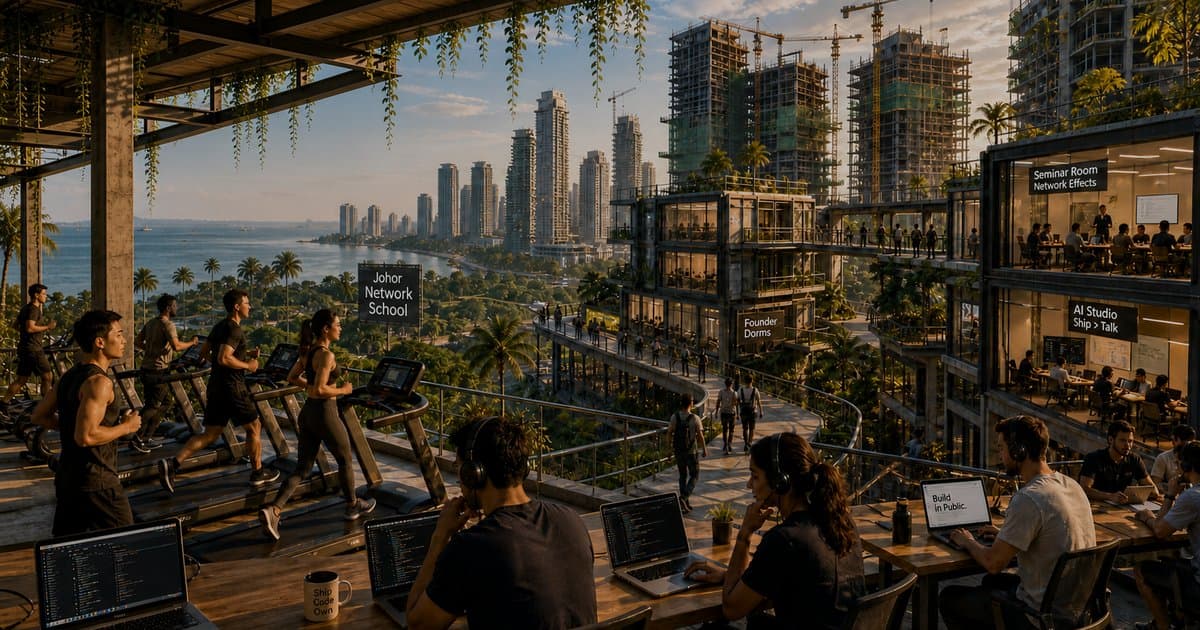
Breaking (July 2026): Network School's Forest City (Johor) campus had its business licence revoked and its operations halted by Malaysian authorities on about 22 July 2026, following an investigation into alleged immigration-law violations. Founder Balaji Srinivasan has signed a Memorandum of Understanding (MoU) with the Republic of Kazakhstan to open the first Network School campus there. The Forest City campus is now shut. What it is: Network School (NS) is a private coliving and coworking "startup society" founded by Balaji Srinivasan, a real-world test of his "Network State" idea, motto Learn, Burn, Earn, Fun. It is a private community, not a government program or an accredited school, and there is no recognised qualification at the end.
In This Guide
What Is Network School?
Network School (NS) is a coliving and coworking community founded by Balaji Srinivasan, former Coinbase CTO and author of The Network State. It was based in Forest City, Johor, Malaysia from 2024 until July 2026. Its motto is "Learn, Burn, Earn, Fun": learn new skills, get fit ("burn"), build and earn (often crypto-native), and enjoy a strong social scene, all from one campus.
At its Forest City peak it drew founders, engineers, creators, athletes and digital nomads from 70+ countries. Think of it as a residential community with daily fitness, deep-work time, talks, demo days and a builder network, run as a live experiment in Balaji's "network state" thesis.
The current status (as of July 2026). On about 22 July 2026 Malaysian authorities in Johor revoked the Forest City campus's business licence and halted its operations, following an investigation into alleged immigration-law violations. Around the same date, Balaji Srinivasan signed a Memorandum of Understanding (MoU) with the Republic of Kazakhstan to open the first Network School campus there, positioning Kazakhstan as an AI and innovation hub. The Kazakhstan city and opening date are not yet confirmed. So the practical picture is simple: the Forest City campus is shut, and NS is relocating abroad.
Two things to fix in your mind before the rest of this guide. First, NS is a private community, not a university, so there is no accredited degree at the end. Second, everything below about cost, daily life and the controversy describes the Forest City era, which is the record of how NS actually operated in Malaysia and what led to the shutdown. Read it as history, then see What's Next for the Kazakhstan move.
The "Network State" Idea Behind It
Network School is the most concrete experiment so far in Balaji's "network state" thesis (from his 2022 book The Network State): the idea that an online community with shared values can cluster in the physical world into a "startup society" that might one day seek some form of recognition.
NS is essentially step one of that plan: gather an aligned community in one place, run shared norms (learning, fitness, building), and iterate. Balaji frames it as voluntary, opt-in and non-coercive, a "reverse secession" that nests inside existing law rather than breaking away from it, with governance modelled on exit ("if you don't like it, fork and leave"). Supporters point to his early January 2020 COVID warning as evidence that his "exit from failing institutions" worldview can be prescient rather than fringe.
Whether any of this ever resembles a "state" is hotly debated (see The Controversy below). As a community and coliving experiment in Johor, though, it is very real and operating. One honest note on the "School" part: the credential is a free, non-transferable NFT ("proof-of-learn"), so treat the name as branding, not accreditation.
History & Timeline
Network School moved fast from idea to permanent community:
- Aug 2024, Balaji previews a "longevity / technocapitalist school" near Singapore; the ns.com domain signals the ambition.
- Sep-Dec 2024 (v1), the first 90-day popup runs (~23 Sep to ~23 Dec 2024) with ~128 participants in Forest City.
- 1 Mar 2025 (v2), a much larger, year-long cohort of 256 members begins.
- May 2025, NS shifts from popup to permanent, adding a "longtermer" program for multi-month stays.
- 2025-26, the community grows to 400+ members from 70+ nationalities, one of the larger "startup society" experiments anywhere.
- Mid-2026, the project draws public scrutiny in Malaysia, including a Johor state call for a federal-state review of its licensing and participants.
- ~16 Jul 2026, the immigration department inspects the 266 foreign participants and clears the viral "Israeli nationals" allegation as a fake story; NS then pauses its planned RM500 million expansion.
- ~22 Jul 2026, Johor and Malaysian authorities revoke the Forest City campus's business licence and halt operations after an investigation into alleged immigration-law violations.
- ~22 Jul 2026, Balaji Srinivasan signs a Memorandum of Understanding with Kazakhstan (with Deputy PM and Minister of AI & Digital Development Zhaslan Madiyev) to establish the first Network School campus in Kazakhstan. City and opening date are not yet confirmed.
The arc went from a short experiment, to a standing 400+ member community, to a Forest City shutdown and a relocation to Kazakhstan inside about two years.
Where It Is: Forest City, and Why It Feels Remote
Network School leases part of Forest City, a mega-development by Chinese developer Country Garden, built on four man-made islands in Iskandar Puteri, Johor, at the southern tip of Peninsular Malaysia. The setting is the single most important practical fact about NS, so it is worth being blunt about it.
It is genuinely far from a town. Forest City sits roughly 37 km from Johor Bahru (JB) city centre, about a 30-minute drive with no traffic, and longer at peak hours. JB City Square, JB Sentral and the real Malaysian shops, markets and hawker food are all a deliberate half-hour car trip each way.
Singapore is closer than JB, via the Second Link. The Tuas / Second Link checkpoint is about 21 km (~17 min) away, versus 44 km (~36 min) to the Causeway-side JB CIQ. For daily border crossing the Second Link is the practical gate, and the resident shuttle routes through it.
On-site amenities are thin. Forest City is widely reported as a "ghost city": only a small fraction of the planned population lives there, so much of the retail is empty or never opened. There is a duty-free mall, golf and a beach on site, and a handful of small groceries and restaurants, but no full-service supermarket or dense food street within walking distance.
That combination, a remote island with sparse walkable amenities, is exactly why food delivery and ride-hailing are not optional here. The next section covers how residents actually eat and move.
Getting Around & Fed: Grab, foodpanda & Daily Logistics
Because Forest City is a half-empty island 30+ minutes from town, day-to-day life runs on your phone. Two apps do most of the heavy lifting, and you should install both before you arrive.
Grab is the default for rides and food. With no walkable town grid and most NS members being short-term foreigners without a Malaysia-registered car, **Grab is how you get almost anywhere: a ride to Gelang Patah, into central JB, or to either checkpoint, plus GrabFood and GrabMart for meals and groceries delivered to your door. Residents describe basically everything worth doing as "a Grab ride away." Budget for the distance: a Grab from Forest City to the JB Causeway CIQ runs on the order of RM100-120 (~35 min)**, while the nearer Tuas / Second Link is roughly half that, so cluster your errands rather than making lots of short hops.
foodpanda widens your food and grocery options. For meals and groceries, **foodpanda is the other app to have, covering restaurants, hawker stalls and pandamart grocery runs across the wider Gelang Patah zone. One practical tip: because Forest City sits on its own islands, drop your exact pin and check live availability in the app before you order**, and expect delivery fees a bit higher than central JB given the distance and low order density. Between GrabFood and foodpanda you will nearly always find something delivering; the trick is to compare both.
Public transport is minimal. The official FC1 shuttle is a cross-border bus to the Singapore checkpoint (about RM4.50, ~20 min, roughly hourly). It solves the Singapore commute, not your daily errands inside Forest City, which is why the two delivery-and-ride apps above end up doing so much work.
Bottom line for daily life: treat Grab (rides + GrabFood + GrabMart) as your default and foodpanda as your second food and grocery app, keep a local **e-wallet or a Wise card** topped up in ringgit to pay for it all, and accept that spontaneity ("walk out and find dinner") is limited here in a way it would not be in central JB or Singapore.
Apps You'll Actually Need at Forest City
Daily life on a remote island runs on your phone. foodpanda handles food and grocery delivery (pair it with Grab for rides and GrabFood), a Wise multi-currency card pays for it all in ringgit and SGD at the real exchange rate across the Johor-Singapore border, and a CelcomDigi SIM keeps you on the data those apps need.

Food delivery from thousands of restaurants, hawker stalls, and grocery shops.

Send money internationally at the real exchange rate. Multi-currency debit card included.

Malaysia's #1 carrier. 65GB tourist SIM with uncapped 100 Mbps. Best rural & Borneo coverage.
The JS-SEZ & Forest City Tax Context
Network School did not land in Forest City by accident. The development has become a policy showcase, and understanding that context explains both the pitch and the caveats:
- JS-SEZ, Malaysia and Singapore signed the Johor-Singapore Special Economic Zone agreement on 7 January 2025 to ease the movement of people, goods and capital between the two; Forest City is one of its flagship zones.
- Forest City Special Financial Zone (SFZ), the zone offers headline incentives such as a 15% individual income-tax rate for qualifying "knowledge workers," a 0% rate for single-family offices, and a 5% concessionary rate for qualifying financial, fintech and global-business-services firms (subsidiary legislation gazetted in October 2025).
Two honest caveats. First, for most NS members these incentives won't apply directly; they are aimed at qualifying employers, family offices and specific roles, so verify eligibility with a Malaysian tax professional before assuming any of it applies to you. Second, uptake so far has been modest: only a small number of family offices have been approved, and businesses have complained the rules are still unclear. The incentives explain why Forest City is being repositioned from ghost city to special zone; they are a work in progress, not a finished tax haven.
Cost & What's Included
Note: the figures below describe how pricing worked at the Forest City campus, which closed in July 2026. Pricing for the planned Kazakhstan campus has not been published; check ns.com for anything current. This is kept as a record of the Forest City era.
Pricing ran roughly US$1,000-2,000+ per month depending on room type (from a shared/double room at the low end up to a private room), typically paid in crypto. The fee bundled most living and program costs:
- Accommodation (shared room from ~US$1,000; private room ~US$2,000; longtermers generally get better housing)
- Three meals a day, a health-focused, "Blueprint"-style diet
- Gym and daily fitness/coaching
- Coworking space
- Courses, talks, demo days and events
The "Earn" part exists, but read it carefully. NS advertises daily crypto bounties (a community prize pool) for things like open-source contributions, AI content and microtasks, and there is a **Network School Fellowship** offering subsidised or sponsored places. Treat the earnings as a possible partial offset, not a salary: what any one member actually nets is not well documented, so do not budget on it.
One thing the fee never covers: everyday spending in Johor. Whatever you pay NS with, daily life here (Grab, foodpanda, groceries, cafes and your condo deposit) runs on ringgit, with Singapore an hour away in SGD. A Wise multi-currency account is the simplest way to handle it: hold your home currency, MYR and SGD together, convert at the real exchange rate, and spend on the card across the Johor-Singapore border without a fresh conversion fee on every hop.
One more thing worth knowing before you commit: in past cohorts, accepted applicants were asked to prepay a full month within about two days, before the exact location was disclosed, a mechanic some applicants publicly called "sketchy." Residency is otherwise flexible, one month up to long-term. Always confirm the current price, the payment terms and exactly what's included at ns.com, as it changes between cohorts.
What Daily Life Is Like
NS is built around its "Learn, Burn, Earn, Fun" rhythm, and member accounts describe a structured day:
- Burn, morning workouts and a strong fitness and longevity culture. The meals lean on Bryan Johnson's "Blueprint" / "Don't Die" protocol, a regime Johnson himself describes as building a movement and which mainstream coverage has called a cultish longevity trend. If that appeals, it is a feature; if it does not, it is a lot.
- Learn / Earn, long deep-work blocks for your own startup or job, plus talks, workshops and demo days with founders and operators.
- Fun / community, shared meals, social events and a tight peer network of ambitious people.
The appeal is the environment and peers: a high-intensity, health-oriented, builder-dense setting where the defaults (fitness, focus, shipping) are easy to follow.
A few honest notes on the social texture, drawn from first-hand member write-ups. The community skews heavily male (sympathetic members estimate roughly 80%), enough that some single residents decamp to Singapore on weekends. Even people who enjoyed their stay describe the occasional clique forming among language groups, and a minority of members giving a "haughty vibe." And in the early cohorts the programming carried little Malaysian content (no Malay language, limited local food or culture), a gap some accounts say is improving slowly. None of this is disqualifying; it is just the reality of an intense, ideologically distinct bubble, and it suits self-directed builders far more than people wanting a structured curriculum or a conventional social mix.
Who It's For
NS skews toward tech and startup people: software engineers, founders, crypto and Web3 builders, content creators and remote workers, with a heavy health-and-fitness culture layered on. The crypto-native builders here work in the same on-chain scene tracked at web3wagmi.
It suits you if you want an intense, builder-focused, fitness-oriented community with a ready-made network near Singapore, you are comfortable with a crypto-native, "network state"-aligned crowd, and you are fine running daily life on delivery apps from a quiet island. It is a poor fit if you want a conventional accredited course, a family setup, a diverse social scene, or a central-city lifestyle with amenities on your doorstep.
The Controversy, In Full
Network School attracts real skepticism, and a useful guide has to lay it out plainly. Weigh these before you send any money, and read first-hand accounts on both sides.
Where the money and the pitch diverge. NS is a private, crypto-prepaid community with no accreditation and no recognised qualification (the credential is a free NFT). Past cohorts asked for a full month upfront on a short window before the location was disclosed, which some applicants called "sketchy." The founding line that NS "got an island through the power of Bitcoin" also overstates reality: NS leased a hotel and facilities on Forest City's reclaimed land, fully subject to Malaysian law and visa policy. Do your own due diligence on refunds and terms.
The Forest City backdrop. The host site is majority-owned by Country Garden, a developer that defaulted on offshore debt in October 2023 and only completed a roughly US$17.7bn restructuring at the end of December 2025, with a Hong Kong court dismissing a liquidation petition as late as February 2026. Forest City itself is roughly 10% built and houses only single-digit thousands of people against a 700,000 target, a "ghost city" whose buyer base collapsed after China tightened enforcement of its US$50,000 annual forex quota. The land reclamation caused documented environmental concerns (seagrass, mangroves, fishing grounds) and a formal objection from Singapore, and a 2024 report that the government might allow a casino to rescue the project drew an angry denial from PM Anwar. None of this is NS's doing, but it is the ground NS stands on.
The ideology fight. Balaji's "network state" is read by critics as an "exit" ideology that lets tech wealth opt out of democratic accountability. The most persistent critic, journalist Gil Duran (a former Democratic political operative), calls the model "tech fascism" and its enclaves "autocratic playgrounds where the ultra-rich and corporations make all the rules," and other writers dismiss the concept as "essentially Galt's Gulch plus blockchain" or tie it to Curtis Yarvin's neoreactionary "Dark Enlightenment." Note that much of the sharpest criticism concentrates in a few adversarial voices, and Balaji rejects those labels, framing NS as voluntary, opt-in and non-coercive and pointing to his prescient 2020 COVID call. Read both sides rather than either pitch deck.
The host-country question. Critics and even sympathetic members note that NS often barely engages the Malaysia it physically occupies, and in mid-2026 the Johor state government called for a federal-state review of the project's licensing, land use and the nationalities of its participants. That review followed viral online allegations about foreign participants, including claims involving Israeli nationals; those specific allegations are unverified and were the subject of the review, so treat them as claims under investigation, not established fact. What is confirmed is that a Malaysian state government asked for the project to be examined, which is a meaningful signal about its regulatory footing.
Update, 16 July 2026: the allegation was debunked, but NS still paused its Malaysia investment. The immigration department inspected all 266 foreign participants, from 40 countries, and found every one held valid documents, with no evidence of Israeli nationals (Malaysia has no diplomatic ties with Israel and generally bars Israeli passport holders). Balaji Srinivasan called the claim, which he said an anonymous account had spread, a "fake story." Even after the finding, NS announced it was putting all further Malaysian investment on hold "until we get sufficient assurance that such issues won't recur." It has already spent about RM100 million on the Forest City campus and had planned a roughly RM500 million expansion, now shelved, while employing dozens of Malaysians. Srinivasan floated either a formal memorandum of understanding (pointing to Kazakhstan's deal with the Solana Foundation) or reallocating the capital to another country.
Final outcome, ~22 July 2026: the licence was revoked and NS is leaving for Kazakhstan. Despite the 16 July debunk of the participant allegation, Johor and Malaysian authorities revoked the Forest City campus's business licence and halted its operations on about 22 July, following an investigation into alleged immigration-law violations at the campus. Within days, Balaji Srinivasan signed a Memorandum of Understanding with the Republic of Kazakhstan (with Deputy PM and Minister of AI & Digital Development Zhaslan Madiyev) to open the first Network School campus in Kazakhstan, pitched around AI education, gathering global tech talent, expedited visas, and placement and recruitment. The Kazakhstan city and opening date are not yet confirmed. This shutdown-and-relocation is now the central fact of Network School's story: the episode shows how fast a viral claim and a regulatory finding can end a real investment, and how exposed a private community is to the politics of its host country.
Bottom line: treat NS as a paid coliving and community experience with a genuine builder scene and a genuinely complicated backdrop. Verify everything at ns.com, talk to current and former members, keep your visa and finances clean, and go in with clear eyes.
How NS Compares to Other Startup Societies
Network School is one of several "network state" experiments, and the most permanent and largest residential one:
- Zuzalu (Montenegro, 2023), Vitalik Buterin's 2-month pop-up; a proof-of-concept that later decentralised into smaller "Zu-" events rather than a permanent base.
- Próspera (Roatán, Honduras), a private special economic zone (ZEDE) with its own legal and tax framework; more a jurisdiction play than a coliving community.
- Vitalia (Roatán, 2024), a longevity-focused pop-up on Próspera land; since split into Infinita and Viva City.
- Praxis, an online community raising capital to build a permanent "city-state"; still largely pre-physical.
Where NS differs: it is operating now, residential, and rotates monthly cohorts at scale (400+ members) rather than running one-off events, trading the legal autonomy of a Próspera for a low-friction, repeatable community an hour from Singapore. Balaji also runs the Network State Conference as the movement's flagship event.
How to Join
Important: the Forest City campus has closed (licence revoked in July 2026), so joining in Malaysia is no longer possible. NS is relocating to Kazakhstan, but the city, opening date and intake details are not yet confirmed. Check **ns.com** for the current status before planning anything. The steps below describe how joining worked in the Forest City era.
- **Apply at ns.com**, the official site had the application form, pricing and intake details.
- Cohorts started on the 1st of each month with an orientation; applicants were told to apply early, as spots filled up.
- Applicants had to be ready to pay in crypto, to verify their background, and to commit on a short payment window. Confirm the refund terms in writing before you send anything.
- Stay logistics mattered: visa and entry (below), getting from Singapore or JB to a remote island, which delivery and ride apps to rely on, and how long to stay (a month vs. longtermer).
Visa & Practicalities for Malaysia
Caveat: with the Forest City campus closed since July 2026, there is no NS cohort to join in Malaysia, so the guidance below is a record of how the Malaysian stay worked, plus general Malaysia travel information. NS is moving to Kazakhstan; visa details there are pending at ns.com. If you are visiting Johor or Forest City independently, your legal stay in Malaysia is your responsibility:
- Short stays: many nationalities get visa-free entry for 30-90 days as tourists, often enough for a one-month stay. Check your passport's allowance.
- Longer stays: don't rely on repeated "visa runs." Use a proper route, Malaysia's DE Rantau Nomad Pass (digital-nomad visa) or, for some, MM2H. See our Visa Guide and MM2H Guide.
- Getting there: fly into Singapore (Changi) or Senai (JHB); Forest City is closest via the Tuas / Second Link.
- Money & daily life: keep a local **e-wallet, bank or Wise card** for day-to-day spending in Johor (Grab, foodpanda, groceries), even though NS fees are crypto, and a local SIM for the data those apps need.
Confirm your specific eligibility with Malaysian Immigration (JIM), not community hearsay. Note that the NS project itself lost its Forest City licence over alleged immigration violations in July 2026, so treat any immigration matter here with extra care.
What's Next for Network School and Forest City
These are forward-looking views, not guarantees.
The Kazakhstan move is now the main story. With the Forest City licence revoked and operations halted in July 2026, Network School is relocating. Balaji Srinivasan signed a Memorandum of Understanding with the Republic of Kazakhstan (with Deputy PM and Minister of AI & Digital Development Zhaslan Madiyev) to open the first Network School campus there. The pitch is heavier on AI than the Forest City version: AI education, gathering global tech talent, expedited visas, and placement and recruitment, with Kazakhstan positioned as a regional AI and innovation hub. The MoU is at national-government level, which is a stronger backing than a leased hotel on a private developer's land. The open questions are large: the exact city and opening date are not yet confirmed, an MoU is an intent to cooperate rather than a finished campus, and NS has to rebuild a community that was rooted in Forest City and near Singapore. Watch ns.com for the concrete details.
What it means for Forest City. NS was one of Forest City's few genuine anchor tenants, a visible source of foreign residents, spending and attention on a development that is roughly 10% built. Losing it removes an anchor and a talking point that the JS-SEZ and Forest City Special Financial Zone were meant to attract. Whether the zone's tax incentives can draw family offices, fintech firms and knowledge workers to fill that gap is now an open question, and the abrupt shutdown is a reminder of how uncertain the project's regulatory footing was.
For ambitious, self-directed builders, the interesting thing to watch is whether NS can reconstitute itself in Kazakhstan and whether a government-level partnership proves more durable than the Forest City arrangement. Go in informed, treat NS as an experiment you are paying to join, wait for confirmed Kazakhstan details, and keep your exit options open.
Disclaimer: Network School is a private project; fees, capacity, programs and entry rules change frequently. Its Forest City campus had its business licence revoked and operations halted in July 2026, and NS has signed an MoU to relocate to Kazakhstan, so the Malaysian campus is closed and joining in Malaysia is no longer possible. This guide is informational, not an endorsement. Verify current details and pricing at ns.com. Last verified: 24 July 2026.
Sources & References
Data in this guide is cross-referenced against the following official sources.
- Network School (official) Application, pricing and program details
- Balaji Srinivasan, Network School Founder's write-up of the concept and the NFT credential
- The Network State The underlying "startup society" thesis
- Balaji, Network School 2025 v1/v2 cohort sizes, member growth & program update
- Network School Fellowship Subsidised / sponsored places
Further reading: Free Malaysia Today · New Straits Times · The Star · The Edge Malaysia · EY · Al Jazeera · Protos · The New Republic · Brandon Possin · Malay Mail · Rome2Rio