
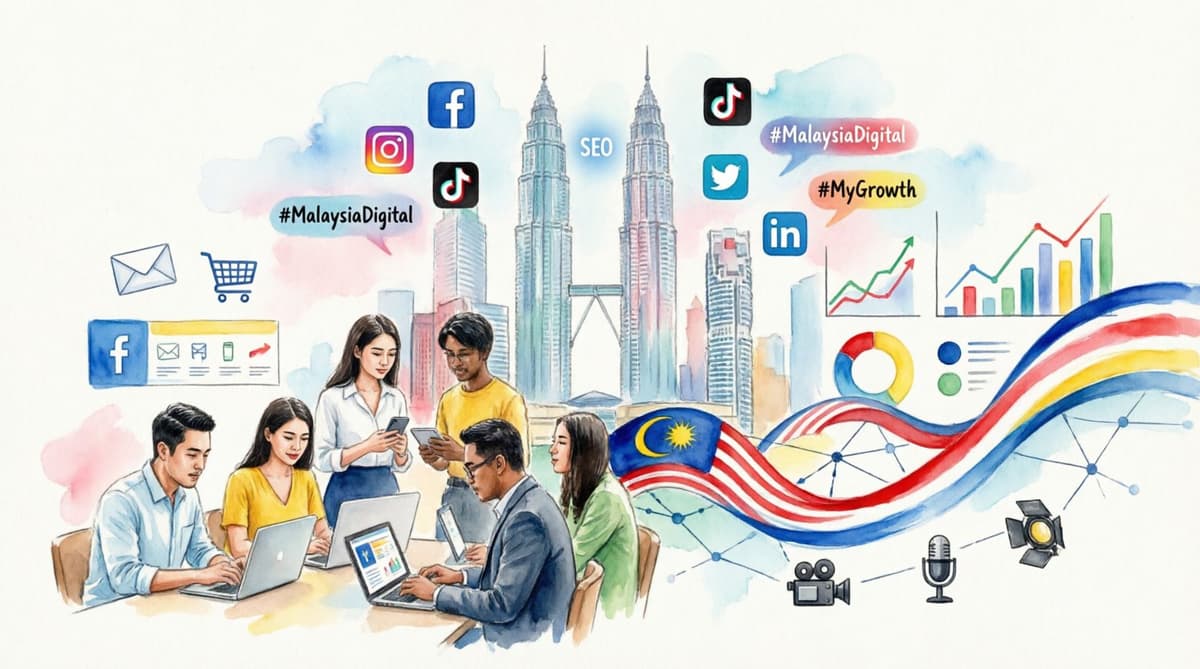
Key facts: 34.9M internet users (97.7%), 25.1M on social media, WhatsApp reaches 90.7% of users, TikTok Shop GMV hit US$5B in 2025.
In This Guide
The Malaysia Digital Landscape, by the Numbers
The Malaysia Digital Landscape, by the Numbers
Malaysia is one of the most connected markets on earth. At the start of 2025, 34.9 million Malaysians were online, a 97.7% internet penetration rate against a population of 35.8 million. For a marketer, the takeaway is blunt: your customer is already on a screen. The questions worth spending money on are which screen, which app, and which language, not whether they are reachable at all.
The headline numbers
| Metric | Figure | Share of population | Source (year) |
|---|---|---|---|
| Total population | 35.8 million | 100% | DataReportal |
| Internet users | 34.9 million | 97.7% | DataReportal |
| Active social media user identities | 25.1 million | 70.2% | DataReportal |
| Cellular mobile connections | 43.3 million | 121% | DataReportal |
| Mobile share of daily online time | 55.8% | n/a | DataReportal |
| Median mobile download speed | 104.99 Mbps | n/a | DataReportal |
| Median fixed download speed | 118.02 Mbps | n/a | DataReportal |
| Avg. daily time online (all devices) | 8h 17m | n/a | DataReportal |
| Avg. daily time on social media | ~2h 48m | n/a | DataReportal |
Two figures deserve a second look. Mobile connections sit at 121% of the population, so many Malaysians carry two SIMs or two phones. And Malaysians spend more than eight hours a day online, among the highest in Southeast Asia. That is a full working day of attention, and more than half of it happens on a phone. Design for mobile first or you are designing for the minority of the session.
Platform by platform: where the audience actually is
No single platform owns Malaysia. A serious 2026 plan runs on at least three or four in parallel, matched to intent.
| Platform | Users / ad reach | Reach vs. population | Source (year) |
|---|---|---|---|
| YouTube | 25.1 million | 70.2% | DataReportal |
| ~90.7% of 16 to 64s use it monthly | Highest-used app | Meltwater / DataReportal | |
| 23.1 million ad reach | 64.4% | DataReportal | |
| TikTok | 19.3 million (adults 18+) | 72.8% of adults | DataReportal |
| 15.5 million ad reach | 43.2% | DataReportal | |
| Messenger | 11.1 million ad reach | 31.0% | DataReportal |
| 9.10 million members | 25.4% | DataReportal | |
| X (Twitter) | 5.10 million | 14.2% | DataReportal |
What the platform mix means for spend:
- WhatsApp is the operating system of Malaysian commerce. With roughly 90% monthly usage, it is where enquiries, catalogues, order confirmations and after-sales chat actually close. Treat it as a sales channel with a staffed inbox, not a personal messenger.
- TikTok is now a demand engine, not just entertainment. Malaysians spend an average of around 42 hours a month in the app, and TikTok Shop re-entered the market in December 2024 and crossed USD 5 billion in GMV in 2025, up 132% year on year. Short video plus live selling is where discovery and checkout have merged.
- YouTube and Facebook remain the broad-reach backbone. For mass awareness across age groups and the older, less TikTok-native segments, these two still deliver the widest single-buy reach.
- Instagram and LinkedIn are targeting layers, for lifestyle/visual brands and B2B respectively, rather than reach plays.
The money: digital ad spend and e-commerce
The spend has followed the eyeballs. Total Malaysian ad revenue was forecast at RM9.54 billion for 2025, with digital taking the clear majority and social growing about 11% year on year. In the first half of 2025, reported digital adex from the agencies tracked hit RM343 million in Q1 and RM661 million in Q2, with social media climbing toward 50% of the digital mix and video the second-largest format at around 22%.
| Money metric | Figure | Source (year) |
|---|---|---|
| Total Malaysian ad revenue | RM9.54 billion | MAGNA / MSA |
| Social media share of digital adex | ~44% to 50% | MSA |
| Video share of digital adex | ~22% to 24% | MSA |
| E-commerce market size | USD 10.62 billion | Mordor Intelligence |
| E-commerce market size | USD 12.18 billion | Mordor Intelligence |
| E-commerce CAGR | 13.67% | Mordor Intelligence |
| Shopee market share | ~60% | Cube |
| Lazada market share | ~30% | Cube |
| TikTok Shop GMV | USD 5+ billion (+132% YoY) | DigitalinAsia |
On the retail side, Shopee still anchors the market at roughly 60% share, Lazada holds about 30%, and TikTok Shop is the fast-mover eating into both through social commerce. During Raya 2025, e-commerce was the top festive shopping channel, with about 83% favouring Shopee for festive essentials and 33% already buying through social commerce platforms like TikTok Shop. More than half of festive shoppers preferred e-wallets over cash.
What these numbers mean for your 2026 plan
- Assume near-total reach, then compete on relevance. With 97.7% penetration, the edge is no longer access. It is message, language and timing against an audience giving you eight hours of daily attention split across four or five apps.
- Budget mobile-first and vertical-first. Over half of online time is on the phone, so vertical video, fast-loading pages and tap-to-WhatsApp flows should be the default, not the adaptation.
- Run a portfolio, not a favourite. WhatsApp for conversion and service, TikTok for discovery and live selling, YouTube and Facebook for reach, Instagram and LinkedIn for targeting. Spending everything on one platform leaves most of the day uncovered.
- Treat social and commerce as one funnel. With TikTok Shop growing triple digits and live formats driving a fifth of platform GMV, the gap between "content" and "checkout" has effectively closed in Malaysia. Plan creative that sells in-feed, not just brand video that hopes for a later visit.
How healthy is your marketing?
Enter your website (or an @handle) and get an instant 0-100 score plus the exact gaps costing you leads — SEO, mobile, tracking, retargeting and social.
Instant · No sign-up · Works on any website · Results in seconds
Channels That Convert — With Benchmarks
Channels That Convert — With Benchmarks
Malaysia is one of the most connected markets on earth: 34.9 million internet users at 97.7% penetration, and 25.1 million active social media user identities equal to 70.2% of the population at the start of 2025. The average Malaysian is on multiple platforms daily, so the question is not whether to be on a channel. It is which channel carries a buyer at which stage, and what a result costs there in ringgit. This section breaks down the five channels that actually move revenue for Malaysian businesses, with current usage data and RM cost benchmarks.
A note on the numbers below: platform costs move with your industry, offer, creative quality, and season. Treat every benchmark as a planning range, not a quote. Finance, legal, insurance, and property sit at the top of every cost band; F&B, fashion, and low-ticket e-commerce sit at the bottom.
Meta (Facebook + Instagram): the workhorse for reach and leads
Meta remains the broadest paid reach in the country. Facebook still counts tens of millions of Malaysian users, and Instagram reached 15.5 million users in early 2025, equal to about 43.2% of the population. Instagram skews younger and more urban; Facebook skews older and reaches deep into secondary towns and East Malaysia. Running both from one Meta Ads Manager account is standard.
What Meta is best at: mid-funnel demand generation and lead capture. The single highest-converting format for Malaysian SMEs is the click-to-WhatsApp ad, which drops the user straight into a chat rather than a landing page. Practitioners consistently report click-to-WhatsApp converting 2 to 3 times higher than standard click-to-website ads.
Rough RM benchmarks:
| Metric | Typical range | Notes |
|---|---|---|
| CPM (per 1,000 impressions) | RM8 – RM25 | Reels and Stories run 30-40% cheaper than Feed for awareness |
| CPC (link click) | RM0.50 – RM3.00 | Most SME industries; finance/property higher |
| CPL (cost per lead) | RM8 – RM80+ | RM8 cap for an RM50 F&B walk-in; RM80 healthy for a high-LTV service |
Sources: ZenWeb Meta Ads Pricing Malaysia; xyzlab Meta Ads Benchmarks Malaysia. Most Malaysian SMEs run RM3,500 to RM7,000/month in Meta spend to keep learning phases stable.
Creative is the biggest lever on cost: strong native creative can cut CPL by 40-60% versus weak, over-designed ads. Shoot vertical, caption in the buyer's language, and lead with the offer in the first two seconds.
TikTok + TikTok Shop: discovery and live commerce
TikTok is Malaysia's fastest-growing major platform, with roughly 18.5 million active users reported in early 2025 and an adult ad-reach audience that platform figures put considerably higher by late 2025. More important than raw reach is intent: Malaysians do not just watch on TikTok, they buy. Malaysia holds about 24% of TikTok Shop's entire Southeast Asia market share, and Malaysia posted around 48% year-on-year GMV growth in 2025, among the fastest in the region.
TikTok Shop now sits as the second-largest e-commerce platform in Malaysia behind Shopee, driven overwhelmingly by live selling. Live sessions with a host demonstrating product, stacking vouchers, and creating urgency ("checkout now, price naik after this") routinely outperform static listings for fashion, beauty, F&B, and home categories.
Rough RM benchmarks:
| Metric | Typical range |
|---|---|
| CPM | RM8 – RM25 |
| CPC | RM0.40 – RM1.50 |
| Daily starting budget | RM50 – RM100 for stable optimisation |
Source: MediaPlus Digital TikTok Advertising Cost Malaysia. DIY boosted-post budgets start near RM1,000/month; a full-funnel setup with paid ads, creators, and live operations typically runs RM3,000 to RM15,000+/month.
The winning pattern here is organic video plus creator plus live: seed short organic clips, amplify the best performers with Spark Ads, and route demand into scheduled live sessions with hard voucher deadlines.
Google Search + Google Business Profile: capturing existing intent
Meta and TikTok create demand. Google captures it. When a Malaysian types "aircond service Petaling Jaya" or "invoice software Malaysia," they are ready to act, which is why Search leads close faster than social leads for most service and B2B businesses.
Rough RM benchmarks:
| Industry band | CPC range |
|---|---|
| F&B, low-competition | RM1.20 – RM2.00 |
| Most SME industries | RM3 – RM6 |
| Legal, healthcare, professional services | RM8 – RM25 |
Sources: ZenWeb Google Ads CPC by Industry Malaysia; Listing.my. CPCs have risen roughly 8-12% a year since 2023 as more advertisers and AI-led bidding enter the auction. A lead-focused SME campaign realistically needs RM150 to RM300/day; RM30 to RM50/day suits brand-awareness or a narrow local keyword set.
Do not overlook the free channel here: Google Business Profile (GBP). For any business with a physical location or service area, a complete, review-rich GBP is the single highest-ROI local asset. It wins the Google Map pack, feeds "near me" searches, and costs nothing but attention. Post weekly, reply to every review, and keep hours and photos current.
Shopee & Lazada ads + live: winning the marketplace shelf
Shopee is the largest e-commerce platform in Malaysia, with Lazada holding a solid third behind TikTok Shop. If you sell physical product, these marketplaces are where high-intent shoppers already are, comparing price and reading reviews. The trade-off is margin: platform commissions, campaign fees, and voucher co-funding compress your take, so marketplace economics have to be built into your pricing.
On-platform advertising works on a keyword and product-placement auction, similar in logic to Google Search but inside the app. The levers that matter most:
- Search and discovery ads to buy the top shelf position for your best-converting SKUs.
- Campaign participation (double-date sales like 9.9, 10.10, 11.11, 12.12) where platform traffic spikes and voucher stacking drives conversion.
- Live and in-app video to replicate TikTok's live-selling energy inside the marketplace, increasingly central to both Shopee and Lazada.
Because CPC and CPM on-platform vary heavily by category and campaign period, budget by target ACOS (advertising cost of sale) rather than a fixed CPC. Start with 5-10% ACOS targets on proven SKUs and scale what stays profitable through the sales calendar.
WhatsApp Business: where Malaysian deals actually close
WhatsApp is the connective tissue of Malaysian commerce. It reaches roughly 84% of the country's internet users and counts well over 26 million users, making it Malaysia's most widely used platform, ahead of any social feed. Malaysians expect to negotiate, ask questions, and pay through chat, and about 73% of Malaysian WhatsApp Business conversations include some Bahasa Malaysia.
WhatsApp is rarely a top-of-funnel acquisition channel on its own. It is the conversion and retention engine that every other channel feeds into. The stack that works:
- WhatsApp Business app for micro and small businesses: catalogue, quick replies, labels, away messages.
- WhatsApp Business Platform (API) for scale: automated flows, broadcast campaigns, and CRM integration. API adoption among Malaysian businesses still sits around 19%, so disciplined use is a genuine edge.
Business messaging carries open rates far above email, and the click-to-WhatsApp ad path from Meta means you can measure cost per conversation directly. Keep broadcasts consent-based and useful; aggressive blasting gets numbers blocked fast.
Channel comparison at a glance
| Channel | Primary funnel role | Best for | CPC / cost signal (RM) | Malaysia reach signal |
|---|---|---|---|---|
| Meta (FB + IG) | Demand gen + lead capture | Broad reach, click-to-WhatsApp leads | CPC RM0.50-3.00; CPM RM8-25 | IG 15.5M users; FB nationwide |
| TikTok + TikTok Shop | Discovery + live commerce | Impulse, beauty/fashion/F&B, live selling | CPC RM0.40-1.50; CPM RM8-25 | ~18.5M users; #2 e-commerce platform (DataReportal; Cube.asia) |
| Google Search + GBP | Intent capture | Services, B2B, local "near me" | CPC RM3-6 typical; RM8-25 competitive | 97.7% internet penetration |
| Shopee / Lazada ads | Marketplace conversion | Physical product, mega-sale spikes | Budget by target ACOS 5-10% | Shopee #1, Lazada #3 |
| WhatsApp Business | Conversion + retention | Closing, follow-up, re-orders | Cost per conversation via click-to-WA | ~84% of internet users; 26M+ |
The funnel pattern that works in Malaysia
No single channel does the whole job. The pattern that consistently converts stitches discovery, intent, and closing together:
- Create demand on TikTok and Instagram Reels with native short video (organic first, then amplify winners with paid).
- Capture intent on Google Search and a fully optimised Google Business Profile, so the buyer you warmed up can find you the moment they act.
- Convert the click-to-WhatsApp lead into a real conversation, where price, questions, and payment get handled in the buyer's own language.
- Close on-platform where the buyer already shops: TikTok Shop live for impulse categories, Shopee and Lazada for considered marketplace purchases.
- Retain through WhatsApp with consent-based broadcasts, restock alerts, and festive offers timed to the local calendar.
The mistake most Malaysian SMEs make is treating these as separate campaigns with separate goals. Treat them as one flow: TikTok and Meta fill the top, Google and GBP catch the ready-to-buy, and WhatsApp plus the marketplaces do the closing. Measure the whole path on cost per closed sale, not cost per click on any one channel.
Sources: DataReportal, Digital 2025: Malaysia; Hashmeta, Social Media & WhatsApp Business Malaysia; Cube.asia, Shopee/Lazada/TikTok Shop SEA; ECDB Malaysia e-commerce; ZenWeb and MediaPlus Digital Malaysia ad-cost guides; Listing.my and xyzlab benchmarks.
Out-of-Home & Digital Billboards (OOH)
Out-of-Home & Digital Billboards (OOH / DOOH)
Malaysia's screens are not only in pockets. Highways, LRT and MRT stations, malls, airports and petrol forecourts still shape how "real" a brand feels, and out-of-home (OOH) is going digital fast.
The formats that matter here
| Format | Where | Best for |
|---|---|---|
| Classic billboards | Federal Highway, LDP, NKVE, plus Penang & JB arterials | Mass brand awareness, credibility, festive |
| Digital billboards (DOOH) | Klang Valley LED sites, increasingly programmatic | Dynamic and festive creative, dayparting, shorter buys |
| Transit | LRT/MRT/Monorail stations and train wraps, RapidKL buses, e-hailing car wraps | Urban commuters, high-frequency repeat exposure |
| Mall & lift media | Atriums, escalators, lift screens | Captive, purchase-adjacent audiences |
| Airport (KLIA / klia2) | Terminals and jetways | Premium, travellers, B2B |
| Petrol & retail | Petronas / Shell forecourts, convenience stores | Broad reach with real dwell time |
Who runs it
The market is led by Big Tree Outdoor (the largest OOH network in Malaysia), alongside operators such as Seni Jaya and Redberry, plus transit-media specialists for the rail and bus networks. Most businesses buy through these site owners or an OOH/media agency rather than direct.
Why OOH still earns its place in a digital plan
- Trust and scale. A physical billboard signals a serious, established brand in a way a feed ad cannot, valuable for property, F&B chains, telco, finance and festive pushes.
- Geographic targeting. Own the highway, station or mall right next to your outlets.
- Un-skippable. No ad-block, no scroll-past, no cost-per-click auction.
The 2026 way to run it: OOH plus mobile
Standalone billboards are hard to measure, so the modern approach integrates them with digital:
- Programmatic DOOH for dynamic creative, dayparting (breakfast vs evening commute) and shorter, cheaper flights than a month-long static booking.
- Location retargeting. Serve mobile ads to devices seen near your OOH sites, then measure the lift.
- QR and search bridges. A memorable URL, QR code or branded search term on the creative turns a physical impression into a trackable tap, closing on WhatsApp as usual.
Budget reality
OOH is a brand spend, not a direct-response one. Static billboards range from a few thousand ringgit to tens of thousands a month depending on site and size; DOOH slots and transit packs can start smaller and flex. Treat it as awareness that makes your digital and chat funnels convert better, not as a lead machine on its own. (Indicative only; site owners quote per location and period.)
PR, Paid & Earned Media (the PESO Mix)
PR, Paid & Earned Media
Ads are only one slice. The full picture is the PESO mix: Paid, Earned, Shared and Owned. Most Malaysian SMEs over-index on paid and ignore the cheaper, more credible earned and owned layers.
The four media types
| Type | What it is | Malaysia examples |
|---|---|---|
| Paid | You pay to place it | Meta/TikTok/Google ads, DOOH billboards, Shopee/Lazada retail media, sponsored KOL posts |
| Earned | Others talk about you (PR) | Press coverage, reviews, organic word-of-mouth, unpaid creator mentions |
| Shared | Social and community | Your social posts, shares, community groups, WhatsApp forwards |
| Owned | You control it | Website, WhatsApp list, email/CRM, your own content |
The strongest plans use all four: PR earns trust, paid scales reach, shared spreads it, owned captures and keeps it.
PR and earned media in Malaysia
PR still moves the needle here, especially for credibility with older and B2B audiences, and it is multi-lingual by necessity.
- The press is segmented by language. English (The Star, New Straits Times, Malay Mail, and The Edge for business), Malay (Berita Harian, Harian Metro, Utusan) and Chinese (Sin Chew Daily, China Press) each reach a different audience. A serious launch often needs all three.
- Digital-first outlets such as Says and Vulcan Post, plus business and tech portals, drive shareable reach with younger readers.
- What PR actually delivers: launch coverage, founder and expert thought leadership, awards and rankings for credibility, product seeding to creators (the modern press kit), and crisis communications when something goes wrong.
- How to run it lean: a genuinely newsworthy angle, a tight release in the right languages, a curated media and creator list, and disciplined follow-up. Many SMEs get more from steady product seeding to micro-creators than from one big paid burst.
Paid media strategy, beyond boosting a post
Paid is the amplifier, not the whole plan.
- Layer it: always-on performance (search, social retargeting, retail media) plus burst campaigns around launches and festivals.
- Fund the whole funnel. Split budget across awareness (video, DOOH, reach), consideration (retargeting, creators) and conversion (search intent, WhatsApp click-to-chat, retail media).
- Retail media is now core. Shopee, Lazada, TikTok and Grab ad networks reach buyers at the point of purchase; treat them as a channel, not an afterthought.
- Measure to a business number. Optimise to cost per lead or ROAS, not reach, and feed the results back into which PR and creator angles are worth amplifying with paid.
The rule: use PR and owned media to build something worth talking about, then use paid to make sure the right Malaysians hear it, in the right language, at the right time.
The Festive Calendar & Seasonal Spend
The Festive Calendar & Seasonal Spend
Malaysia runs on festivals. A multi-ethnic, multi-faith market means the calendar has four major cultural peaks (Raya, Chinese New Year, Deepavali, Merdeka/Malaysia Day) stacked on top of four platform-engineered mega-sales (9.9, 10.10, 11.11, 12.12). For most consumer businesses, 50-70% of the annual e-commerce take lands inside these windows. Planning the year backwards from this calendar is the single highest-leverage decision a Malaysian marketer makes.
The behavioural shift to watch: Malaysians now shop festivals early. Malaysians increasingly begin Raya shopping weeks ahead, many as early as Q4, months before Ramadan, to stack year-end sale discounts. Treat the sale date as the delivery deadline, not the campaign start.
The 2026 festive and sale calendar
| Event | 2026 date | Ethnic/segment focus | Campaign live window |
|---|---|---|---|
| Chinese New Year (Year of the Horse) | 17-18 Feb | Chinese | 3-4 weeks prior (from mid-Jan) |
| Ramadan begins | ~18 Feb | Malay/Muslim | Ramadan is the shopping runway |
| Hari Raya Aidilfitri | ~20-22 Mar (4-day long weekend) | Malay/Muslim | Full Ramadan month + balik kampung week |
| Hari Raya Aidiladha (Haji) | ~27 May | Malay/Muslim | 2 weeks prior |
| Merdeka Day | 31 Aug | National, all segments | 3-4 weeks (August) |
| Malaysia Day | 16 Sep | National, East Malaysia strong | Overlaps Merdeka + 9.9 |
| Deepavali | 8-9 Nov | Indian | 3 weeks prior (from mid-Oct) |
| Christmas / year-end | 25 Dec | Urban, all segments | December |
Islamic dates (both Raya, Awal Muharram) depend on JAKIM moon-sighting and can shift by a day. Build one day of slack into ad flight and delivery promises.
| Mega-sale (platform-driven) | Date | Character |
|---|---|---|
| 9.9 | 9 Sep | First big Q4 sale, overlaps Malaysia Day |
| 10.10 | 10 Oct | Mid-season, warms up for 11.11 |
| 11.11 | 11 Nov | The largest single sale day of the year, overlaps Deepavali |
| 12.12 | 12 Dec | Year-end clearance, Christmas gifting |
How big is the spike?
The festive peaks are visible in raw platform GMV. Shopee Malaysia's monthly gross merchandise value was estimated at around RM60 billion in March 2025 (the Raya month), up roughly 11% from about RM54 billion in February, driven by fashion, hampers, and festive treats. Across the region, TikTok Shop's Raya sales nearly doubled year-on-year, and Lazada stacked a Birthday Sale on top of Raya to pull a traffic surge.
The structural backdrop is a market that is still growing fast. Southeast Asia's platform e-commerce GMV reached US$128.4 billion in 2024, up 12% year-on-year, with Malaysia among the fastest-growing markets at roughly +19.5%. Malaysia was TikTok Shop's fastest-growing SEA market, with GMV up about 150% in H1 2025, and Malaysia already accounts for around 15.7% of TikTok Shop's regional transaction volume.
What Malaysians actually spend, by festival
Hari Raya is the biggest consumer event of the year. It is also increasingly budget-conscious. In 2025, 70% of Raya shoppers kept spending under RM500, and half set a budget of RM300-500. Fashion and beauty lead: 70% bought traditional attire, modest wear, footwear, and cosmetics; 20% prioritised household items, festive food, and hampers. Shopee dominated purchase intent (83% for hampers and household goods, 84% for Raya clothing), with Lazada as the browse-and-compare second stop. The message that converts: value and trust, not luxury.
Chinese New Year centres on reunion, gifting, and duit raya/ang pow. Ang pow amounts now typically start at RM6-RM8, with lucky-number denominations of RM8, RM18, and RM88 preferred, and odd numbers like RM5 or RM7 avoided. Commercially this is the season for hampers, mandarin oranges, apparel, home refresh, and e-wallet ang pow (Touch 'n Go, GrabPay, ShopeePay all run CNY ang pow mechanics). Regional targeting matters: Central region shoppers skew fully online, while Northern and East Coast shoppers still browse in-store then buy online.
Deepavali is the key Indian-Malaysian window (gold, apparel, sweets, home). It falls on 8-9 November 2026, directly beside 11.11, so a single well-planned mid-October to mid-November flight can serve both a cultural festival and the year's largest mega-sale.
Merdeka and Malaysia Day (31 Aug, 16 Sep) are the cleanest festivals commercially but the strongest for brand and national sentiment. Local-pride creative, "Jalur Gemilang" visual cues, and Merdeka-themed bundles perform, and the window feeds naturally into the 9.9 sale.
Ad costs rise with the calendar: plan for auction inflation
Every advertiser targets the same weeks, so the ad auction heats up. Baseline Malaysian Meta CPMs run roughly RM8-RM25 (RM10-RM50 for competitive categories), with CPCs of about RM0.50-RM3.00. During Hari Raya, 11.11, and the year-end auctions, CPMs typically climb 30-50%; category budgets should index 1.4x-1.7x of base spend in peak windows.
The counter-intuitive point: peak months are usually the highest-ROAS of the year, because conversion rate and average order value rise faster than CPM. You pay more per impression and still come out ahead. The mistake is arriving late. Warm your audiences and retargeting pools in the 3-4 weeks before the sale, when CPMs are still cheap, so you are only paying the inflated peak rate on high-intent, bottom-funnel clicks.
| Season | CPM vs baseline | Budget index | Best-performing angle |
|---|---|---|---|
| Ramadan build-up (pre-Raya) | +10-25% | 1.2-1.4x | Early-bird value, free shipping |
| Raya week / CNY week | +30-50% | 1.4-1.7x | Gifting, hampers, last-mile delivery cut-off |
| 11.11 / 12.12 | +30-50% | 1.5-1.7x | Voucher stacking, live selling, flash deals |
| Merdeka / off-peak | Baseline | 1.0x | Brand, local pride, list-building for Q4 |
Planning lead times and localisation
Lead times that work in Malaysia:
- Creative and offer locked: 6-8 weeks out. Festive creative needs language variants (Bahasa Malaysia for Raya and Merdeka, Mandarin for CNY, Tamil for Deepavali) and correct cultural cues.
- Audience warming and content seeding: 3-4 weeks out. Run reach and engagement campaigns while CPMs are low; seed TikTok and Instagram organic content; brief KOLs and TikTok live sellers.
- Voucher, stock, and logistics: 2-3 weeks out. Confirm platform campaign registration (Shopee/Lazada/TikTok Shop sale sign-ups close early), courier cut-off dates, and balik kampung delivery timelines.
- Peak spend and live selling: the sale week itself. This is when TikTok Shop live commerce earns its keep, with Malaysia among the region's strongest live-selling markets.
Localisation checklist:
- Language by festival and by segment, not one generic English creative. Raya greetings, CNY prosperity phrasing, and Deepavali warmth each need native copy.
- Respect the ritual. "Balik kampung" for Raya, reunion dinner for CNY, oil-lamp and rangoli motifs for Deepavali. Avoid crossing religious cues (halal framing for Raya, no pork/alcohol imagery).
- WhatsApp is the closer. Malaysia's dominant commerce channel carries festive order confirmation, hamper customisation, and re-order flows; keep a broadcast list warm ahead of each peak.
- Payment cues: feature e-wallet ang pow, BNPL (Atome, SPayLater, PayLater by Grab), and free-shipping thresholds, the three levers that move festive baskets.
The operating rhythm for 2026: CNY and Ramadan/Raya back-to-back in Feb-Mar dominate H1; Merdeka feeds 9.9 in Q3; and Deepavali fused with 11.11 and 12.12 makes Oct-Dec the single most important quarter of the year. Build the media plan around those three blocks and hold reserve budget for the peak-week auction.
Multi-Language, Multi-Segment Targeting
Multi-Language, Multi-Segment Targeting
Malaysia is not one market. It is at least four audiences reading four feeds in four languages, and the single biggest mistake local advertisers make is running one Bahasa-or-English creative across all of them and hoping the algorithm sorts it out. It will not. Cost per result drops sharply when the creative, the language, the creator, and the platform all match the segment you are buying.
The demographic base: who you are actually talking to
Malaysia's population reached 34.3 million in Q3 2025 and is estimated near 36.3 million by Q1 2026. The ethnic split has stayed remarkably stable and it is the starting grid for any targeting plan.
| Segment | Share of population | Primary languages | Est. population (of ~34.3M) |
|---|---|---|---|
| Malay / Bumiputera (Malay) | 58.2–58.3% | Bahasa Malaysia, English | ~20.0 million |
| Chinese | 22.1–22.2% | Mandarin, Chinese dialects, English, BM | ~7.6 million |
| Other Bumiputera (Sabah/Sarawak) | 12.3% | BM, Iban, Kadazandusun, indigenous languages | ~4.2 million |
| Indian | 6.5% | Tamil, English, BM | ~2.2 million |
Source: DOSM Demographic Statistics, Q3 2025 / Q1 2026.
Language does not map one-to-one onto ethnicity, and that nuance is where campaigns are won. Bahasa Malaysia is spoken by over the national language, understood by the vast majority, and is the connective tissue across all groups. English dominates business, urban, and higher-income communication. Mandarin is the lingua franca among Chinese-Malaysians, layered over Hokkien, Cantonese, and Hakka. Tamil has roughly 1.8 million speakers and strong institutional roots, with 523 Tamil schools nationwide. Treat language as the real targeting lever, with ethnicity as the demographic context behind it.
Platform skews by segment
Everyone is on WhatsApp (90.7% of internet users aged 16–64), Facebook (84.9%), Instagram (77%), and TikTok, which reached roughly 19.3 million adult users in early 2025. The divergence shows up on the second-tier platforms and in how each group behaves on the shared ones.
| Segment | Where they over-index | Behaviour to design for |
|---|---|---|
| Malay | Facebook, TikTok, WhatsApp; strong TikTok live-selling and short video | Value-led, community and family framing; halal cues; festive (Raya) peaks; WhatsApp for closing |
| Chinese | Xiaohongshu (RED) rising fast, Instagram, WeChat, TikTok | Review-and-research before buying; product credibility, aesthetics, price transparency |
| Indian | Instagram, TikTok, YouTube, Facebook | Tamil-language creators; Deepavali and Ponggal peaks; strong music/entertainment engagement |
| East Malaysia (Sabah/Sarawak) | Facebook, TikTok | BM-first with local context; do not assume Peninsular references land |
The standout structural shift for 2026 is Xiaohongshu (RED) among Chinese-Malaysians. It reached roughly 3.5 million Malaysian users, about 10% of the population, skewing around 80% female and aged 18–35, heavily concentrated in the urban Chinese-Malaysian segment. Tourism Malaysia formally partnered with the platform in May 2025 to court Chinese visitors for Visit Malaysia 2026. In influencer campaign share, Malaysia now runs a TikTok–Instagram duopoly, with Xiaohongshu taking 7.87% in its first formal brand year and functioning as the review-and-seeding channel that Instagram and TikTok do not cover. If you sell beauty, F&B, travel, property, or lifestyle to a Chinese-Malaysian audience, Xiaohongshu belongs in the 2026 plan.
How to structure ad sets and creators per segment
Do not translate one master creative. Build for each segment from the ground up, because the language, the casting, the reference points, and the platform all change together.
1. Split at the ad-set level, not the creative level. In Meta Ads Manager, run separate ad sets per language (Bahasa Malaysia, English, Mandarin, Tamil). Meta lets you target by language and by detailed-interest proxies that correlate with each community. Give each ad set its own budget so the algorithm optimises within-segment and you can read true cost per result per language. Malaysian Meta CPMs run roughly RM8–RM25 and CPC RM0.50–RM3.00, and festive windows (Raya, 11.11, year-end) push CPM up 30–50%, so segment-level budgeting is what protects your efficiency during peaks.
2. Cast creators from inside the segment. A Malay TikTok live-seller, a Chinese-Malaysian Xiaohongshu reviewer, and a Tamil YouTube creator are not interchangeable. The accent, the slang (Manglish, rojak code-switching, dialect), and the cultural cues signal authenticity that a mismatched face cannot fake. Brief each creator in their own language and let them rewrite your hook.
3. Match the platform to the segment, then the objective.
- Malay mass reach and conversion: TikTok (including TikTok Shop live selling) and Facebook, closing on WhatsApp.
- Chinese consideration and trust: Xiaohongshu for review-based seeding, Instagram for brand building, TikTok for awareness.
- Indian reach and engagement: Instagram Reels and TikTok with Tamil creators, YouTube for longer-form.
4. Sync the calendar to each community's festivals. Hari Raya Aidilfitri, Chinese New Year, Deepavali, and Gawai/Kaamatan each carry their own spend surge and creative language. Pre-build segment-specific festive creative rather than recolouring a generic template.
5. Localise the funnel end to end. A Tamil ad that clicks through to an English-only landing page and an English WhatsApp auto-reply breaks the trust the ad built. Match the language all the way to checkout and to the human replying on WhatsApp, where most Malaysian conversions actually close.
The practical rule for 2026: one campaign objective, four parallel builds. Same offer, four languages, four creator sets, four platform mixes, four budgets you can read independently. That is how you turn Malaysia's diversity from a targeting headache into four efficient, self-optimising audiences.
The Agency Landscape (Current)
The Agency Landscape (Current)
Malaysia's digital ad market has real money moving through it, which is why the agency scene is crowded. Reported digital ad expenditure hit RM343 million in Q1 2025 (+6.4% YoY) and RM661 million in Q2 2025 (+22% YoY), with social platforms alone taking close to 50% of the spend. That figure covers roughly 60% of the market from 21 reporting agencies, so the true national spend is meaningfully larger. With 34.9 million internet users at 97.7% penetration and 25.1 million social media identities, almost every ringgit of that budget flows through an agency of one type or another.
The mistake most Malaysian business owners make is picking an agency by reputation instead of by type. A five-outlet F&B chain does not need the shop that made the Kancil-winning film, and a listed brand running a national campaign should not hand it to a two-person social studio. Match the agency type to your business stage and budget. The categories below reflect who is actually active and winning work in 2025-26.
1. Global network agencies (holding groups)
These are the KL offices of WPP, Omnicom, Publicis, Dentsu, Havas, and Hakuhodo. They carry the biggest creative and media budgets, full strategy and production benches, and regional coordination. They are built for brands spending seven figures a year across TV, out-of-home, and digital.
- NAGA DDB Tribal was named Agency of the Year at the Kancil Awards 2025 (4As Malaysia).
- Leo Malaysia (the former Leo Burnett, now under Publicis) took the Golden Kancil in 2025 for McDonald's "Fans Fries Meal," its second best-of-show in a row.
- Dentsu Malaysia was named Digital Agency of the Year at MDA's D Awards 2025 with a record 20 wins.
- Omnicom's PHD won Gold for Malaysia Media Agency of the Year at Campaign's Southeast Asia Agency of the Year 2025.
- On the media-buying side, WPP Media now houses Mindshare, m/SIX, and OPENMIND after WPP retired the GroupM brand in 2025; Publicis Media (including Spark Foundry) and Dentsu Media round out the majors.
- Other active network shops include FCB SHOUT, McCann, Grey Malaysia, Ogilvy Malaysia, M&C Saatchi Malaysia, and Kingdom Digital.
Best for: established national brands, MNCs, GLCs, and IPO-stage companies that need big creative ideas plus large-scale media buying under one roof. Watch for: minimum retainers that rarely make sense below RM30,000 to RM50,000 a month, and slower turnaround than a boutique.
2. Independent creative agencies
Local, owner-run creative shops that compete on ideas and cultural fluency without the holding-group overhead. They understand the Malaysian multi-ethnic, multi-language context in a way template-driven shops do not, which matters for Raya, CNY, Deepavali, and Merdeka work. DEMOJO is a well-known independent working across digital and experiential.
Best for: growing brands (RM5m to RM50m revenue) that want distinctive creative and a senior team on the account, at a lower cost than a network. Watch for: thinner media-buying muscle; many pair with a separate media specialist.
3. Performance and digital agencies
These agencies live in the numbers: Meta and Google ads, TikTok ads, SEO, and increasingly AEO/GEO (optimising to appear in AI answers from Google AI Overviews and ChatGPT). They report on cost per lead, ROAS, and pipeline rather than awards. This is the largest and most relevant category for Malaysian SMEs.
- Primal runs integrated search, social, and performance with in-house execution.
- Cleverus blends performance media with creative for local and international clients.
- On search specifically, LOCUS-T holds a Malaysia Book of Records entry for the most active SEO service contracts, and newer players such as Rankpage position around AI-search (AEO) optimisation.
Best for: e-commerce, lead-gen, property, education, and B2B businesses that want measurable acquisition and can commit RM3,000 to RM15,000 a month plus ad budget. Watch for: agencies that hide behind vanity metrics; insist on seeing cost per lead and ROAS in RM.
4. Social and content agencies
Specialists in always-on social, short-form video, community management, and influencer/KOL coordination. Demand here tracks the platforms: TikTok has more than 12 million Malaysian users, and short video is now the default format for local brand-building. Many of these shops also handle UGC pipelines and creator whitelisting.
Best for: consumer brands, F&B, beauty, and retail that need a steady content engine and KOL activation. Watch for: confirm they can prove reach-to-sales, not just follower growth; ask for their current active TikTok and Instagram case studies from 2025.
5. Commerce and marketplace specialists (enablers)
A fast-growing category built specifically for TikTok Shop, Shopee, and Lazada. These "enablers" run your store operations, live selling, affiliate programmes, and marketplace ads. Malaysia was one of Southeast Asia's fastest-growing e-commerce markets in 2025 at roughly 47.6% GMV growth, with TikTok Shop reaching about 24% platform share locally, so this is where a lot of the new money is.
- AnyMind Group is a certified TikTok Shop Partner and a Shopee and Lazada Certified Enabler in Malaysia.
- Look also at the official partner directories: TikTok Shop's Malaysian Partner listings and Shopee's Certified Enabler programme both publish current, vetted providers, which is the safest way to verify a commerce agency is genuinely accredited before signing.
Best for: product brands that want to scale on marketplaces and through live commerce without building an in-house team. Watch for: commission-plus-retainer structures; make sure the fee model rewards GMV growth, not just management hours.
Matching agency type to business stage
| Business stage | Monthly marketing budget (guide) | Best-fit agency type |
|---|---|---|
| Solo / micro business | Under RM3,000 | Freelancers or a boutique social/content shop; DIY ads with a consultant |
| Growing SME | RM3,000 to RM15,000 | Performance/digital agency; add a commerce enabler if selling on marketplaces |
| Established SME / regional brand | RM15,000 to RM50,000 | Independent creative agency paired with a performance or media specialist |
| National brand / MNC / GLC | RM50,000+ | Global network agency for integrated creative plus large-scale media |
How to verify an agency is worth hiring
- Ask for 2025 case studies in your category, with results in RM (cost per lead, ROAS, GMV), not screenshots of likes.
- Check platform accreditation directly: Meta Business Partner status, Google Partner badge, and TikTok Shop / Shopee enabler listings are all verifiable online.
- Confirm who actually runs the account. In many shops the senior team pitches and juniors execute. Meet your day-to-day lead before signing.
- Insist on data ownership: your ad accounts, pixels, and analytics should sit under your business, not the agency's.
- Be wary of any shop still selling dated tactics (blog ad networks, mass-blast email, follower-buying). The current playbook is short-form video, marketplace/live commerce, performance media, and AI-search visibility.
Influencer & KOL Marketing (Current)
Influencer & KOL Marketing (Current)
Influencer marketing is now a core performance channel in Malaysia, not a top-of-funnel experiment. The reason is scale plus trust: 79% of Malaysian social media users follow at least one influencer, 58% have bought a product an influencer endorsed, and a large, growing share buy through creator recommendations and affiliate links. Layer that on 25.1 million social media identities (70.2% of the population), 18.5 million TikTok users, and 15.5 million Instagram users, and the creator layer becomes the most efficient way to reach Malaysians where they already make buying decisions.
Malaysian brands are estimated to spend around USD 84 million on influencer marketing in 2026, roughly 7% up year on year, with the market projected to reach USD 119.29 million by 2030 at a 9.14% CAGR. The shift from "pay a celebrity for a post" to "run a managed pool of creators against a KPI" is the defining change of this cycle.
The Malaysian creator stack: what's actually current
Ignore the 2000s blog-ad-network model. The live 2025-2026 ecosystem runs on four layers:
- Native discovery: TikTok Creator Marketplace (TTCM). TikTok's official brand-creator matching tool, now folded into the broader TikTok One suite, lets brands filter Malaysian creators by niche, audience demographics, and past performance, then brief and pay them inside the platform. It is the default first stop for TikTok-led campaigns.
- Influencer-marketing platforms/marketplaces (web-verified active in MY): SushiVid (Malaysia-founded self-serve marketplace covering MY, Singapore, Indonesia), Kobe / getKobe (AI-driven matching across a 6,000+ creator network), and KOLHUB (Malaysia KOL campaign platform). These handle discovery, briefing, contracting, and reporting at scale.
- Managed agencies: MYSense, Envisage Digital Space, GoFluence and similar KOL-focused shops run done-for-you campaigns, useful when you lack in-house campaign managers.
- Affiliate / live-commerce networks: Involve Asia (800,000+ partners, 500+ advertisers) powers commission-based creator promotion across Shopee, Lazada and TikTok Shop. This is where "influence" converts directly to tracked sales.
Rule of thumb: verify a name is live before you sign. The category is fast-moving. When unsure, brief through TTCM or one of the marketplaces above rather than chasing a brand you read about years ago.
Creator tiers and the economics that matter
Micro creators are the workhorse of the Malaysian market, making up around 52% of the influencer base, while nano creators post the highest engagement at roughly 4.7-4.8%. Engagement falls as follower count rises, which is why budget is migrating down-market.
Indicative Malaysian rate cards, varying by niche, exclusivity and usage rights:
| Tier | Follower range | Typical rate per post (RM) | Best use |
|---|---|---|---|
| Nano / KOC | 1K–10K | RM 100–600 | Authentic seeding, reviews, product gifting |
| Micro | 10K–50K | RM 500–3,000 | Highest-ROI segment; core of most campaigns |
| Mid-tier | 50K–100K | RM 3,000–8,000 | Category authority, sustained series |
| Macro | 100K–1M | RM 8,000–25,000 | Reach, launches, brand association |
| Celebrity / mega | 1M+ | RM 25,000+ | Mass awareness, tentpole moments |
Platform matters for pricing. A micro creator (10K–50K) typically charges roughly RM 500–1,800 for a TikTok video, RM 600–2,000 for an Instagram post, and RM 1,500–6,000 for a YouTube integration. YouTube commands a premium because the content has a long shelf life and high intent.
Budget frameworks by monthly spend
| Monthly / campaign budget | Play |
|---|---|
| RM 3,000–10,000 | Nano + micro seeding: brief 8–12 creators, gift product, collect content and reviews |
| RM 10,000–50,000 | Micro + mid-tier campaigns with a clear KPI (traffic, sign-ups, TikTok Shop sales) |
| RM 50,000–200,000+ | Macro + integrated multi-platform, usually with paid amplification behind winners |
The pattern that consistently beats a single expensive macro post is the creator pool: brief eight to ten micro creators for a combined RM 5,000–8,000, then put paid budget (Spark Ads / boosted posts) behind the two that perform. You get authentic content and ad fuel from the same spend.
Affiliate and live-commerce creators: where influence becomes revenue
This is the fastest-growing slice of the Malaysian creator economy. TikTok Shop Malaysia has crossed USD 5 billion in local GMV with triple-digit year-on-year growth, and creators are the engine behind it. More than 100,000 creators use TikTok Shop's affiliate program, and TikTok affiliate content engages at around 5.2%, roughly 160% higher than Instagram affiliate links.
The economics favour performance deals:
- TikTok Shop affiliate commissions in Southeast Asia typically run 10–20%, materially higher than Shopee or Lazada rates, so creators self-select into TikTok Shop content.
- Live selling in beauty, fashion, food and gadgets is where affiliate creators earn most, combining commission with per-session fees.
- Malaysian creator-based campaigns average a 3.8x–5.6x ROAS, which is why brands increasingly pay creators on a base-plus-commission model rather than flat fees.
For sellers, this means two distinct creator motions: pay flat fees for branded content that builds awareness, and open an affiliate/commission program (via TikTok Shop's affiliate tools or Involve Asia across Shopee and Lazada) so a long tail of nano and micro creators sell for you on pure performance.
Per-segment creator strategy for Malaysia's audience
Malaysia's multi-ethnic, multilingual market rewards matching creator to segment rather than buying reach in aggregate:
- Malay-language creators dominate mass reach on TikTok and drive the biggest TikTok Shop volumes; essential for FMCG, food, modest fashion and mass beauty.
- Chinese-language creators (Mandarin/Cantonese) carry strong purchasing power in F&B, skincare, lifestyle and property; Xiaohongshu-style review content travels well here.
- English-language creators skew urban, professional and Gen Z; suited to tech, finance, travel and premium brands.
- Tamil-language and Indian-community creators are underused and cost-efficient for reaching a loyal, engaged audience.
Fashion and beauty remain the top niches, but the highest-efficiency plays in 2026 are micro creators briefed by language segment, seeded at volume, and amplified selectively. State the offer plainly, hand creators real product experience, and let performance data decide where the paid budget goes.
Sources: [DataReportal Digital 2025 Malaysia], INSG Influencer Marketing Malaysia 2026, Zenweb Influencer Cost Malaysia, Envisage Digital Space KOL Pricing, SushiVid, Kobe, KOLHUB, Involve Asia, Branvas TikTok Shop Statistics, Resourcera TikTok Shop Statistics.
Budgets & Cost Benchmarks in RM
Budgets & Cost Benchmarks in RM
The single most common budgeting mistake in Malaysia is confusing the management fee with the ad spend. They are two separate line items. A RM5,000 social media package pays the people doing the work. The money that actually reaches Meta, Google, or TikTok to buy reach sits on top of that. Fund both, or the campaign starves.
The figures below are researched 2025-2026 ranges. Treat them as planning anchors, not quotes. Rates move with your industry, competition, festive season, ringgit exchange rate (ad platforms bill in USD), and the seniority of whoever you hire.
The three ways to buy marketing
You have three delivery models, and the right one depends on volume and control, not just price.
| Model | Typical cost (RM/month) | Best for | Trade-off |
|---|---|---|---|
| Freelancer / solo specialist | 800 – 5,000 | One channel, small SME, testing the water | Limited bandwidth, single point of failure, patchy coverage |
| Boutique / full-service agency | 3,000 – 15,000 | Multi-channel SMEs wanting managed growth | Retainer plus ad spend; scope creep if brief is loose |
| In-house hire | 5,000 – 12,000 (salary) | Steady, high-volume marketing you want to own | Add EPF, SOCSO, tools, and hiring risk on top |
Sources: ZenWeb, 2025; Netzlinx, 2025; FreelanceMY, 2025.
Agency retainers by service type
Malaysian SME retainers generally run RM1,500 to RM15,000 a month, and large multi-channel programmes can exceed RM75,000. What you pay depends far more on scope than on the agency's letterhead, so compare deliverables line by line.
| Service | Entry (RM/mo) | Mid (RM/mo) | Scale (RM/mo) | Notes |
|---|---|---|---|---|
| Social media management | 1,200 – 2,000 | 2,500 – 5,000 | 6,000 – 15,000+ | Content, community mgmt, monthly reporting |
| SEO | 2,000 – 3,000 | 3,500 – 6,000 | 7,000+ | Long game; judge on 6-12 month horizon |
| Content marketing | 1,500 – 3,000 | 3,500 – 6,000 | 7,000+ | Higher tiers add video and distribution |
| Paid ads management (Meta/Google/TikTok) | 1,000 – 3,000 fixed | or 15% – 20% of ad spend | — | Fee sits on top of the ad budget |
| Managed multi-channel mix | 3,000 – 8,000 | 8,000 – 15,000 | 15,000+ | Bundled strategy across channels |
Freelancer and full-stack solo rates
The cheapest entry point, and the one with the most variance in quality.
- Social media freelancer: RM800 – RM2,000/month per client for content and light community work.
- Full-stack solo marketer: RM1,000 – RM5,000/month depending on services and experience.
- Hourly / project work: roughly RM60 – RM150/hour for experienced local freelancers.
One honest caveat: the true cost of a freelancer is higher than the sticker once you count your own time managing them, briefing gaps, and coverage during MC or off days. Industry estimates put the effective monthly cost at RM2,000 – RM6,000 when overheads are loaded in.
In-house salary benchmarks
If marketing volume justifies a hire, budget the full-loaded cost, not just the salary. Add roughly 13%-19% for EPF and SOCSO, plus tools (Meta/Google spend aside, think RM200-RM1,000/month for scheduling, design, and analytics software).
| Role | Monthly salary (RM) | Annual avg (RM) | Source |
|---|---|---|---|
| Digital marketing executive / junior | 3,000 – 5,000 | ~40,000 – 55,000 | Jobstreet, 2025 |
| Specialist (SEO / paid ads) | 4,500 – 8,000 | ~85,500 avg | PayScale, 2025 |
| Digital marketing manager | 5,000 – 12,000 (avg ~8,500 in Selangor) | ~67,600 avg | ajobthing, 2025 |
| Senior / head of digital (8+ yrs) | 12,000 – 18,000+ | ~157,700 | PayScale, 2025 |
Ad-spend starting points by channel
These are realistic minimums to get usable data, not to win. Below these floors the algorithm cannot optimise and you are effectively paying for noise.
| Channel | Sensible starting spend (RM/month) | Why this floor |
|---|---|---|
| Meta (Facebook + Instagram) | 1,500 – 3,000 | Needs volume to exit the learning phase |
| Google Ads (Search) | 1,500 – 3,000 | Enough clicks to find converting keywords |
| TikTok Ads | 3,000 – 6,000 | Higher test floor; creative-hungry |
CPM, CPC and CPL benchmarks by channel
The metrics that decide whether your spend works. CPM is what you pay per 1,000 impressions; CPC per click; CPL per lead. Expect all three to spike 20%-50% during Chinese New Year, Hari Raya, and the 11.11 / 12.12 mega-sales when every advertiser is bidding at once.
| Channel | CPM (RM) | CPC (RM) | Notes |
|---|---|---|---|
| Meta (FB/IG) | 8 – 25 (up to 50 in competitive niches) | 0.50 – 3.00 (up to 6.00) | Reels/Stories run 30-40% cheaper than Feed; click-to-WhatsApp converts 2-3x better) |
| TikTok | 8 – 25 | 0.40 – 1.50 | In-feed CPM from ~RM10; cheapest reach, creative burns fast |
| Google Search | — | 1.80 (F&B) – 12.50 (legal/pro) | Most SMEs sit RM3 – RM6; intent-driven, higher CPC but warmer traffic |
Cost per lead (CPL) reality check. CPL is CPC divided by conversion rate, which is why a "cheap" click can still deliver an expensive lead. Worked examples from Malaysian Google Ads data:
- F&B: RM1.80 CPC at ~8% conversion ≈ RM23 per lead
- Legal / professional services: RM12.50 CPC at ~3.5% conversion ≈ RM357 per lead
Chase cost per lead and cost per acquisition, not the headline CPC. A dearer click that converts is cheaper than a bargain click that bounces.
KOL and influencer rates by tier
Paid-per-post rates for a single deliverable. Usage rights, exclusivity, and multi-post bundles push these higher; TikTok Shop affiliate deals often blend a lower flat fee with commission.
| Tier | Followers | Rate per post (RM) |
|---|---|---|
| Nano / KOC | 1k – 10k | 150 – 800 |
| Micro | 10k – 100k | 800 – 3,000 |
| Mid-tier | 100k – 250k | 3,000 – 8,000 |
| Macro | 250k+ | 8,000 – 25,000 |
| Celebrity / mega | 1M+ | 25,000+ |
Source: ZenWeb, 2026; Envisage, 2026.
A worked starter budget (SME, ~RM8,000/month)
To make the split concrete, here is one balanced allocation for a Malaysian SME running Meta plus a light KOL layer:
| Line item | RM/month | Share |
|---|---|---|
| Meta ad spend | 3,000 | 38% |
| Agency / freelancer management | 2,500 | 31% |
| Micro-KOL (2 creators) | 1,600 | 20% |
| Tools (design, scheduling, analytics) | 400 | 5% |
| Content / creative buffer | 500 | 6% |
| Total | 8,000 | 100% |
Shift the weighting toward ad spend as you find winning creative, and toward KOLs during festive peaks when organic-feeling content outperforms polished ads. Revisit the split monthly against your actual cost per acquisition.
> Remember: every figure here fluctuates with season, industry, competition, and the USD/MYR rate that platforms bill in. Use these as a starting frame, then let your own cost-per-acquisition data redraw the budget.
The Data-Backed Playbook
The Data-Backed Playbook
Malaysia gives an SME a rare setup: 97.7% internet penetration, 34.9 million people online, 25.1 million social media identities, and WhatsApp on nearly every phone. The plumbing is already installed. The job is to build a funnel that meets Malaysians where they already are, which is a chat thread, a short video feed, and a Google search bar. Run these nine steps in order. Each one earns its place by pointing at a specific number.
Step 1: Fix the offer before you spend a ringgit
Paid traffic multiplies whatever you point it at. Malaysian Meta CPMs sit at RM8 to RM25 and CPCs at RM0.50 to RM3.00, which is cheap enough that a weak offer will still spend your budget and return nothing. Write one specific offer with a reason to act now: a bundle, a first-order discount, a festive gift, a limited quantity. Decide your target ROAS before launch. Beauty and supplements with repeat purchase can hit 6.5x on Meta in Malaysia, while high-AOV electronics realistically land around 2.8x. If your margin cannot survive the low end of that band, redo the offer, not the ads.
Step 2: Make WhatsApp the funnel, not an afterthought
WhatsApp holds 80.1% share of Malaysian instant messaging, far ahead of Messenger at 16.5% and Telegram at 14%. This is where Malaysians actually want to buy. Point your paid ads at click-to-WhatsApp rather than a cold landing page: those placements convert 2 to 3 times higher than standard click ads in Malaysia. Set up WhatsApp Business with a catalog, quick replies, and labelled stages (New, Quoted, Paid, Follow-up). Southeast Asia conversational commerce GMV is forecast to reach US$23 billion by 2027, and Malaysia is squarely inside that shift. Treat the chat as your checkout, your sales floor, and your CRM at once.
Step 3: Install tracking on day one
You cannot optimise CPMs of RM8 to RM25 if you are guessing which ad produced which sale. Put three things in place before scaling spend:
| Tool | What it does | Why it matters here |
|---|---|---|
| Meta Pixel + Conversions API | Tracks click-to-WhatsApp and site events server-side | Recovers signal lost to iOS and browser blocking, feeds Meta's algorithm |
| GA4 | Attributes traffic across Google, social, direct | Free, and the baseline for any intent campaign in Step 6 |
| Google Business Profile | Captures local "near me" and map searches | 70% to 92% of search traffic is long-tail, 3+ words, much of it local intent |
Tag every campaign with UTMs so WhatsApp enquiries trace back to a source. Without this, Steps 5 through 8 are unmeasurable.
Step 4: Produce short-form video, segmented by audience
TikTok reached 19.3 million Malaysian adults and its ads touch 72.8% of adults 18+. Short video is now the default discovery surface. Reels and Stories also run 20% to 40% cheaper on CPM than Feed in Malaysia, so vertical video is both where attention is and where the cost is lowest. Malaysia is multi-ethnic and multilingual, so cut the same offer into separate creatives rather than one blended message:
- Malay-language, value and festive angle: the largest reach segment, strong during Raya.
- English, urban and professional: higher AOV, responds to convenience and quality.
- Chinese-language: promotion-driven, price and bundle sensitive, active on Xiaohongshu (XHS) and Shopee.
- Tamil-language: underserved, low competition, high loyalty when addressed directly.
Shoot for the platform. Native, unpolished TikTok clips outperform repurposed TV-style ads for the discovery-to-purchase loop that live selling depends on.
Step 5: Retarget everyone who engaged
With 25.1 million social identities in the market, the cheapest sale is the person who already watched, clicked, or messaged you. Build these audiences from your Step 3 tracking and run always-on retargeting at a low daily budget:
- Video viewers past 50% and profile visitors: send them the offer.
- Add-to-cart and WhatsApp enquiries with no purchase: send proof and urgency.
- Past buyers: send the repeat and upsell, which is where that 6.5x ROAS lives.
Retargeting CPMs are higher, but conversion rates more than pay for it because you are talking to warm intent.
Step 6: Capture Google intent for high-consideration buys
Video creates demand. Search captures it. Transactional-intent searches grew 19% year-on-year and long-tail queries of three words or more drive 70% to 92% of search traffic. When a Malaysian is ready to buy an aircon, a contractor, insurance, or a course, they Google it. Run tight Google Search campaigns on your money keywords plus location terms ("service kereta Shah Alam", "aircon repair Penang"), and keep Google Business Profile complete for map and "near me" results. This layer matters most for considered purchases where the buyer researches before messaging you.
Step 7: Seed with current-platform KOLs and KOCs
Micro-influencers are 52% of Malaysia's creator pool, and nano creators post the highest engagement at 4.7% average. You do not need a celebrity. Start with nano and micro seeding, where rates run roughly RM200 to RM600 for KOC and nano creators and RM800 to RM3,000 for micro KOLs per post. A workable monthly ladder:
| Budget tier | Monthly spend | Play |
|---|---|---|
| Seeding | RM3,000 to RM10,000 | Nano + micro KOCs, volume of authentic content |
| Growth | RM10,000 to RM50,000 | Micro + mid-tier, live selling included |
| Scale | RM50,000 to RM200,000+ | Macro + integrated multi-platform |
Prioritise creators who can run TikTok Shop and Shopee Live sessions. Influencer-led live streams are projected to grow around 70% year-on-year. Verify a creator is currently active and posting before you pay. Follower counts age fast.
Step 8: Close in the chat, fast
Every ad, video, and KOL post should funnel back to Step 2's WhatsApp thread, and the close happens there. Speed is the variable that decides the sale in a market where buyers message three sellers at once. Reply inside minutes, answer objections with photos and voice notes, send a payment link, and follow up the "let me think" leads with a labelled reminder. This is the mechanism behind TikTok Shop's 150% first-half GMV surge in Malaysia: the discovery-to-purchase loop stays inside one conversation. Your WhatsApp does the same job for everything that starts outside the app.
Step 9: Plan the festive calendar in advance
Malaysian demand is seasonal and the ad auction knows it. Hari Raya, 11.11, 12.12, and year-end sales push Meta CPMs up 30% to 50%. Two things follow. First, launch creative and warm up audiences two to three weeks before each peak so your algorithm has exited the learning phase before costs spike. Second, front-load retargeting stock and KOL live sessions into these windows, because that is when conversion intent is highest across Shopee, Lazada, and TikTok Shop.
| Period | Peak window | SME priority |
|---|---|---|
| Ramadan / Hari Raya | Feb to Apr | Malay-segment video, festive bundles, KOL seeding |
| Mid-year sales (6.6, 7.7) | Jun to Jul | Marketplace + live selling push |
| Merdeka / Malaysia Day | Aug to Sep | Local pride angle, GBP and search |
| Deepavali | Oct to Nov | Tamil-segment creative, gifting |
| 11.11 / 12.12 / year-end | Nov to Dec | Full-funnel, highest budget, live selling |
How the steps stack
The Malaysian e-commerce market is on track to grow from about US$10.62 billion in 2025 to US$12.18 billion in 2026. The demand is expanding. The playbook wins by compounding: tracking makes retargeting possible, video and KOLs feed the retargeting pool, search catches the ready buyers, and WhatsApp closes all of them in one thread. Run the steps in order, hold each to its number, and let the festive calendar set the tempo.
Measurement & Attribution
Measurement & Attribution
Malaysia runs a chat-led funnel, and that breaks most of the tidy dashboards marketers were trained on. A shopper sees a TikTok video, taps through to a landing page, then jumps into WhatsApp to ask "COD ke?" and close the sale over three days of back-and-forth. The click is digital. The conversion happens in a private inbox that GA4 never sees. If you measure only what the ad platforms self-report, you will overpay for the wrong channel and starve the one that actually pays.
This section covers what to track, how to track it in a WhatsApp-first market, and where measurement genuinely fails so you stop pretending otherwise.
The Malaysian measurement problem in one paragraph
WhatsApp is the most-used platform in the country, reaching about 90.7% of internet users aged 16-64, with over 26 million users and roughly 51% of registered SMEs using WhatsApp Business for customer interactions. Meanwhile Malaysia has 34.9 million internet users at 97.7% penetration and 25.1 million social media identities. So your traffic is measurable, but your closing conversation moves into an app where the referrer chain snaps. GA4 can log that someone tapped a WhatsApp button. The moment they switch to the app, attribution is gone. Every measurement decision below is built around that single break point.
What to actually track: the four-layer stack
Do not try to track everything. Track four layers, each with one job.
| Layer | Tool | What it answers | Malaysia-specific note |
|---|---|---|---|
| Site behaviour | GA4 | Which pages and sources drive engaged sessions | Set WhatsApp button click as a key event; it is your last measurable step |
| Ad-side conversions | Meta Pixel + Conversions API, TikTok Pixel + Events API | Which ads/creatives the platform can optimise toward | Server-side is mandatory now, not optional (see iOS reality below) |
| Chat entry | Click-to-chat with per-source pre-filled messages | Which campaign sent the person into WhatsApp | The real handoff point; tag it or lose the whole funnel |
| Money truth | CRM / sales sheet / WhatsApp Business CRM | Who actually paid, and how much | Reconcile weekly against ad spend; this is your source of truth |
The rule: platforms optimise, GA4 explains, chat tags connect, and your sales record decides. When they disagree, the sales record wins.
GA4: set it up for a chat funnel, not an e-commerce funnel
Default GA4 assumes checkout happens on your site. Most Malaysian SME conversions do not. Configure it accordingly.
- Mark the WhatsApp click as a key event. GA4 does not track `wa.me` or `api.whatsapp.com` clicks automatically. Add a custom event through Google Tag Manager or gtag, then in Admin, mark it as a key event. This is the single most important GA4 setup step in this market.
- Import that key event into Google Ads so Smart Bidding can optimise toward WhatsApp contacts instead of raw traffic.
- Track micro-conversions that precede the chat: scroll depth on the offer, price-list view, "Add to cart" on Shopee/Lazada redirects, form starts. These are the only signals you get before the app boundary.
- Accept the ceiling. GA4 tells you a click happened. It cannot tell you that click became a RM480 sale unless you push that back yourself with a chat tag or CRM reconciliation.
WhatsApp click-to-chat tracking: the one technique that saves the funnel
You cannot append UTMs to a `wa.me` link and expect them to survive; WhatsApp ignores parameters on the chat link itself. The working method is to encode the source inside the pre-filled message.
Give each channel a distinct pre-filled text:
- Facebook ad: `wa.me/60XXXXXXXXX?text=Hi,%20saya%20nak%20tanya%20pasal%20promo%20(FB)`
- TikTok bio: `...?text=Hi,%20nak%20tanya%20(TT)`
- Instagram story: `...?text=Hi%20(IG-story)`
Now every inbound message self-identifies its source, and your team (or WhatsApp Business labels / a CRM) can attribute the eventual sale by hand or automatically. Pair this with distinct landing-page URLs carrying full UTMs, and capture those UTMs server-side at the moment the button is clicked so the source is logged even after the user leaves for the app. This is the bridge across the break point. It is slightly manual, and it is the difference between knowing and guessing.
For higher volume, a WhatsApp Business API provider (via Meta's Cloud API) lets you route each ad's "Click to WhatsApp" traffic with a tracked entry point and stitch it to conversions properly.
The iOS and privacy reality: stop trusting the raw Ads Manager number
This is where honesty matters most. Apple's App Tracking Transparency broke browser-based pixel tracking, and the damage is structural, not a bug you can fix.
- Roughly 75-85% of iOS users opt out of tracking after the ATT prompt, which cost the Meta pixel access to about half its browser signals).
- The typical under-reporting gap is 20-40% for e-commerce and 30-50% for lead generation. If Meta shows 100 leads, you likely got 120-150. Your real cost per lead is lower than the dashboard claims, which means channels can look worse than they are and get cut by mistake.
- Server-side tracking recovers 25-40% of that lost attribution when properly configured.
What this means practically for a Malaysian advertiser:
- Install Meta Conversions API and TikTok Events API. Not later, now. Send server-side events (Lead, Purchase, InitiateCheckout) with hashed customer data. This is the recovery mechanism, and iOS penetration among urban Malaysian buyers is high enough that browser-only tracking leaves you half-blind.
- Watch the Event Match Quality score in Meta Events Manager. Feed it email, phone (in E.164 format, e.g. +601XXXXXXXX), and other identifiers to lift match rates.
- Expect a permanent gap and plan around it. Even a good CAPI setup does not restore 100% visibility. Use platform numbers for optimisation direction and your own sales record for spending decisions.
Malaysia's own privacy regime is tightening too. The Personal Data Protection (Amendment) Act came into force in stages through the first half of 2025, adding stricter consent standards, mandatory Data Protection Officers from June 2025, and breach notification duties. There is still no cookie-specific rule, but where a tracker processes personal data, PDPA consent and notice obligations apply. Put a clear privacy notice on landing pages that collect phone numbers, and get consent before adding buyers to a WhatsApp broadcast list.
The metrics that decide budget: CPL, CAC, ROAS
Track these three in Ringgit against your own sales data, never against the platform's self-reported conversions alone.
| Metric | Formula | What it tells you | Reconcile against |
|---|---|---|---|
| CPL (cost per lead) | Ad spend / qualified leads | Efficiency of the top of a chat funnel | Count leads at the WhatsApp-conversation stage, not raw clicks |
| CAC (customer acquisition cost) | Total spend / paying customers | What a buyer actually costs you | Your sales sheet, weekly |
| ROAS (return on ad spend) | Revenue attributed / ad spend | Whether a channel funds itself | Blended ROAS across all channels, not per-platform |
Because per-platform numbers double-count and over-claim, blended CAC and blended ROAS are the trustworthy figures: total revenue this month divided by total ad spend this month. When Meta claims a 6x ROAS and TikTok claims 4x but your blended ROAS is 2.5x, the blended number is the truth and the platform numbers are optimistic self-scoring.
Malaysian ad-cost benchmarks to sanity-check your CPL
Use these ranges to judge whether your cost per lead is healthy for the channel. They vary by industry, creative quality, and season (expect CPMs to spike during Raya, Merdeka, and 11.11/12.12).
| Channel | CPC (RM) | CPM (RM) | Typical CPL (RM) |
|---|---|---|---|
| Facebook / Instagram (Meta) | 0.85 - 2.40 | 8.50 - 18.00 | Retail/e-commerce 12-25; B2B services 35-65 |
| TikTok | 0.40 - 1.20 | 8 - 25 | Generally 30-50% below Meta on CPC |
Sources: ZenWeb, 2026; [Shinjiru, 2026]; MediaPlus Digital, 2026. A common finding: a hybrid split (Meta for warm retargeting and lead capture, TikTok for cold reach) can cut CPL by 25-40% versus a single platform, because you stop paying premium Meta prices for cold traffic TikTok delivers cheaper.
What is genuinely hard to measure, stated plainly
Being honest about the gaps protects you from false confidence.
- The WhatsApp conversation itself. Once a buyer is in your inbox, only manual labelling, a WhatsApp Business CRM, or the API can reconstruct which ad drove the eventual purchase. Solo operators do this by hand.
- View-through and cross-device journeys. Someone watches a TikTok on their phone, then buys on a desktop during a lunch break. No single platform sees the whole path.
- Word-of-mouth and dark social. A product link forwarded inside a family WhatsApp group or a Telegram deal channel shows up in analytics as "direct" traffic with no source. In a country this WhatsApp-heavy, a meaningful share of sales are invisible referrals.
- Offline-to-online. Pop-up stalls, pasar malam flyers with a QR code, and in-store pickups after an online order rarely close the loop cleanly.
- True incrementality. Ad platforms claim credit for buyers who would have purchased anyway. The only rigorous test is a geo or holdout experiment, which most SME budgets cannot justify.
The pragmatic measurement setup for a Malaysian SME
If you do nothing else, do this:
- GA4 with the WhatsApp button click set as a key event, imported into Google Ads.
- Meta Conversions API and TikTok Events API live, sending server-side Lead and Purchase events with hashed phone and email.
- Per-channel pre-filled WhatsApp messages so every inbound chat self-identifies its source.
- A weekly reconciliation: total ad spend versus paying customers from your sales sheet, giving blended CAC and blended ROAS.
- A UTM naming convention written down and enforced (`utm_source` / `utm_medium` / `utm_campaign`), because inconsistent tagging quietly poisons every report downstream.
Everything fancier is optimisation on top of this foundation. Get these five right and you will make correct budget calls even in a funnel that hides half its conversions inside a chat app.
2026 Trends to Act On
2026 Trends to Act On
Five shifts are moving budget and attention in Malaysia right now. Each one is backed by hard numbers, and each has a clear action for a Malaysian business owner or marketer to take in 2026. Digital already pulls roughly 78% of total Malaysian ad revenue, climbing about 9.1% to around RM7.5 billion (US$1.7 billion), so the question is no longer whether to go digital. It is which of these five plays to fund first.
1. AI search and GEO: your customers now ask, they don't just search
Malaysians are moving from typing keywords into Google to asking full questions of ChatGPT, Gemini, Perplexity, and Google's AI Overviews. Gartner projects traditional search engine volume will fall about 25% by 2026 as users shift to AI chatbots and assistants. The commerce impact is already measurable locally: 58% of Malaysian shoppers now use AI to help with their shopping journey, 69% say AI introduced them to brands they would not have found otherwise, and 60% are open to buying directly through AI tools.
This creates a new discipline sitting next to SEO: Generative Engine Optimization (GEO), also called Answer Engine Optimization (AEO). The goal is to get your brand cited inside AI-generated answers, not just ranked on a results page.
What to do in 2026:
- Publish clear, self-contained answers to the exact questions customers ask (pricing, comparisons, "best X in Malaysia" queries), structured with headings and short definitive statements that an LLM can lift.
- Add structured data (schema markup), FAQ blocks, and clean sourcing so AI engines trust and quote you.
- Track your visibility inside AI answers, not only Google rank. Ask ChatGPT and Gemini the questions your buyers ask and see whether you appear.
On the ad side, roughly 90% of advertisers globally now use generative AI somewhere in their creative workflow, and Meta, Google, and TikTok have all shipped AI campaign tools (Advantage+, Performance Max, Smart+) that automate targeting and creative. Feed these tools strong first-party data and clear conversion signals, then let them optimise.
2. Retail media networks: advertising where the buying happens
The fastest-growing ad channel in the region sits inside the marketplaces and super-apps themselves. Shopee Ads, Lazada Sponsored Solutions, GrabAds, and TikTok Shop ads let you reach shoppers at the exact moment of purchase intent, using the platform's own transaction data. Southeast Asia retail media network (RMN) ad spend is forecast to reach US$4.7 billion by 2030, with year-on-year growth rising from about 8% in 2024 to 11% by 2030. Adoption is already mainstream: 62% of SEA brands have incorporated retail media into their media plans, and 99% plan to invest more.
| Retail media channel | Type | Best for |
|---|---|---|
| Shopee Ads | Marketplace RMN | Bottom-funnel product sales, keyword and discovery ads |
| Lazada Sponsored Solutions | Marketplace RMN | Brand stores, sponsored search, affiliate reach |
| GrabAds | Super-app RMN | High-intent reach using ride, food, and payments data |
| TikTok Shop Ads | Social-commerce RMN | Video-driven and live-selling conversion |
What to do in 2026: Shift a defined slice of your performance budget (start with 10 to 20%) into the marketplace where you actually sell. Measure on marketplace ROAS, not vanity reach. Grab's edge comes from first-party data spanning ride-hailing, food delivery, and payments, so it is worth testing for high-intent local targeting beyond pure e-commerce.
3. Social commerce keeps compounding, led by TikTok Shop
Malaysia's e-commerce GMV grew from about US$13 billion in 2023 to a projected US$16 billion in 2025, and social commerce is the sharpest curve inside it. TikTok Shop crossed roughly US$5 billion in Malaysian GMV in 2025, a 132% year-on-year jump, while TikTok Shop across Southeast Asia doubled to US$45.6 billion. Live selling and shoppable video are now core retail channels, not experiments.
The audience is there and highly engaged. TikTok reached about 18.5 million users in Malaysia in 2025, and Malaysian Android users average 42 hours 44 minutes on the app per month, well above the global average of around 35 hours.
What to do in 2026:
- Run a consistent TikTok live-selling schedule, not one-off streams. Frequency drives the algorithm and repeat buyers.
- Pair creator content with TikTok Shop ads so organic discovery has a paid amplifier.
- Keep WhatsApp ready as the close-and-repeat channel (see first-party data below), since much of Malaysian social commerce still finishes in chat.
4. Short-form video is the default creative format
Vertical short video is now the baseline unit of attention across TikTok, Instagram Reels, YouTube Shorts, and Facebook. Social media ad spend in Malaysia is growing about 11.4% to roughly RM4.1 billion, and video specifically about 7.6% to around RM700 million. With 25.1 million social media user identities in Malaysia (70.2% of the population) and 2 hours 46 minutes of daily social use per user, short-form is where reach and cost-efficiency now concentrate.
What to do in 2026:
- Produce high-volume, low-polish vertical video. Native, creator-style clips outperform glossy TV-style ads on cost per result.
- Localise by language and community: separate hooks and captions for Malay, English, Chinese, and Tamil audiences rather than one generic cut.
- Repurpose one shoot into many clips across TikTok, Reels, and Shorts to lower production cost per placement.
5. First-party data becomes the foundation, not a nice-to-have
Third-party cookies are unreliable, and Malaysia's Personal Data Protection Act (PDPA) tightened materially through 2025. Amendments rolled out in phases, with mandatory data breach notification, Data Protection Officer requirements, and data portability rights taking effect from June 2025. Consent now needs to be explicit and purpose-specific. That makes data you collect directly, with permission, the most durable targeting and personalisation asset you own.
Malaysia's WhatsApp dominance makes this practical. WhatsApp holds roughly 80% share of instant messaging in Malaysia, so an opted-in WhatsApp list, a customer database, and website/pixel data together form a first-party stack you fully control.
What to do in 2026:
- Build opt-in WhatsApp and email lists deliberately, with clear consent language that satisfies the amended PDPA.
- Use first-party audiences to power lookalike targeting and to feed the AI ad tools in trends 1 and 2, which perform best with clean conversion data.
- Appoint or assign a Data Protection Officer function and document consent, since 2025's rules carry real compliance weight.
The 2026 priority stack at a glance
| Trend | Headline data point | First action |
|---|---|---|
| AI search and GEO | ~25% drop in traditional search volume forecast by 2026 (Gartner) | Publish question-led, quotable answer content |
| Retail media networks | SEA RMN spend to hit US$4.7bn by 2030 (Marketing-Interactive) | Move 10 to 20% of performance budget into your selling marketplace |
| Social commerce | TikTok Shop Malaysia GMV ~US$5bn, +132% YoY | Run a fixed weekly live-selling schedule |
| Short-form video | Malaysia video ad spend ~RM700m, +7.6% | Ship high-volume localised vertical video |
| First-party data | PDPA breach-notification and DPO rules live since June 2025 | Grow consented WhatsApp and email lists |
Where Malaysian Marketing Is Heading (2026+ Predictions)
Where Malaysian Marketing Is Heading
These are forward calls, not facts. They are where the momentum in the data above points, and how the sharper operators are already positioning for 2026 and beyond.
1. WhatsApp turns into an AI storefront
The chat window is already where deals close in Malaysia. The next move is AI agents living inside WhatsApp that answer, quote, upsell and book around the clock in Bahasa Malaysia, English and Mandarin. Winners will run the WhatsApp inbox like a staffed shopfront, then automate the repetitive 80% of replies.
2. Live and social commerce eat the browse-and-search funnel
TikTok Shop's triple-digit growth is not a blip. Expect live selling and shoppable video to become the default first purchase for impulse categories (fashion, beauty, F&B, gadgets), while the classic "search on Shopee" journey narrows to considered, higher-ticket buys.
3. AI search rewrites discovery, so optimise for the answer, not ten blue links
As more Malaysians ask ChatGPT, Gemini and Google's AI Overviews instead of scrolling results, being cited by the AI will matter more than ranking first. Structured data, clear factual content and genuine reviews become the new SEO. Brands that write for machines to quote them will pull ahead.
4. The mid-tier agency unbundles
AI creative and media-buying tools let a small full-stack team deliver what a fifteen-person agency once did. Expect budgets to split between one lean strategic operator and in-house doers, squeezing the undifferentiated middle of the agency market.
5. Micro-creators plus affiliate become the performance default
Big celebrity endorsements give way to fleets of nano and micro creators paid on performance and live-commerce commission, segmented by language. Cheaper, more trusted, and far more measurable than a single big name.
6. First-party data and WhatsApp CRM become the moat
As cookies and ad tracking keep degrading, brands that own a permissioned WhatsApp and CRM list will out-market those renting audiences from Meta each month. Owned lists beat rented reach.
7. Retail media graduates to a core budget line
Shopee, Lazada, Grab and TikTok ad networks become a standalone channel with their own team and budget, not an afterthought bolted onto e-commerce operations.
8. Vernacular deepens, it no longer just translates
Mandarin discovery among Chinese-Malaysians shifts further toward RED (Xiaohongshu), which is increasingly popular in that community, Bahasa Malaysia creators own the mass market, and "adapt per segment" becomes the baseline rather than a nice-to-have.
The through-line: marketing in Malaysia keeps collapsing the distance between attention and purchase, and keeps rewarding whoever owns the conversation. Build for chat, short video, AI discovery and owned data, and you are positioned for all eight.
Common Mistakes
Common Mistakes MY SMEs Make (And What They Cost)
Malaysia has 34.9 million internet users, about 97.7% of the population, and 25.1 million active social media identities. The audience is already online. Most SME marketing budgets leak because of avoidable execution errors, not because the channels do not work. Each mistake below is tied to a benchmark so you can see the money walking out the door.
1. Boosting posts instead of running structured campaigns
The "Boost Post" button is the single most expensive habit in Malaysian SME marketing. Boosting optimises for cheap engagement, likes and comments, rather than leads or sales. A properly structured Meta campaign with a Sales or Leads objective, a pixel, and a defined audience will convert far better at the same spend.
The cost gap is real. Malaysian Meta CPM runs roughly RM8 to RM25 per 1,000 impressions and cost per lead sits between RM15 and RM80 depending on industry and offer. Weak creative and boosted traffic push you to the top of that CPL range. Strong, structured creative can cut CPL by 40% to 60% versus weak creative on the same audience. On a RM3,000 monthly budget, that difference is 40 to 100 extra leads a month.
2. Ignoring WhatsApp as a conversion channel
WhatsApp reaches 90.7% of Malaysian internet users, ahead of Facebook at 84.9%, Instagram at 77.0% and TikTok at 68.8%. Yet only about 51% of registered Malaysian SMEs use WhatsApp Business for customer interactions. Businesses treat it as a passive inbox instead of a sales pipeline.
The leak happens at the handoff. SMEs pay RM15 to RM80 to generate a lead through Meta ads, then let enquiries sit unanswered for hours in a personal WhatsApp with no follow-up system. Click-to-WhatsApp ads already convert at higher rates than standard Meta Lead Forms for most Malaysian retail categories. The fix costs nothing beyond discipline: a business catalogue, quick replies, labelled chats, and a rule that no enquiry waits more than 15 minutes during business hours.
3. Sitting out TikTok Shop while competitors scale
Malaysia posted the highest TikTok Shop GMV growth rate in Southeast Asia at roughly 150% in H1 2025, with daily sales around USD17 million by June 2025. Southeast Asia's TikTok e-commerce GMV doubled to USD45.6 billion in 2025, and 63% of users report buying something through the app.
The mistake is dismissing it as "not for my business." Malaysia has an outsized seller density relative to its GMV, which means the shelf is filling fast and organic reach for late entrants keeps getting more expensive. Beauty and personal care, electronics and fashion lead GMV, but the live-selling format works for F&B, home goods and services too. Waiting another festive season is a compounding cost as acquisition prices rise.
4. Chasing vanity metrics instead of revenue attribution
Follower counts and likes do not pay rent. Malaysian SMEs increasingly adopt GA4, Meta conversion tracking and CRM dashboards, and the ones that do move budget toward what actually drives sales. Many still report campaign success in reach and engagement while having no idea of cost per acquisition or return on ad spend.
Tie every ringgit to a CPL ceiling based on customer lifetime value. If a dental new-patient is worth RM5,000, an RM80 CPL is healthy. If an F&B walk-in is worth RM50, your CPL cap is closer to RM8. Without this number, you cannot tell a good campaign from a bad one, and you will keep funding the wrong one.
5. Underfunding digital and starving it of skills
69% of Malaysian companies allocate only 1% to 5% of annual revenue to digital tools and solutions, and 51% do not actively promote a digital culture internally (MDEC BDAI). Cost constraints and lack of skills remain the top barriers to adoption.
The result is a half-built engine: an ad account with no pixel, a website that is not mobile responsive when 96.6% of Malaysian users are on mobile, or a TikTok account posting once a month. Underfunding does not save money. It wastes the money you do spend because nothing is set up to capture or measure the demand you generate.
6. One message for a multi-ethnic, multi-language market
Malaysia is Malay, Chinese, Indian and multiple regional audiences with different languages, festivals and buying triggers. Running a single English creative to a national broad audience wastes impressions on people who scroll past. Malay-language creative for Hari Raya, Mandarin for Chinese New Year, and Tamil for Deepavali consistently lift relevance and cut CPM because the ad speaks to the person seeing it.
Quick-reference: the mistake-to-cost map
| Mistake | Benchmark / data point | What it costs you |
|---|---|---|
| Boosting posts vs structured campaigns | CPL RM15 to RM80; strong creative cuts CPL 40% to 60% | 40 to 100 lost leads/month on a RM3k budget |
| Under-using WhatsApp | 90.7% reach; only ~51% of SMEs use WhatsApp Business | Paid leads dying in an unmanaged inbox |
| Skipping TikTok Shop | ~150% GMV growth, highest in SEA; 63% buy in-app | Rising acquisition cost as the shelf fills |
| Chasing vanity metrics | GA4/CRM adoption rising among SMEs | No idea which campaigns actually pay |
| Underfunding digital | 69% spend only 1% to 5% of revenue on digital (MDEC BDAI) | Wasted spend on an un-instrumented funnel |
| One-language creative | 96.6% mobile; multi-ethnic audience | Higher CPM, lower relevance, wasted reach |
Last updated: July 2026. Statistics are cited with source and year inline; platform data moves fast, so verify before quoting. All RM cost benchmarks (CPM, CPC, CPL, ROAS) are indicative ranges that vary widely by industry, offer and season. The audit tool checks public technical marketing signals only.
Sources & References
This guide is cross-referenced against primary official sources, regulatory references, and locally relevant materials.
Social & Live Commerce
Social & Live Commerce
Social and live commerce is the single biggest structural shift in Malaysian digital marketing this decade. Malaysians now discover, decide, and check out inside the same app, often during a livestream, and often over a WhatsApp chat instead of a checkout cart. If your funnel still assumes a website landing page and a Google search, you are fishing where the fish left.
Why it dominates in Malaysia
Malaysia over-indexes on social commerce for three concrete reasons:
The GMV story: TikTok Shop is the disruptor
TikTok Shop is the fastest-moving player in the market. Malaysia crossed USD 5 billion in TikTok Shop GMV in 2025, growing roughly 132-150% year on year, the highest growth rate in Southeast Asia. Daily GMV hit about USD 17 million by June 2025, and live-stream formats now drive up to 22% of platform GMV. Malaysians spent an estimated RM 12.07 billion on TikTok Shop in 2024, making Malaysia one of its highest-value markets globally.
Shopee remains the overall market leader. It held roughly 60% of Malaysia's e-commerce market in 2025, with Lazada near 30% and TikTok Shop taking about 24% share and climbing. Across Southeast Asia, TikTok Shop has already passed Lazada for the #2 position.
Category matters: Beauty and Personal Care is the leading GMV category on TikTok Shop Malaysia as of Q1 2025, followed by Electronics and Fashion.
Live selling: how to actually run it
Live selling is where Malaysian social commerce earns its money. The mechanics that work here:
Festive periods supercharge this. During Raya 2025, Shopee Live drew over 1 billion livestream views, and around 90% of Shopee sellers reported double-digit growth powered largely by live commerce and flash drops. Plan your biggest live pushes around Ramadan/Raya, 9.9/10.10/11.11/12.12, CNY, Merdeka, and year-end.
Chat commerce: WhatsApp and Instagram DM
For higher-consideration or service-led businesses, the sale closes in the chat, not the cart.
What this means for your 2026 plan