
Key Takeaways
- →Malaysia mandates e-invoicing through LHDN's MyInvois platform in phases by annual turnover — Phase 1 (RM 100m+) since Aug 2024, Phase 2 (RM 25m–100m) since Jan 2025, Phase 3 (RM 5m–25m) since Jul 2025, and Phase 4 (RM 1m–5m) live from 1 Jan 2026 with a relaxation period to 31 Dec 2027.
- →The Cabinet raised the permanent exemption from RM 500,000 to RM 1,000,000 turnover on 6 December 2025, and cancelled the planned RM 150k–500k Phase 5. If your business turnover is below RM 1 million you are permanently exempt — though you can opt in voluntarily.
- →Each validated e-invoice must contain up to 55 data fields (buyer/seller TIN, SST registration, classification codes, line items). Suppliers and buyers have a 72-hour window to cancel/reject; after that any change requires a credit, debit or refund note.
- →Three submission paths: (1) free MyInvois Portal — fine for low volume, (2) integrated accounting software (SQL, AutoCount, QNE, Million, Xero, AutoCount Cloud), or (3) direct API / PEPPOL middleware for high volume. Most SMEs do option 2.
- →Penalty for failure to issue a valid e-invoice falls under Section 120(1)(d) of the Income Tax Act 1967: RM 200–RM 20,000 fine per offence, or imprisonment up to 6 months, or both — and each non-compliant invoice is a separate offence.
Phase 4 was relaxed twice. Businesses with RM 1m–5m turnover were technically required to start on 1 January 2026, but LHDN extended the penalty-free relaxation period to 31 December 2027. During the relaxation window you can issue consolidated e-invoices without enforcement under Section 120 — but you must still register on MyInvois and show genuine effort to comply. Full enforcement begins 1 January 2028.
In This Guide
What e-Invoicing and MyInvois Actually Are
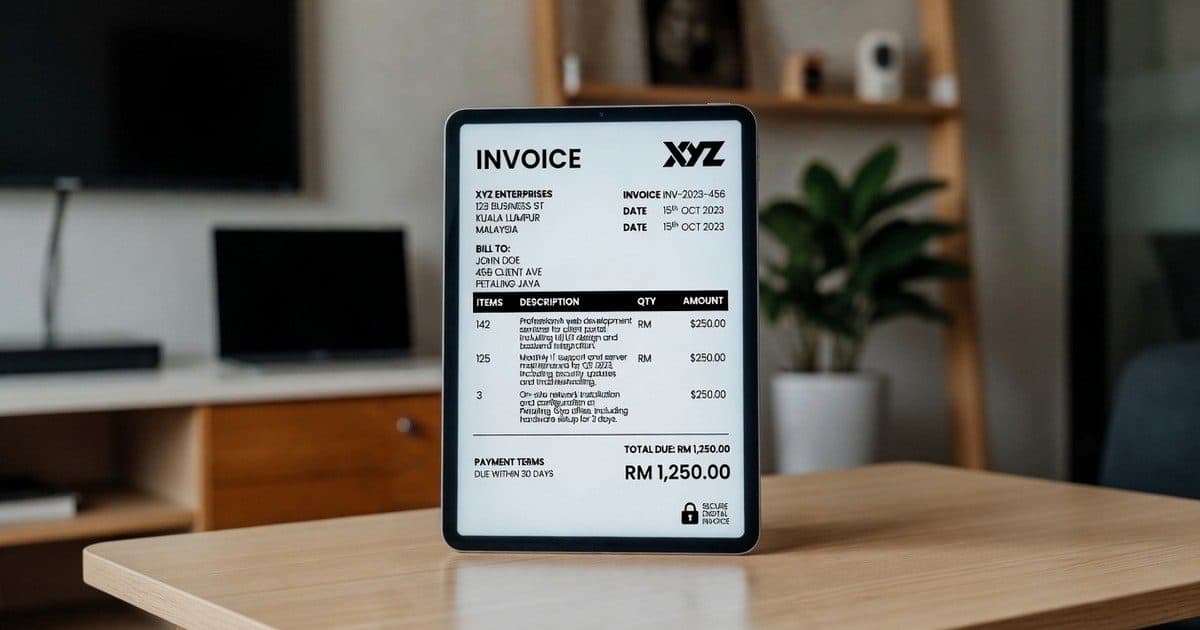
e-Invoicing in Malaysia isn't a PDF emailed to a customer. It's a structured, machine-readable invoice (XML or JSON in UBL 2.1 format) that is submitted to LHDN's MyInvois platform, validated in near real-time, returned with a unique IRBM identifier and QR code, and only then sent to the buyer. The PDF "tax invoice" you used to print is now just a visual representation of the validated underlying e-invoice.
MyInvois is the LHDN-operated Continuous Transaction Control (CTC) platform that sits in the middle. Every B2B, B2G and B2C invoice issued by an in-scope taxpayer flows through it. Once validated, the document carries an IRBM Unique Identifier Number (UIN) and a QR code that any party can use to verify authenticity at myinvois.hasil.gov.my.
Document types covered:
- Invoice (standard tax invoice). - Credit note (reduce a previous invoice). - Debit note (increase a previous invoice). - Refund note (return / refund of previously invoiced amount). - Self-billed e-invoice (for foreign suppliers, agent commissions, individual payments where the buyer raises the invoice on the supplier's behalf).
Why Malaysia is doing this: the same reason every major economy is moving to e-invoicing — close the VAT/SST gap, eliminate fake invoices used for tax evasion, give LHDN real-time visibility into business activity, and lay the groundwork for pre-filled tax returns. Malaysia's design borrows heavily from the PEPPOL (Pan-European Public Procurement OnLine) standard, which is the global lingua franca for e-invoicing.
What it does not change:
- Your underlying tax position (income tax, SST) is unchanged. The mechanism is reporting, not a new tax. - Your accounting principles are unchanged. - B2C cash transactions are accommodated through consolidated e-invoices — you don't need to capture every customer's TIN at the till.
Rollout Phases — Who Has to Comply and When
Implementation is staggered by annual turnover as reported in the FY2022 Audited Financial Statements (or the latest annual return for non-audited entities). Once you're in scope at any phase, you stay in scope — even if your turnover later drops.
| Phase | Mandatory date | Annual turnover band | Status (May 2026) |
|---|---|---|---|
| Phase 1 | 1 Aug 2024 | > RM 100 million | Live, fully enforced |
| Phase 2 | 1 Jan 2025 | RM 25m – RM 100m | Live, fully enforced |
| Phase 3 | 1 Jul 2025 | RM 5m – RM 25m | Live, fully enforced |
| Phase 4 | 1 Jan 2026 | RM 1m – RM 5m | Live, relaxation to 31 Dec 2027 |
| Phase 5 (cancelled) | — | RM 150k – RM 500k (originally) | Withdrawn by Cabinet 6 Dec 2025 |
The big December 2025 reset: on 6 December 2025 the Cabinet: 1. Raised the permanent exemption threshold from RM 500,000 to RM 1,000,000 annual turnover. 2. Cancelled Phase 5 entirely — the planned 1 July 2026 cut-in for businesses earning RM 150k–RM 500k will not happen. 3. Directed LHDN to focus enforcement on the four live phases.
The April 2026 second relaxation: in April 2026 IRBM extended the Phase 4 penalty-free relaxation by a further 12 months to 31 December 2027. Until then, RM 1m–5m businesses can issue consolidated monthly e-invoices (one summary per month per buyer category) instead of per-transaction e-invoices, and IRBM will not enforce Section 120 penalties provided you've registered on MyInvois and made a genuine compliance effort. Full enforcement starts 1 January 2028.
If you're below RM 1m turnover: you are permanently exempt. You can still opt in voluntarily — useful if you sell to large enterprise customers who require validated e-invoices to claim deductions or if you want to be ready for any future threshold change.
Permanently exempt regardless of turnover:
- Federal/state government and local authorities (not commercial activities). - Statutory bodies, embassies and consulates, international organisations. - Foreign diplomatic offices. - Individuals (not in business).
Always check the latest LHDN e-Invoice Specific Guideline — version 4.7 (issued April 2026) is the current reference and supersedes earlier guidance.
How to Submit — Portal vs Accounting Software vs API
LHDN provides three official channels. Pick based on monthly invoice volume and how integrated your accounting workflow already is.
1. MyInvois Portal (free, manual)
- Web-based form at myinvois.hasil.gov.my — log in with MyTax / e-Filing credentials. - Manually key in or bulk upload (CSV/XML) up to a few hundred invoices per session. - Best for: micro-businesses, freelancers opting in voluntarily, and Phase 4 companies during the relaxation window. - Pros: zero software cost, no integration, immediate. - Cons: manual data entry is slow and error-prone. Painful past ~50 invoices/month.
2. Accounting software with native MyInvois integration
- The major Malaysian accounting packages have built-in MyInvois submission as of the relevant phase deadline: - SQL Account / SQL Payroll (eStream MSC) — most common for SMEs. - AutoCount Accounting / AutoCount Cloud (AutoCount Sdn Bhd). - QNE Cloud / QNE Optimum (QNE Software). - Million Accounting (Million Software). - Xero (via partner Peppol Access Points like Storecove, Pagero or Comply.exchange). - Quickbooks Online (Malaysia edition with MyInvois plugin). - Submission flow is invisible: you create an invoice as before, the software submits it to MyInvois in the background, fetches the UIN and QR code, and shows a "validated" status. - Best for: every SME above RM 500k turnover even if not yet mandatory. - Cost: typically RM 100–300/month subscription + one-off setup of RM 500–2,000 for MyInvois module activation.
3. Direct API integration / Peppol Access Point / middleware
- Direct: build to the LHDN MyInvois API (OAuth 2.0, JSON over REST). Best for in-house ERP teams (SAP, Oracle Fusion, Microsoft D365, Odoo on-prem). - Middleware: route through a certified PEPPOL Access Point or Service Provider (e.g. Storecove, Pagero, Avalara, Comply.exchange, Sovos). They handle XML conversion, rate limits, retries, and PEPPOL onboarding. - Best for: Phase 1–3 enterprises with > 500 invoices/month or multi-entity ERP setups. - Cost: middleware typically RM 0.50–RM 2.00 per validated invoice + monthly platform fee.
Quick decision rule:
- < 30 invoices/month → MyInvois Portal. - 30–500 invoices/month → accounting software with MyInvois module. - > 500 invoices/month or ERP-driven → API / middleware.
e-Invoicing cost estimator
Estimate monthly compliance cost across the three submission channels
Recommended for 100 inv/mo: Accounting software module
Rule: <30 → Portal, 30–500 → Software, >500 → API.
Estimated monthly cost
RM 325
Matches recommendation
Estimate only — figures may differ from official rates. See sources →
The 55 Mandatory Data Fields
Every validated e-invoice must carry up to 55 data fields drawn from the LHDN e-Invoice Specific Guideline. Most accounting software pre-populates them, but during onboarding you'll have to map your master data once. The fields cluster into eight groups:
| Group | Examples | Owner |
|---|---|---|
| Supplier (you) | Name, TIN, SST registration, MSIC code, address, contact, business activity | Master data |
| Buyer | Name, TIN, SST reg (if any), address, contact, individual NRIC for B2C-on-request | Sales / CRM |
| Document | Invoice number, date, time, currency, exchange rate, original invoice ref (for credit/debit notes) | System |
| Line items | Classification code, description, quantity, unit price, measurement unit, subtotal, discount | Inventory |
| Tax | SST rate, SST amount per line, exempt indicator, total tax | System |
| Totals | Subtotal, discounts, total excluding tax, total tax, total payable, rounding | System |
| Payment | Payment mode, terms, bank account ref, payment ref (for reconciliation) | Finance |
| Other | Shipping recipient, frequency of billing, IRBM UIN, QR code (returned by MyInvois) | MyInvois |
Two fields trip up almost everyone:
- TIN (Tax Identification Number) — every business buyer must provide their TIN. For B2C, you can use the LHDN-issued General Public TIN: EI00000000010 when the buyer doesn't request a tax invoice. Once they do request one, you must issue an individual e-invoice within the deadline. - MSIC code — your 5-digit Malaysia Standard Industrial Classification code (the same one on your SSM Form 9/49 or business license). Pick the one that best matches the specific transaction, not just your overall business activity.
Classification codes: every line item must carry a 3-digit classification code from LHDN's e-Invoice Catalogue (e.g. 022 for "Education fees", 045 for "Medical examination"). Most accounting software ships with the catalogue pre-loaded; you map your SKU/service codes once.
Currency and FX: non-MYR invoices must include the original currency, the exchange rate used, and the MYR equivalent. The exchange rate must be the prevailing selling rate of any Malaysian licensed bank on the invoice date — don't hardcode FX rates in your system.
Validation, the 72-Hour Window & Corrections
The lifecycle of an e-invoice:
1. Supplier submits draft to MyInvois (via portal/software/API). 2. MyInvois validates structure, TINs, SST status, classification codes, totals — typically returns within 1–5 seconds. 3. If valid: MyInvois returns an IRBM UIN and a unique QR code. The invoice is now legally issued. 4. Supplier shares the validated invoice (PDF + UIN + QR) with the buyer. 5. 72-hour rejection/cancellation window opens. 6. After 72 hours, the invoice is locked. Any change requires a separate credit note, debit note or refund note referencing the original UIN.
Within the 72-hour window:
- Supplier can cancel via the same channel they submitted (portal, software, or API) — typically used to fix data-entry errors caught after submission. - Buyer can reject — typically used when the buyer disagrees with the amount, classification, or sees a typo in their TIN. - Either action returns the document to the supplier for correction, free of penalty.
After 72 hours:
- Issue a credit note to reduce a previously issued invoice (over-billing, returns, partial cancellation). - Issue a debit note to increase (under-billing, late charges). - Issue a refund note when cash is being returned to the buyer. - Each adjustment document references the original UIN and goes through the same validation flow.
Common validation rejections:
- Buyer TIN doesn't match LHDN records — most common cause is a buyer giving you a stale/wrong number. - MSIC code doesn't match buyer's registered activity for B2B invoices. - Classification code missing or invalid for one or more line items. - SST charged where the buyer is exempt (or vice versa). - Total mismatch (line items + tax don't reconcile to invoice total — usually a rounding bug).
System downtime: if MyInvois is unavailable, you're allowed to issue a paper or PDF invoice as a temporary measure but must submit the e-invoice within 72 hours of the system being restored. LHDN has had a handful of outages since launch — keep evidence (screenshots of the error, timestamp) just in case.
B2C and Consolidated e-Invoices — How Retail Works
B2C transactions (selling to individuals at a counter, restaurant, e-commerce checkout) are accommodated through consolidated e-invoices, so you don't have to capture every walk-in customer's TIN.
The standard B2C flow:
- At the till you issue a normal receipt (no e-invoice required at point of sale). - Once a month — by the 7th of the following month — you submit a single consolidated e-invoice to MyInvois summarising all B2C transactions for which the buyer did not request an individual e-invoice. - The consolidated e-invoice uses the General Public TIN: EI00000000010 as the buyer. - Line items can be aggregated by SKU, service, or business segment depending on the consolidation rules in the LHDN Specific Guideline.
When the buyer requests an individual tax invoice:
- They must request it at the time of the transaction (or within the calendar month). - You must issue an individual validated e-invoice by the 7th of the following month. - In practice, accounting software prompts you with "Customer requesting tax invoice? Yes/No" at checkout.
Sectors with stricter B2C rules (per the Specific Guideline): - Telecommunications — must issue individual e-invoices for postpaid bills. - Utilities (TNB, water, gas) — already operate on individual customer accounts, so essentially no consolidation. - Insurance — individual e-invoice required for premiums. - Aviation — individual e-invoice required for ticketed flights once requested. - Banking and financial services — special self-billed e-invoice arrangements for fees, profits and interest.
E-commerce and platforms: marketplaces (Shopee, Lazada, TikTok Shop, Foodpanda) typically issue self-billed e-invoices on behalf of merchants for platform fees, and merchants issue normal e-invoices for the underlying sale (consolidated B2C unless the buyer requests individual). Each platform has its own onboarding flow — check the platform's seller help center for current MyInvois integration details.
Why this matters: if you run an F&B outlet, retail store or e-commerce business, you almost certainly fall into "consolidated B2C" territory. You don't need POS hardware upgrades — you need a monthly process to push aggregated sales data to MyInvois by the 7th of every month.
Picking & Setting Up Accounting Software
For most Malaysian SMEs, the realistic path is integrated accounting software. The vendors most active in MyInvois support:
| Software | Strengths | Typical monthly cost |
|---|---|---|
| SQL Account | Most widely used in Malaysian SMEs, mature MyInvois module, large ecosystem of bookkeepers | RM 100–250 |
| AutoCount | Strong inventory and POS, native MyInvois module since 2024 | RM 120–280 |
| AutoCount Cloud | Browser-based, no install, multi-user | RM 150–300 |
| QNE Optimum / QNE Cloud | Good for trading and distribution, MyInvois native | RM 100–250 |
| Million Accounting | Long-time SME tool, MyInvois ready | RM 80–200 |
| Xero | Cloud-only, multi-currency, integrates via Storecove/Pagero PEPPOL Access Points | RM 150–350 |
| QuickBooks Online (MY) | Strong for service businesses, MyInvois plugin | RM 150–300 |
The 6-step rollout most accountants run:
1. Confirm phase and date. Pull FY2022 turnover from your audited accounts, identify which phase you're in. 2. Register on MyInvois. Log into MyTax, navigate to MyInvois, register the company and any sub-entities. Generate API credentials if going software/API route. 3. Update master data. Add TINs and SST registration numbers for every customer and supplier, MSIC codes for product/service lines, classification codes per inventory item. 4. Activate the MyInvois module in your accounting software (vendor-specific — SQL has "e-Invoice Setup" wizard, AutoCount has "Module Activation" etc.). 5. Run a parallel period — for the first 30 days, issue paper/PDF + e-invoice in parallel, reconcile any rejections. 6. Switch to e-invoice as primary and continue monitoring rejections weekly.
Don't pay for "MyInvois consultancy" without checking what's actually included. Many "RM 5,000 setup" packages are essentially the vendor activating their existing module + walking you through master-data cleanup. If your bookkeeper is competent, the rollout is a 2–4 week part-time project, not a six-month transformation.
Penalties and Section 120 Liability
Failing to issue a valid e-invoice when required is an offence under Section 120(1)(d) of the Income Tax Act 1967. The penalty schedule:
| Element | Amount |
|---|---|
| Fine per offence | RM 200 – RM 20,000 |
| Imprisonment | up to 6 months |
| Combination | fine and imprisonment both possible |
| Counting | Each non-compliant invoice = one separate offence |
That last row is the kicker. A batch of 50 missing/invalid e-invoices can theoretically rack up to RM 1,000,000 in maximum fines. In practice, IRBM enforces proportionately — first offences typically draw the lower end of the range and a compliance directive — but the legal exposure is real.
Other risks in the broader e-invoicing regime:
- Disallowed deductions for buyers. If your buyer can't show a validated e-invoice for a purchase, LHDN can disallow the related expense in their tax return. This is why your B2B customers will increasingly insist on validated e-invoices — your non-compliance becomes their problem. - Audit triggers. Persistent rejection rates, mismatches between e-invoice totals and SST returns, or B2C consolidation patterns that don't reconcile to bank deposits can trigger an audit under the Tax Audit Framework. - SST exposure. A misclassified e-invoice that under-declares SST is treated as an SST shortfall, with penalties under the Sales Tax Act 2018 / Service Tax Act 2018 (10–40% surcharges) on top of the income tax penalty. - Reputational and B2B contracting risk. Large enterprise buyers and government tenders increasingly include "e-invoicing compliance" as a vendor pre-qualification.
The relaxation period offers safety, not amnesty. During Phase 4's penalty-free period (to 31 Dec 2027), IRBM has said it will not enforce Section 120(1)(d) for in-scope businesses that have registered on MyInvois and are issuing consolidated e-invoices in the required format. If you haven't registered or aren't trying to comply, the relaxation doesn't shield you.
Implementation Checklist
Use this as a 10-step rollout plan. It works whether you're already in scope or voluntarily adopting.
Pre-flight (week 1)
1. Confirm your phase. Pull FY2022 audited turnover. Map to the table in the "Rollout Phases" section above. If under RM 1m, you're permanently exempt — decide whether to opt in voluntarily. 2. Register the entity on MyInvois. Log into MyTax (mytax.hasil.gov.my), open MyInvois, complete the company registration. You'll get an API client ID/secret if you tick "API integration".
Master data clean-up (weeks 1–2)
3. TIN + SST cleanup. Pull customer and supplier lists, validate every TIN, capture SST registration numbers where applicable. Many ERPs have a free LHDN TIN-validator API. 4. MSIC + Classification codes. Map your top 50 SKUs/services to the LHDN e-Invoice Catalogue 3-digit codes. Don't try to code everything on day one.
Tooling decision (week 2)
5. Pick channel. < 30 invoices/month — Portal. 30–500 — accounting software MyInvois module. > 500 — API / Peppol Access Point. 6. Activate MyInvois module. Whichever you picked, enable it in sandbox first. SQL, AutoCount, QNE all have sandbox environments before production cutover.
Parallel run (weeks 3–4)
7. Issue 20–50 test invoices end-to-end (creation → validation → buyer share → 72-hour window test → credit note flow). Watch for TIN mismatches, MSIC errors, classification rejections. 8. Brief sales and finance teams. Sales need to capture TINs at deal stage; finance needs to monitor the rejection queue daily.
Go live (week 5)
9. Cutover. Issue all new invoices via MyInvois. Keep paper/PDF as visual representation only. Set up a daily rejection monitoring routine. 10. Document & monitor. Write a one-page SOP for invoice cancellation and credit note issuance. Track key KPIs monthly: rejection rate (target < 2%), validation latency, monthly consolidated B2C submission status.
Ongoing:
- Subscribe to LHDN e-Invoice news — Specific Guideline updates ship every 3–6 months. - Reconcile MyInvois total revenue vs SST return revenue vs CP204 estimated tax monthly. - Renew API credentials per vendor schedule (typically annual).
Where e-Invoicing Is Headed (2027–2030)
These are forward-looking predictions, not guarantees — but for Malaysian businesses the long arc of e-invoicing is genuinely good news.
- Compliance becomes invisible. By 2028, MyInvois submission should be a fully background process in every major accounting package — you create an invoice as always and validation just happens, with the painful manual-portal days behind you.
- Pre-filled tax returns arrive. Real-time invoice data lays the groundwork for partially pre-populated SST and income-tax filings, slashing the year-end scramble and shrinking accountant bills for SMEs.
- Faster payments and easier financing. Validated, structured e-invoices make invoice financing and instant credit decisions far simpler — expect lenders and platforms to offer quicker working capital to compliant businesses.
- A cleaner, fairer playing field. As fake invoices and the SST gap close, honest businesses should benefit from a more level market and, over time, a healthier national tax base.
- Seamless cross-border trade. Malaysia's PEPPOL-aligned design means e-invoices that flow smoothly to partners across ASEAN and Europe — a quiet competitive edge for exporters by 2030.
The smartest move now is to get set up early and let the system do the heavy lifting — the businesses that embraced MyInvois first are the ones finding it effortless today. Malaysia's invoicing is going digital-first, and that's a win for everyone who plays it straight.
This guide is general information, not tax or legal advice. Malaysia's e-invoicing rules continue to evolve — the December 2025 RM 1m threshold reset and the April 2026 Phase 4 relaxation extension are recent changes. Always verify the latest LHDN e-Invoice Specific Guideline and General FAQs at hasil.gov.my, or consult a licensed tax agent before making compliance decisions.
Sources & References
This guide is cross-referenced against primary official sources, regulatory references, and locally relevant materials.
- LHDN — e-Invoice Implementation Timeline Authoritative LHDN page with current rollout phases, threshold updates and the Dec 2025 RM 1m exemption reset
- MyInvois Portal Official LHDN MyInvois login, document verification (UIN/QR lookup), API credentials and SDK access
- LHDN e-Invoice Specific Guideline (v4.7) Master guideline document — covers all rollout phases, 55 mandatory fields, classification codes and correction rules
- Income Tax Act 1967 — Section 120 Statutory basis for e-invoicing penalties (RM 200–RM 20,000 fine per offence, imprisonment up to 6 months)
- LHDN e-Invoice General FAQs Official LHDN FAQ PDF — TIN validation, MSIC codes, consolidated B2C rules, exemptions and Phase 4 relaxation