
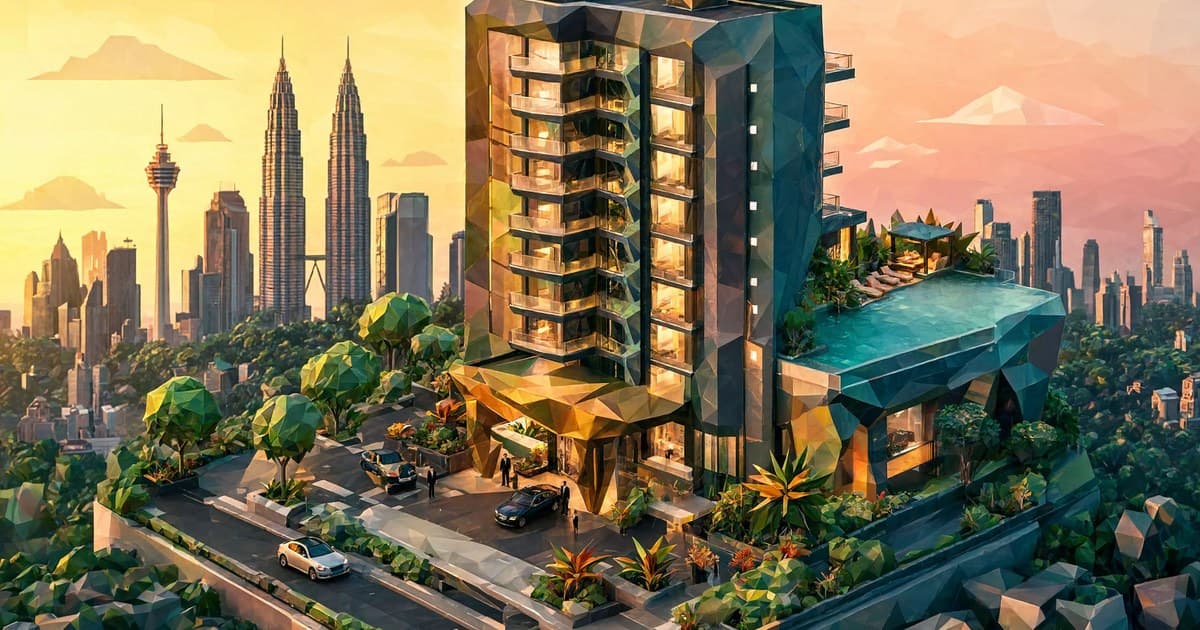
Branded residences carry a real premium over comparable unbranded stock in the same district. Savills put the 2024 global average near 30 percent, and Kuala Lumpur has read higher on market-wide measures. Buy them for the service, the address and the resale story, price the yield conservatively at 2.5 to 4 percent, and check completion and operator risk on anything still being built.
In This Guide
What a branded residence actually is
A branded residence is a home sold under the name of a hotel or luxury brand and run to that brand's service standard. The developer licenses the name (Four Seasons, Ritz-Carlton, St Regis, Banyan Tree, Kempinski and so on), the operator trains and supplies the staff, and residents get hotel-grade services layered on top of a normal strata title.
The services are the point. A typical KL branded tower offers 24-hour concierge, valet, in-residence dining, housekeeping on request, a residents-only lounge, and priority access to the attached hotel's spa, pool and ballroom. Some run a rental programme where the operator lets your unit as a hotel suite when you are away and splits the income.
Two structures exist in Malaysia:
- Hotel-attached residences sit above or beside a working hotel and share its facilities and staff. Four Seasons Place, Tropicana The Residences beside the W Kuala Lumpur hotel, and SO/ Kuala Lumpur Residences follow this model.
- Standalone branded residences carry the brand and service standard without a hotel underneath, such as YOO8 serviced by Kempinski at 8 Conlay.
You still own a strata parcel with an individual title, and you still pay quit rent, assessment and a service charge. The brand sits on top of ordinary Malaysian property law. The brand is a service and quality contract, and it is usually renewable rather than permanent, a point worth checking in the sale documents.
The Malaysian market at a glance
Malaysia's branded stock is small and concentrated in Kuala Lumpur's Golden Triangle. As of 2026 there is a small cluster of hotel-branded residences in the city, a few newer completions, and a handful of resort-branded schemes outside the capital.
Established hotel-branded residences in KL:
- Four Seasons Private Residences Kuala Lumpur (Four Seasons Place, KLCC, freehold)
- The Ritz-Carlton Residences, Kuala Lumpur (No. 105 Jalan Ampang, near KLCC, developed by Berjaya Land)
- The Residences at The St. Regis Kuala Lumpur (KL Sentral)
- Banyan Tree Signatures Pavilion Kuala Lumpur (Jalan Conlay)
The Edge Malaysia counts these four as the hotel-branded residences operating in the city.
Newly completed and pipeline:
- SO/ Kuala Lumpur Residences at Oxley Towers KLCC (Accor's SO/ brand). Construction completed in August 2025 with vacant-possession handover underway, and the SO/ hotel is due to open in the fourth quarter of 2026.
- YOO8 serviced by Kempinski and the planned Kempinski hotel and residences at 8 Conlay (KSK Land, Jalan Conlay). Tower A of YOO8 topped out earlier, but the wider scheme is in receivership as of 2026 after a dispute between KSK Land and its main contractor. Read the project note below before considering it.
- Ascott Star KLCC, a serviced-residence product marketed from around RM2,500 psf.
Related but distinct in KL:
- Tropicana The Residences on Jalan Ampang, completed in 2018, sits beside the W Kuala Lumpur hotel. The residences carry the Tropicana name and share the site with a W hotel without being W-branded.
- The RuMa Hotel and Residences on Jalan Kia Peng, completed in 2018, is a home-grown luxury brand managed by Urban Resort Concepts.
Resort-branded, outside KL:
- Anantara Desaru Coast Residences (Johor), a small collection of about 20 leasehold beachfront villas managed by Anantara, from roughly RM7.5 million.
- Angsana Residences Teluk Bahang (Penang), finished to Banyan Tree Group's Angsana standard.
The segment is thin by design. Slower take-up is normal: completed branded towers have carried close to 15 percent unsold inventory against about 3 percent for comparable serviced apartments, which means patient buyers can still negotiate on completed stock.
Notable projects compared
Prices below are 2024 to 2026 transacted and asking ranges from property portals, developer marketing and transaction data. Treat them as a guide, since branded units vary widely by floor, view, size and furnishing.
| Project | Brand / operator | District | Tenure | Indicative psf (RM) | Status |
|---|---|---|---|---|---|
| Four Seasons Private Residences | Four Seasons | KLCC | Freehold | 3,000 to 3,950 | Completed |
| The Ritz-Carlton Residences | Ritz-Carlton (Berjaya Land) | Jalan Ampang, near KLCC | Freehold | 2,300 to 3,000 | Completed |
| The Residences at St. Regis | St. Regis | KL Sentral | Freehold | 2,000 to 2,800 | Completed |
| Banyan Tree Signatures Pavilion | Banyan Tree | Jalan Conlay | Freehold | 2,200 to 2,900 | Completed |
| YOO8 serviced by Kempinski | Kempinski (KSK Land) | Jalan Conlay | Freehold | 2,700 to 3,370 | Tower A handed over, scheme in receivership |
| SO/ Kuala Lumpur Residences | Accor SO/ | KLCC (Oxley Towers) | Freehold | 2,300 to 2,600 | Residences completed 2025, hotel opening 2026 |
| Tropicana The Residences (beside W) | Tropicana | Jalan Ampang | Freehold | 900 to 2,780 | Completed 2018 |
| The RuMa Hotel and Residences | Urban Resort Concepts | Jalan Kia Peng | Freehold | 1,800 to 2,600 | Completed 2018 |
Reading the table: Four Seasons sits at the top of the KL branded market on a per-square-foot basis. The wide band at Tropicana The Residences reflects a mix of compact units and large layouts in the same tower. Whole-floor and penthouse units transact well above the ranges shown, with individual Four Seasons units having sold for RM11 million and above. The YOO8 range reflects developer pricing before the 8 Conlay scheme entered receivership, and distressed listings have appeared below it.
Four Seasons Private Residences, the benchmark
Four Seasons Place on Jalan Ampang is the reference point for ultra-prime KL. The freehold tower rises alongside the Four Seasons Hotel Kuala Lumpur, a short walk from the Petronas Twin Towers and Suria KLCC, and the private residences occupy the upper floors above the hotel.
What the numbers look like in 2026:
- Median transacted price around RM3,010 psf over the year to early 2025, with recent individual sales printing near RM3,950 psf and asking prices averaging about RM3,300 psf.
- Whole units have changed hands from about RM3.7 million for smaller layouts up to RM11 million and beyond for the largest, with a median deal price near RM10.5 million.
- Built-ups run from around 1,300 sq ft to several thousand square feet for the grandest configurations.
Residents draw on Four Seasons hotel services, a dedicated residential lobby and lift core, concierge and in-residence dining. The combination of the freehold title, the KLCC address and the operator's global recognition is what supports the premium and the relatively resilient resale market. For a UHNW buyer wanting the clearest trophy address in the city, this is the default comparison every other project is measured against.
8 Conlay and the Kempinski residences
The 8 Conlay development by KSK Land was designed to bring two branded residential products to Jalan Conlay. YOO8 serviced by Kempinski is a pair of spiralling towers designed with the YOO studio and serviced to Kempinski standards, marketed as among the world's tallest twisted residential towers. A separate Kempinski hotel tower within the same integrated scheme was planned to carry its own private residences tied directly to the hotel.
Where the project stands in 2026:
- The scheme is distressed. After a long dispute between KSK Land and its main contractor GDB, the Kuala Lumpur High Court in early 2026 ordered KSK Land to pay about RM102 million to a GDB subsidiary, and the RM5.4 billion project was placed under receivership and put up for sale by the receivers.
- Tower A of YOO8 topped out and reached handover earlier in the timeline, so some units are occupied, while Tower B, the retail podium and the Kempinski hotel component have run well behind schedule.
- Advertised pricing has run from roughly RM2,700 to RM3,370 psf, with Tower A averaging about RM3,283 psf and Tower B about RM3,370 psf, and distressed subsale listings appearing below that.
The original attraction was a Kempinski service standard at entry sizes a broader HNW audience could reach. The receivership changes the calculus. Anyone considering a unit here should confirm the exact handover status of their specific tower, who the eventual developer and operator will be, whether the Kempinski agreement survives a change of ownership, and the strata and maintenance position, before committing any money. Treat it as a distressed situation with real completion and brand risk, and take independent legal advice.
St Regis, Banyan Tree, Ritz-Carlton, SO/ and The RuMa
Beyond Four Seasons and 8 Conlay, several operators anchor the rest of the branded field.
- The Residences at The St. Regis Kuala Lumpur sit above the St. Regis hotel at KL Sentral, the transport hub linking the airport express, KTM and LRT lines. The St. Regis butler service is the signature, and KL Sentral suits buyers who value connectivity over a pure KLCC address.
- Banyan Tree Signatures Pavilion Kuala Lumpur on Jalan Conlay pairs the residences with a Banyan Tree hotel and its wellness and spa heritage, near Pavilion KL.
- The Ritz-Carlton Residences, Kuala Lumpur at No. 105 Jalan Ampang, developed by Berjaya Land, deliver Ritz-Carlton service in a single tower of about 296 units near KLCC.
- Tropicana The Residences, developed by Tropicana and completed in 2018, sit beside the W Kuala Lumpur hotel on Jalan Ampang. The residences carry the Tropicana name, so read them as Tropicana stock that shares a site with a W hotel.
- SO/ Kuala Lumpur Residences at Oxley Towers KLCC carry Accor's design-driven SO/ brand, with entry pricing from around RM1.45 million. Construction finished in August 2025 and handover is underway, with the SO/ hotel due to open in late 2026.
- The RuMa Hotel and Residences on Jalan Kia Peng, completed in 2018 and managed by Urban Resort Concepts, is a home-grown luxury brand emphasising a residential, boutique feel over a global chain name.
Each brand carries a distinct personality. The choice is as much about which service culture and social scene fits the buyer as it is about price.
Who buys, and why
Branded residence buyers in KL are overwhelmingly people who already own their primary home and are adding a trophy, a city base or a lock-and-leave second residence. For YOO8, overseas buyers made up roughly three-quarters of purchasers.
Typical profiles:
- Regional UHNW individuals and families from Greater China, Hong Kong, Taiwan, Japan, South Korea and Singapore, buying a KL pied-a-terre for business trips or a hedge against home-market prices.
- Malaysian business owners and professionals who want a serviced city residence near the office and the airport, often alongside a landed family home in the suburbs.
- Corporate and family-office buyers placing a company or trust-held apartment for executive use, sometimes structured through a holding vehicle.
The motivation is service and certainty. These buyers want to arrive to a made-up apartment, hand luggage to a valet, and never think about maintenance, staffing or security. Most rate the experience and the address above the rental yield, and many leave the unit lightly used for much of the year. That preference shapes everything else in this guide, from the service charge they accept to the yield they are willing to forgo. For estate and holding structures around these purchases, see the family-office and trust guides linked below.
Foreigner eligibility and thresholds
Foreigners can own branded residences in Malaysia, and in practice most branded units clear the rules comfortably because they sit well above the price floors.
The essentials for Kuala Lumpur in 2026:
- The minimum purchase price for foreign buyers in KL is RM1,000,000 for strata residential property. Almost every branded unit exceeds this.
- Foreigners may buy strata-titled homes such as these serviced residences. Malay Reserved Land, Bumiputera-quota units and low or medium-cost housing are off-limits.
- State Authority consent is required on the transfer, and meeting the price floor does not by itself guarantee approval. The application adds time to completion.
- Foreign buyers face higher transaction taxes than locals, including an elevated stamp duty on the instrument of transfer that rose again from 2026.
Thresholds, consent mechanics, MM2H interactions and the exact stamp-duty figures differ by state and change with each Budget. This guide keeps to a summary. For the full state-by-state rules and the current foreigner cost stack, read the foreigner property guide. For the underlying transfer-tax and RPGT mechanics that apply to every buyer, read the property investment guide. Both are linked below.
Service charges and what they buy
Branded residences cost more to hold than ordinary condos because the service is the product. Expect a monthly service charge in the range of about 90 sen to RM2.30 psf, against roughly 30 to 60 sen for a standard KL condo.
A worked example. A 2,000 sq ft branded unit at RM1.80 psf carries a service charge near RM3,600 a month, or about RM43,000 a year, before quit rent, assessment and your own utilities and insurance. A larger 4,000 sq ft residence can run past RM80,000 a year in service charge alone.
What the charge covers:
- 24-hour concierge, security and valet parking.
- Housekeeping, though deep or daily service is often billed on top.
- Maintenance of shared facilities: pools, gym, lounges, lifts and the residential lobby.
- Access to hotel amenities, sometimes with resident discounts.
- The sinking fund for long-term repairs.
Budget for the charge to rise over time and for it to be non-negotiable, since the operator sets the standard. This carrying cost is the main reason branded yields look thin, and it is the number many buyers underestimate. Ask for two to three years of actual service-charge accounts before you commit, not just the developer's estimate.
Prestige versus yield
Branded residences are prestige assets first. Rental yields on existing KL branded stock run about 2.5 to more than 4 percent gross, below what a well-chosen unbranded condo or a suburban rental can return. Some developers offer a guaranteed return of 5 to 7 percent for an introductory period, and those guarantees end, after which the market rent and the service charge decide the real yield.
Why the yield is modest:
- High purchase price per square foot compresses the yield denominator.
- Heavy service charges eat into net income.
- Many owners barely rent the unit, keeping it for personal use.
What you get instead of yield:
- Capital preservation in a globally recognised, freehold, hard asset.
- A resale market that holds up better in a downturn than mass-market stock.
- Use value: a serviced home you actually enjoy.
For a buyer whose goal is income, mass-market subsale, auction stock or REITs will serve better, and the property investment and REIT guides cover those. For a buyer who wants a trophy that also broadly holds its value, the branded segment does its job. Set the yield expectation low and the decision becomes clear.
Financing an ultra-prime purchase
Malaysian banks lend on branded residences, though the terms differ from a mass-market mortgage and many UHNW buyers do not borrow at all.
How financing usually works:
- Local mortgages are available to residents and, more selectively, to foreigners. Foreign buyers typically see loan-to-value of about 50 to 70 percent against 70 to 90 percent for locals, with the exact figure set case by case.
- Private-bank lending is common at this level. A private bank may lend against a portfolio of assets rather than the property alone, or offer a Lombard facility so the buyer keeps investments intact and still completes in cash terms.
- Cash purchases are frequent, especially for foreign trophy buyers who prefer to avoid local borrowing and consent delays.
Points to check:
- Whether the bank values the unit on the branded transacted price or a more conservative comparison, which affects the loan amount.
- The interest-rate structure and lock-in, since carrying costs are already high.
- Currency: if income is in USD or SGD and the loan is in ringgit, size the exposure deliberately.
For the banking relationships, mandates and cross-border structuring behind these purchases, the private banking and family-office guides go deeper. Line up financing before you sign, because branded launches often ask for staged payments on tight timelines.
The prime districts
Branded stock clusters in one district, while the wider ultra-prime market spreads across four.
- KLCC and the Golden Triangle. The centre of gravity for branded residences and the highest per-square-foot prices in the country. Four Seasons, SO/, the Kempinski residences at 8 Conlay, Banyan Tree, the Ritz-Carlton, The RuMa and Tropicana The Residences beside the W hotel all sit here or a short drive away. This is where the trophy addresses are.
- Damansara Heights. Old-money KL, a low-density enclave of embassies, landed mansions and a small number of high-end towers. Prime, quieter, and largely unbranded, favoured by established Malaysian families.
- Bangsar. Leafy, walkable and social, with strong owner-occupier demand and premium unbranded condos. Popular with professionals and returning Malaysians.
- Mont Kiara. The expatriate heartland, dense with international schools and high-end condos, deeper rental demand and generally lower entry prices than KLCC.
For a pure branded purchase, KLCC is effectively the market. The other three districts matter for the UHNW buyer building a wider KL portfolio, for a landed family home to sit alongside the city apartment, or for a rental play where Mont Kiara's tenant depth beats KLCC's thin luxury-rental pool.
Buying well: a short due-diligence checklist
The brand does a lot of work, and it does not replace ordinary diligence. Run through this before you commit.
- Confirm the brand term. Ask how long the operator agreement runs and on what terms it renews. A brand that can walk in ten years changes the resale story.
- Read the service-charge accounts. Get two to three years of actuals, the sinking-fund balance and any planned special levies. Do not rely on the launch estimate.
- Check the developer and operator track record. Delivery history, build quality and how well existing towers by the same team have been maintained. The 8 Conlay receivership is a reminder that even a marquee scheme can stall.
- Verify the title and tenure. Freehold versus leasehold, individual strata title issued, and any master-title or bumi-release conditions on a foreign transfer.
- Understand the rental programme. If income matters, get the operator's split, occupancy history and the restrictions on using the unit yourself.
- Model the full carry. Service charge, quit rent, assessment, insurance, financing and vacancy, then compare that against a realistic market rent.
- Line up consent and financing early. State Authority approval and any foreign-buyer approvals add weeks. Budget the higher foreign transaction taxes from the start.
- Plan the holding structure. Personal name, company or trust has tax and succession consequences. The trust, wills and family-office guides cover the estate side.
Get these right and the premium you paid becomes defensible. Skip them and the brand simply makes an expensive mistake more expensive.
Sources & References
This guide is cross-referenced against primary official sources, regulatory references, and locally relevant materials.
- Four Seasons Private Residences Kuala Lumpur (operator site) Official operator page for the benchmark KL branded residence.
- KSK Land, 8 Conlay (YOO8 serviced by Kempinski) Developer marketing site for the Kempinski-serviced residences on Jalan Conlay. The wider scheme is now under receivership.
- The Ritz-Carlton Residences, Kuala Lumpur (developer site) Official site for the Ritz-Carlton branded residences at No. 105 Jalan Ampang.
- SO/ Kuala Lumpur Residences, Oxley Towers KLCC Developer page for Accor's SO/ branded residences at Oxley Towers KLCC.
Further reading: The Edge Malaysia · The Edge Malaysia · iProperty · EdgeProp · brickz.my