
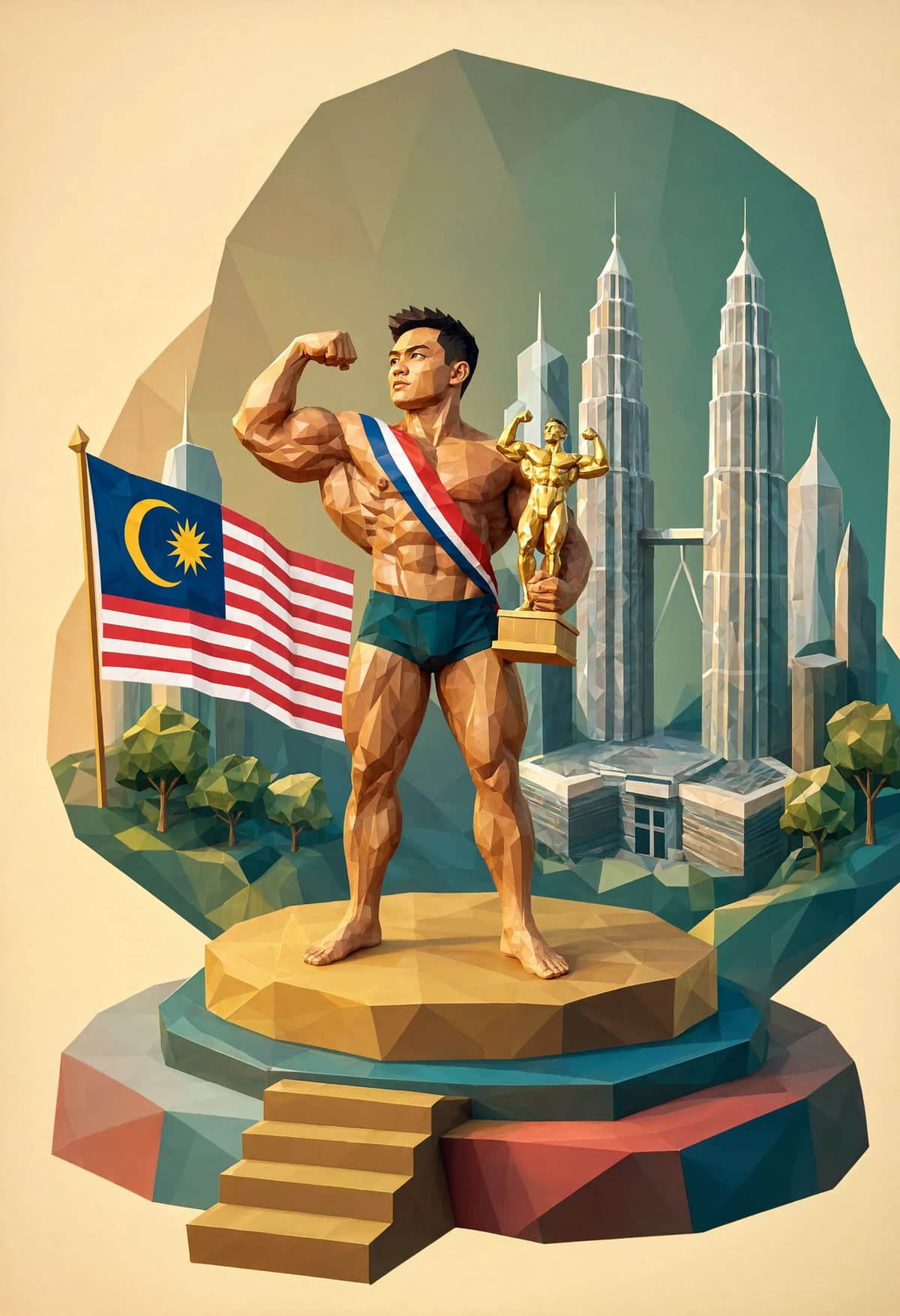
Key Takeaways
- →Competitive bodybuilding in Malaysia runs under several rival federations. The Malaysian Bodybuilding Federation (MBBF, also known as PBBM) is the long-established national body, and its officials helped drive the 2009 breakaway that created the Malaysian-led World Bodybuilding and Physique Sports Federation (WBPF), which sits apart from the older IFBB structure.
- →The headline national title is Mr Malaysia, decided at the national championship, with state-level qualifiers feeding into it. Malaysia has also hosted WBPF and Asian-level world events.
- →Modern shows split competitors into divisions: open bodybuilding (by weight class), classic physique, men’s physique (board shorts), plus women’s bikini, figure, and wellness. You pick one lane and train it.
- →Federations divide into untested (open) and drug-tested natural circuits. Natural shows use polygraph and sometimes urine testing. Being honest with yourself about which side you are entering matters for both results and health.
- →A realistic first-timer budget runs from roughly RM3,000 upward once you add a prep coach, extra food, posing trunks, tan, stage fees and travel. You can spend far more. Start with a coached 16 to 24 week prep and a local novice show.
- →Malaysia’s most decorated name is Sazali Samad, a multiple-time Mr Universe and world champion in the lighter classes. Malaysian lifters continue to place at WBPF and Asian events.
In This Guide
Bodybuilding in Malaysia: The Scene in 2026
Bodybuilding in Malaysia has grown from a small club sport into a visible amateur circuit with dozens of shows a year, several competing federations, and a steady flow of Malaysian athletes at Asian and world stages. This is the "Mr Muscle" side of things, in the old Mr Universe sense: physique competition judged on muscle size, symmetry, conditioning and posing. It is a separate world from beauty pageants. If you are looking for Miss Universe Malaysia, Miss World or Unduk Ngadau, that scene is covered in the beauty pageants guide instead.
What competitive bodybuilding actually is
On a physique stage, judges score how you look, not how much you lift. Competitors diet down over months to strip body fat while holding muscle, then present a series of mandatory poses under bright lights while deeply tanned. Winners are the ones who best match their division’s ideal: mass and dryness for open bodybuilding, proportion and taper for men’s physique, an athletic softer look for bikini. Strength training builds the raw material, but the sport itself is judged on the finished look.
A quick lay of the land
- Several federations run parallel circuits in Malaysia, and they do not all recognize each other.
- The main split is between the older IFBB-aligned world and the Malaysian-led WBPF that broke away in 2009.
- Shows run from small state novice contests up to national championships (the Mr Malaysia title) and international qualifiers.
- Modern events are divided into divisions and classes so a lean 65kg poser is not judged against a 100kg mass monster.
- There is a growing drug-tested natural movement alongside the traditional untested open scene.
Who competes
The field is broad. You will find lifelong gym rats, ex-athletes, fitness coaches building a brand, and complete first-timers doing a single novice show to prove they can. Women’s divisions, especially bikini and wellness, have grown fast and now often draw the biggest classes at local shows. The barrier to entry is low: pay the fee, hit the stage. The barrier to placing well is high and takes years.
How to use this guide
The sections below walk through the governing bodies and their history, the competitions, the divisions, the tested-versus-untested question, how to actually enter your first show, prep coaches and costs, notable Malaysian names, the gym and supplement scene, and the honest health and PED cautions. Figures move around a lot in this sport, so prices, titles and federation politics here are anchored to 2026 and should be checked against the organizers before you rely on them.
The Federations: MBBF, WBPF, IFBB and the Splits
Bodybuilding worldwide is governed by rival federations that have split and re-split for decades, and Malaysia sits close to the center of one of the biggest fractures. Understanding who runs what saves confusion when you see the same athlete listed as a "world champion" under two different bodies.
The national body: MBBF / PBBM
The Malaysian Bodybuilding Federation (MBBF), known in Malay as Persatuan Bina Badan Malaysia (PBBM), is the long-standing national governing body. It coordinates the state associations, sanctions the national championship, and has historically fielded Malaysia’s teams at Asian and world level. State affiliates (for example in Selangor, Penang, Sabah and Sarawak) run their own championships that feed athletes upward.
The 2009 breakaway: WBPF
For years, Asian bodybuilding ran under the Asian Bodybuilding Federation, which was aligned with the global IFBB (International Federation of Bodybuilding and Fitness). Around 2008 to 2009, a dispute over governance and control led Asian officials, with Malaysians prominent among them, to break away and form the World Bodybuilding and Physique Sports Federation (WBPF). Malaysia has been central to the WBPF ever since, and the federation has run World and Asian championships that Malaysian athletes regularly medal at. Because of this split, "world champion" can mean an IFBB title or a WBPF title, and the two do not recognize each other.
The IFBB world
The IFBB remains the largest global federation and the one linked to the professional scene most people know from international magazines and the Olympia. Its amateur wing runs its own Malaysian and Asian qualifiers. Over the years the IFBB itself has had internal splits (notably IFBB versus IFBB Pro League arrangements), which is another reason the same acronym can point at different organizations.
NABBA, WFF and the smaller circuits
Beyond the two giants, several older or independent federations run shows in Malaysia and the region:
| Federation | Rough character |
|---|---|
| MBBF / PBBM | National governing body, feeds Asian / WBPF teams |
| WBPF | Malaysian-led world body, Asian and World championships |
| IFBB (amateur) | Global body, separate Asian and Malaysian qualifiers |
| NABBA | Older British-rooted body, runs its own Universe titles |
| WFF | Fitness-and-physique federation with regional shows |
| Natural bodies (see below) | Drug-tested circuits with polygraph testing |
What this means for you
If you want to compete, pick a federation before you pick a show, because your registration, your division names, your weight classes and even your posing rules will differ between them. A card under one body does not carry over to another. Ask a local prep coach which federation is most active and best organized in your state right now, since the balance shifts. For a broader look at how organized sport is run in the country, the Malaysian sports guide gives useful context.
Mr Malaysia and the Main Competitions
The competitive calendar runs on a rough pyramid: many small local and state shows at the base, national championships in the middle, and international qualifiers and world events at the top.
Mr Malaysia and the national championship
The headline domestic title is Mr Malaysia, awarded to the overall winner of the national bodybuilding championship. Historically this has been run under the MBBF, with the overall champion crowned from the winners of each weight class in a final posedown. State championships (Mr Selangor, Mr Penang, Mr Sabah, Mr Sarawak and others) act as feeders and are titles in their own right. Because several federations now operate, you may see more than one event marketing itself around the "Mr Malaysia" idea in a given year, so check which body sanctions the one you care about.
State and open shows
Most people start here. State associations and private promoters run open shows throughout the year, usually with novice, junior, masters and open categories so a first-timer is not thrown straight in against seasoned competitors. These are the realistic entry point for a debut. Entry is by registration and fee rather than strict qualification.
Regional and world events
At the top of the pyramid:
- The SEA Games has included bodybuilding at various editions, and Malaysian lifters have medaled when it appears on the programme.
- The Asian Bodybuilding and Physique Sports Championships bring together the region’s best.
- The WBPF World Championships are the flagship of the Malaysian-led world body, and Malaysia has both hosted and medaled at them.
- Malaysian athletes also compete in IFBB, NABBA and WFF international events depending on their federation.
Qualifying upward
To represent Malaysia at Asian or world level you generally need to place at the sanctioned national championship of that federation, then be selected for the national team. Selection, funding and travel are handled by the federation, and the specifics change year to year. If your goal is a national team spot, get into that federation’s pathway early and talk to its officials rather than assuming a good result at an unaffiliated open show will carry you there.
Reading the calendar
Show dates cluster but move around each year, and promoters announce late. Follow the federation and promoter social channels, ask at hardcore gyms, and expect the schedule to firm up only a couple of months out. Malaysia’s broader events scene, including fitness expos where shows are sometimes staged, is worth watching for crossover dates.
The Divisions: From Open Bodybuilding to Bikini
Modern physique shows are split into divisions so different body types compete against their own ideal. You enter one division and one class within it. Picking the right lane for your build and your goals is one of the most important early decisions.
Men’s divisions
- Open bodybuilding. The classic muscle-mass division, judged on size, hardness, symmetry and conditioning. Split into weight classes (for example lightweight through heavyweight) so lighter and heavier competitors are judged separately, then the class winners meet in an overall posedown. This is the most demanding division to build for and usually the most dominated by heavy PED use at the top.
- Classic physique. A throwback to the smaller, more proportioned "golden era" look. Competitors are capped by a height-to-weight formula, so you cannot simply add unlimited mass. Rewards taper, waist control and posing.
- Men’s physique. Judged in board shorts from roughly the waist up, on a lean, athletic, "beach" look rather than extreme mass. No leg judging and no most-muscular posing. Often the largest men’s class at local shows because the look is more achievable.
Women’s divisions
- Bikini. The most popular women’s division, an athletic-but-soft look with muscle tone, roundness and stage presence, judged in a two-piece and heels. Least extreme conditioning of the women’s categories.
- Figure. More muscle and sharper shoulders and back than bikini, still with a balanced feminine line.
- Wellness. A newer and fast-growing division that rewards fuller lower body (glutes and legs) relative to a smaller upper body. It has drawn many new competitors.
- Women’s physique and bodybuilding. The most muscular women’s divisions, with visible conditioning and mandatory poses closer to the men’s open format. Smaller fields locally.
How judging works
Judges compare competitors head to head in a lineup, calling them out to hit mandatory poses (quarter turns for the softer divisions, a full mandatory series for bodybuilding). Placings come from where the panel ranks you across rounds. Conditioning (how lean and "dry" you are on the day), symmetry, and how well you present your best angles all matter. Two people with similar muscle can place very differently based on peaking and posing.
Choosing your division
Be honest about your frame, your years of training, and whether you want an extreme or a moderate look. Many first-timers over-reach into open bodybuilding when men’s physique or classic suits their build and timeline far better. A good coach will steer you here. If your interest is more general strength and aesthetics than stage competition, the gym and fitness guide covers training and gym options without the competition commitment.
Tested vs Untested: Natural Bodybuilding and PEDs
One of the first honest questions to settle before you compete is whether you are entering a drug-tested (natural) show or an untested (open) one. This choice shapes who you compete against, how you prepare, and the risks you take.
The untested / open reality
Most mainstream open bodybuilding, especially at the higher weight classes, is untested in practice. Performance-enhancing drugs (PEDs), primarily anabolic steroids, are widely used in the upper levels of the open sport globally, and Malaysia is no exception. Federations rarely test open classes, so the top of an open show is effectively an enhanced field. Nobody is required to disclose use, and asking is considered rude, but a realistic newcomer should understand that the physiques winning open heavyweight are usually not drug-free.
The natural / tested circuit
Drug-tested "natural" federations run a parallel circuit for competitors who want to stay off PEDs and be tested for it. Internationally these include bodies such as WNBF, INBA/PNBA (whose championship is the Natural Olympia) and others, and natural or "classic natural" shows do appear in Malaysia and the region. Testing methods vary:
- Polygraph (lie detector) questioning about banned substance use, the most common method at amateur natural shows.
- Urine testing, sometimes at higher-level natural events.
- Bans of a fixed length (many natural bodies require you to have been drug-free for a set number of years, sometimes for life).
Why the distinction matters
- Fair comparison. A natural competitor on an untested stage is usually outclassed on sheer size, which is demoralizing and misleading about their own progress.
- Health and legality. In Malaysia, anabolic steroids are prescription-controlled substances. Buying, importing or possessing them without a prescription carries legal risk, and the underground supply chain is unregulated and frequently counterfeit. The broader legal picture on controlled substances is set out in the drugs and the law guide.
- Honesty with yourself. Deciding your lane up front keeps expectations sane and keeps you from quietly drifting into use just to keep up.
A plain caution
PEDs carry real and documented health costs: cardiovascular strain, liver and kidney load, hormonal disruption, mood effects, and fertility problems, among others. None of this is medical advice, and this guide does not endorse use. If you are considering it, talk to a doctor, understand the law, and read the health section below. Many people build a genuinely impressive, competition-ready natural physique over years of consistent training and diet.
How to Actually Compete: Registration, Classes and Posing
Getting on stage is more accessible than most people assume. The preparation is the hard part; the paperwork is simple. Here is the realistic path for a first-timer.
Step 1: Pick a show and a federation
Choose a local novice or open show 16 to 24 weeks out, run by an active, well-organized federation in your state. A first show should be nearby and low-pressure. Novice classes exist precisely so beginners are not judged against veterans.
Step 2: Pick your division and class
Decide honestly between open bodybuilding, classic physique, men’s physique, or a women’s division, then confirm the weight or height class you will fall into. Divisions and class limits differ between federations, so read that specific show’s rulebook rather than a generic one.
Step 3: Register
Registration is usually online or through the federation, with:
- An athlete membership or license fee with the federation
- A per-class entry fee (many people enter two related classes)
- Age, weight and sometimes medical or drug-test declarations
- A deadline, often weeks before the show, with late fees after
Step 4: The prep
This is the real work, typically 12 to 24 weeks:
- A structured diet that strips body fat while preserving muscle, usually run by a coach
- Consistent resistance training adjusted through the phases
- Cardio added progressively as the show nears
- A peak week to manage water, carbs and sodium so you look your best on the day
Step 5: Posing practice
Posing is a skill and it wins or loses close placings. Learn your division’s mandatory poses and quarter turns, practise holding them without shaking, and rehearse your individual routine if your division has one. Many competitors book posing sessions with an experienced coach in the final weeks.
Step 6: Stage logistics
In the final days and on the day you will deal with:
- Tan. A dark competition tan (several coats) so the lights do not wash you out. Usually applied by a professional tanning service at the venue.
- Trunks or suit. Posing trunks for men, a bikini or suit for women, in the color and cut your federation allows.
- Check-in and weigh-in. Confirm your class, sometimes the day before.
- Backstage pump-up. Light bands and reps to fill the muscles before you walk out.
Step 7: On stage
Walk out, hit your poses on the judges’ calls, hold your presentation, and enjoy it. Placings are announced at the finals. Win or lose, a first show teaches you more about your physique than a year of guessing.
A realistic mindset
Most first-timers do not win. The goal of a debut is to complete a full prep, learn to peak and pose, and get honest feedback from the judges. That is the foundation everything else builds on.
Prep Coaches, Timeline and What It Costs
Competing costs more than the entry fee, and the biggest variable is how much help you pay for. Here is an honest breakdown for a Malaysian first-timer in 2026. Treat every figure as a rough guide, since coaches, tans and travel vary widely.
The prep coach
A prep coach handles your diet, training adjustments and peak week, and talks you off the ledge when the diet gets hard. For a first competitor this is the single most valuable spend. Coaching is usually monthly:
- Online coaching commonly runs from roughly RM300 to RM800 or more per month
- In-person or higher-profile coaches cost more
- A full 16 to 24 week prep therefore adds up to roughly RM1,500 to RM4,000 or beyond just for coaching
A good coach earns their fee by keeping you healthy, on track, and correctly peaked. A bad or absent one is worse than none.
The other line items
| Item | Rough cost (RM) | Notes |
|---|---|---|
| Federation membership / license | 50 to 200 | Annual, per federation |
| Entry fee per class | 100 to 300 | Many enter two classes |
| Extra food during prep | Hundreds/month | Higher protein raises the grocery bill |
| Supplements | Varies | Protein, creatine and basics; see below |
| Posing trunks / bikini suit | 100 to 600+ | Division-specific cut and color |
| Competition tan | 150 to 400 | Professional application at venue |
| Coaching (full prep) | 1,500 to 4,000+ | The main variable |
| Travel and stay | Varies | If the show is out of town |
A realistic total
Add it up and a modest, coached first prep lands from around RM3,000 upward once food, coaching, stage kit and fees are included. Skip the coach and self-run and you can do it for much less, at higher risk of a poor peak. Chase premium coaching, multiple shows and travel and it climbs quickly.
The timeline
- 16 to 24 weeks out: commit to a show, hire a coach, start the diet
- 12 weeks out: conditioning becomes visible, cardio ramps
- 4 to 6 weeks out: buy trunks or suit, book tan, drill posing hard
- Peak week: manage water, carbs and sodium under coach guidance
- Show day: tan, pump, compete
Where to save without cutting corners
Cook in bulk, buy staple proteins in bulk, keep supplements to the proven basics, and reuse trunks across shows. Do not save by skipping the coach on your first prep or by rushing conditioning, because those are the errors that waste the whole effort. For general budgeting context, the cost of living guide helps frame how a prep fits your monthly spend.
Notable Malaysian Bodybuilders and International Results
Malaysia has produced world-class competitors, most famously in the lighter weight classes where the country has consistently punched above its size.
Sazali Samad
Sazali Abdul Samad is Malaysia’s most decorated bodybuilder and a national sporting figure. Competing in the lighter classes, he became a multiple-time Mr Universe and world champion across the 2000s and 2010s, winning at the highest amateur level repeatedly. Documented highlights include a bantamweight Mr Universe gold won in the Czech Republic in 2006, a silver in the 65kg class at the 2006 Asian Games in Doha, and gold in the up-to-75kg men’s bodybuilding class at the 2014 WBPF World Championship in Mumbai. He is widely cited as a seven-plus-time Mr Universe or world champion, which if accurate makes him one of the most successful bodybuilders Asia has produced. He is often held up as the face of Malaysian bodybuilding.
A broader tradition
Beyond Sazali, Malaysia has fielded medal-winning teams at Asian and WBPF World Championships across both men’s and women’s divisions, including women’s bodybuilding, and at SEA Games editions where bodybuilding featured. Names rotate as athletes retire and new ones emerge, so any current roster is best confirmed with the federation.
Why the lighter classes
Malaysia’s international success has clustered in the lighter weight classes rather than the open heavyweight ranks that global professional bodybuilding is known for. This mirrors the reality of the country’s athlete pool and the amateur, federation-team structure it competes through, which rewards conditioning and symmetry in a defined class over sheer mass.
The pro question
Very few Malaysians have crossed into the IFBB professional ranks that lead to the international pro stage, and the amateur world and Asian titles remain the realistic pinnacle for most. The amateur federation system is where the country’s medals and recognition have come from. For Malaysia’s wider sporting hall of fame across all sports, see the Malaysian sports legends guide.
A note on records
Exact title counts, years and class names in bodybuilding are notoriously inconsistent across sources because of the federation splits. Where this guide gives a number, treat it as approximate and verify against the federation or the athlete’s own record before quoting it.
The Gym and Supplement Scene
You cannot prep for a show at a lunchtime-only fitness studio. Serious training needs serious equipment, and Malaysia has a healthy spread of options.
Where competitors train
- Hardcore and independent gyms. Bodybuilders gravitate to no-frills gyms with heavy free weights, proper racks, and a competition-minded crowd. These exist across the Klang Valley, Penang, Johor Bahru and the East Malaysian cities, often as independent or locally-owned setups rather than the big chains.
- Full-service chains. The large chains have the machines and are fine for general training and off-season work. What they may lack is the heavy-lifting culture and posing space of a dedicated bodybuilding gym.
- Prep gyms. Some gyms are known hubs where prep coaches operate and competitors cluster before shows. Ask around the local scene to find them.
For a full comparison of gym chains, real price ranges and how to avoid a bad membership contract, the gyms and fitness guide covers it in detail.
The supplement scene
Supplements in Malaysia are widely available through dedicated retailers, pharmacies, and online marketplaces:
- The proven basics that actually matter: whey or other protein powder, creatine monohydrate, and a sensible multivitamin. These are cheap, legal and effective.
- Optional extras like caffeine or a pre-workout, electrolytes, and joint support have their place but are secondary.
- Everything else is largely marketing. Fat burners, testosterone "boosters" and exotic blends rarely justify their price.
Buy from reputable sellers, watch for counterfeits on open marketplaces, and check that imported products clear local rules. Many supplements are sold at competitive prices during major online sales, and the shopping guide covers how those sale cycles work.
A word on regulation
Ordinary sports supplements (protein, creatine) are food products and freely sold. Anabolic steroids and similar PEDs are a completely different legal category: they are prescription-controlled, and buying them without a prescription is illegal and risky, both legally and because the grey-market supply is unregulated and often fake. Do not confuse the two. General nutrition and wellbeing, including the spa-and-recovery side that many competitors lean on after a hard prep, sits in the wellness guide.
Health, Recovery and PED Cautions
Competitive physique sport pushes the body to extremes, and the honest version of this guide has to cover the downsides alongside the trophies.
The prep is a stress on the body
Cutting to stage-lean body fat is a deliberate, temporary extreme. Holding it year-round harms your health. Expect during a hard prep:
- Low energy, hunger and mood swings as calories drop
- Reduced libido and, for women, disrupted or absent menstrual cycles
- Sleep disruption in the final weeks
- Social strain from a rigid diet and training schedule
None of this is dangerous when done sensibly for a defined window and then reversed. It becomes a problem when people stay in a deep deficit too long or chase ever-lower body fat year-round.
The rebound and eating around competition
The period after a show is where many competitors struggle. A sudden return to unrestricted eating after months of restriction can trigger binge patterns and rapid rebound. A managed "reverse diet" back to maintenance, ideally with a coach, protects both your health and your physique. Disordered eating and body-image issues are real in this sport. If food or your reflection starts to control you, that is worth taking seriously, and the mental health guide lists support resources.
PEDs: the plain risks
For those weighing performance-enhancing drugs, the documented health costs are real:
- Cardiovascular strain, including effects on blood pressure, cholesterol and heart structure
- Liver and kidney load
- Hormonal disruption, including suppressed natural testosterone and, in men, fertility and testicular effects
- Mood and psychological effects
- For women, potentially irreversible virilizing effects
- The added danger that grey-market products are unregulated, mislabeled or counterfeit
In Malaysia these substances are prescription-controlled, so unprescribed use also carries legal exposure. This guide does not endorse PED use. If you are considering it, speak with a doctor first and understand what you are taking on.
Sensible medical basics
- Get a general health check before starting a hard prep, especially if you are older or have any existing condition
- Keep an eye on blood pressure and bloodwork through a long prep
- Do not self-diagnose; use a real doctor, and see the healthcare guide for how to access care
- Prioritize sleep and recovery as much as training
The balanced take
Done naturally and sensibly, a competition prep is a demanding but rewarding project that most healthy adults can complete safely. The trouble comes from extremes: staying too lean too long, chasing the untested top of the sport, or reaching for drugs to shortcut years of work. Compete for the challenge and the discipline, keep your health first, and the sport gives back far more than a trophy.
Sources & References
Data in this guide is cross-referenced against the following official sources.
- World Bodybuilding and Physique Sports Federation (WBPF) Official site of the Malaysian-led world federation formed in the 2009 breakaway; championship calendar and rules.
- International Fitness and Bodybuilding Federation (IFBB) The largest global federation, with its own separate Asian and Malaysian amateur qualifiers and divisions.
Further reading: Malaysia at the 2006 Asian Games (Wikipedia) · 2014 WBPF World Championship (Wikipedia)